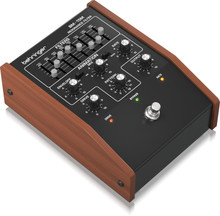
Behringer BM-15M Resonance Filter Pedal

Retailing in the region of £129.99

On the menu for January 2026 are the Behringer Guitar Pedals, freshly added and carefully selected. These New units are available to order online with fast, secure delivery from trusted UK retailers. Read on for full details, specifications, demos, videos, reviews, and the best places to buy the Behringer Guitar Pedals today.


Spread the love

Description

Spread the love

On the menu for January 2026 are the Behringer Guitar Pedals, freshly added and carefully selected. These New units are available to order online with fast, secure delivery from trusted UK retailers. Read on for full details, specifications, demos, videos, reviews, and the best places to buy the Behringer Guitar Pedals today.

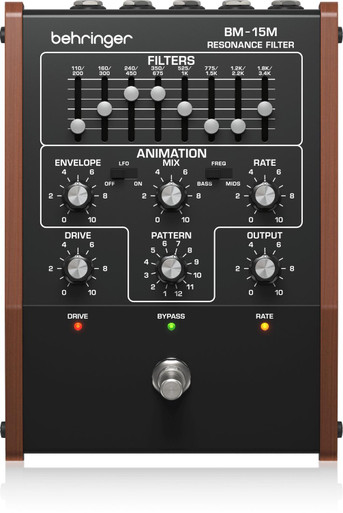
Based on one of the most unique and creative pedals of the early 2000s, the Behringer BM-15M Resonance Filter combines 8 resonant filters across bass and middle frequency bands with a selection of interesting patterns, LFO modulation as well as versatile Envelope control to recreate the unmistakable rhythmic, sweeping effects found in the long-unavailable and highly valued original. All in all, creating a unique effect that is reminiscent of a fully customisable, rhythmic tremolo effect combined with a phaser and envelope filter. Designed to work with Guitars and Synths and built with enough I/O and MIDI options to seamlessly fit into any producer’s workspace or studio setup, the Behringer Resonance Filter is made to inspire.

Key Features

  • Analogue Circuitry – Like the original, the Behringer Resonance Filter is an authentic recreation featuring analogue circuitry for a truly vintage voiced sound design workstation, built for the modern world.
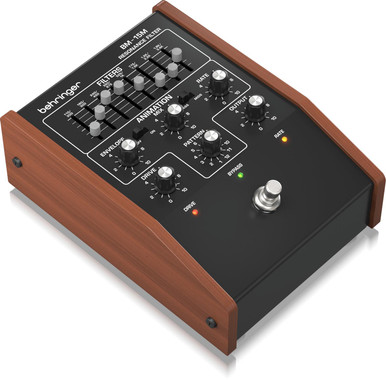
  • Classic Aesthetics – Constructed in a tried and tested roadworthy solid metal enclosure and beautifully finished with wooden side panels, the BM-15M is built to withstand life on the road.
  • Go Further – Connect via its USB to the Guitar Tribe App and expand the pedal even further by customising patterns as well as creating your own unique presets.
  • Even Further!– The Behringer Resonance Filter’s versatile I/O and MIDI control allows you to push your sound design to the limits by controlling parameters via external CV, such as the Behringer Neutron or an expression pedal.

Specifications

Audio in

  • Connector: 1 x 1/4″ TS, unbalanced
  • Impedance: 238 kΩ

Left / mono out

  • Connector: 1 x 1/4″ TS, unbalanced
  • Output impedance: 1 kΩ

Right out

  • Connector: 1 x 1/4″ TS, unbalanced
  • Output impedance: 1 kΩ

Tap / step

  • Connector: 1 x 1/4″ TRS, balanced
  • Input impedance: 48 kΩ

Control Connections

  • Rate

    • Connector: 1 x 1/4″ TRS
    • Impedance: 22 kΩ, unbalanced
    • CV input range: 0 V to +5 V
  • Mix

    • Connector: 1 x 1/4″ TRS
    • Impedance: 22 kΩ, unbalanced
    • CV input range: 0 V to +5 V
  • Envelope

    • Connector: 1 x 1/4″ TRS
    • Impedance: 22 kΩ, unbalanced
    • CV input range: 0 V to +5 V
  • LFO / sweep

    • Connector: 1 x 1/4″ TRS
    • Impedance: 22 kΩ, unbalanced
    • CV input range: 0 V to +5 V

MIDI in

  • 2 x 5-pin DIN, 16 channels

USB

  • 1 x USB, type C

Controls

  • Filter: 8 x sliders
  • Drive: 1 x rotary knob
  • Output: 1 x rotary knob
  • Envelope: 1 x rotary knob
  • LFO (off / on): 1 x sliding switch
  • Mix: 1 x rotary knob
  • Freq (bass / mids): 1 x sliding switch
  • Rate: 1 x rotary knob
  • Pattern: 1 x rotary knob
  • Bypass: 1 x footswitch

System

  • Frequency response: 20 Hz to 20 kHz (+0 / -2 dB)
  • Dynamic range: > 66 dB
  • Signal-to-noise ratio: > 56 dB
  • Overall gain: +16.5 dB
  • Power Supply / Voltage
  • Power input: Standard 9 V DC, centre negative, > 400 mA (power supply not included)
  • Power consumption: 1.8 W

Dimensions / Weight

  • Dimensions (H x W x D): 85.9 x 147.6 x 196.9 mm (3.38 x 5.81 x 7.75″)
  • Weight: 1,108 g (39.1 oz)

Additional information

Weight 1.5 kg

Brand

Behringer

Behringer is a prominent manufacturer of audio equipment, including mixers, amplifiers, signal processors, synthesizers, and digital effects units, known for their affordability and wide range of products. Founded in 1989 by Uli Behringer, the company has grown rapidly to become one of the largest manufacturers of audio equipment in the world.

Behringer’s product lineup covers a broad spectrum of audio equipment, catering to musicians, audio engineers, DJs, and live sound professionals. The company offers a variety of mixers, ranging from compact analog mixers for home studios to digital mixers with advanced features for live sound and recording applications.

In addition to mixers, Behringer produces a wide range of amplifiers, including guitar amps, bass amps, and powered PA speakers, as well as signal processors such as equalizers, compressors, and effects units. Behringer synthesizers, like the DeepMind series, have also gained popularity for their affordability and impressive sound quality.

Behringer is known for its commitment to providing high-quality audio equipment at affordable prices, making professional-grade gear accessible to a wide range of musicians and audio enthusiasts. However, the brand has also faced criticism and controversy over issues related to intellectual property rights and product cloning. Despite this, Behringer’s extensive product lineup continues to be popular among musicians and audio professionals seeking reliable and affordable audio solutions.

Category

Guitar Pedals

Tags

envelope filter

Expression

Expression pedals allow real-time control over specific parameters on compatible guitar pedals, such as volume, delay time, modulation depth, or filter sweep. Used with an expression input, they let players shape effects dynamically with their foot, adding movement and performance control that cannot be achieved with fixed knob settings.

Filter

MIDI

MIDI pedals use the Musical Instrument Digital Interface standard to communicate with other guitar pedals, effects units, and hardware. They allow control over presets, parameters, and switching across multiple devices from a single controller. MIDI integration makes it possible to build complex, synchronised pedal setups while keeping control simple and consistent.

New

This is brand new, fresh in, and a UK warranty is included. New Gear always comes from trusted UK music retailers.

Phaser

A phaser is a type of guitar effects pedal that creates a swirling, sweeping sound by modulating the phase of the audio signal. It works by splitting the incoming signal into two paths, shifting the phase of one path, and then recombining them. This creates peaks and troughs in the frequency spectrum, resulting in a distinctive, “phasing” effect characterized by moving notches in the frequency response.

Here’s how a phaser pedal typically works and some common features:

1. **Rate**: The rate control adjusts the speed at which the phase-shifting effect oscillates. Increasing the rate produces faster modulation, creating a more pronounced swirling effect, while decreasing the rate slows down the modulation for a smoother, more subtle effect.

2. **Depth**: The depth control adjusts the intensity or depth of the phase-shifting effect. Higher depth settings result in more pronounced peaks and troughs in the frequency response, while lower settings produce a more subtle modulation.

3. **Feedback (or Regeneration)**: Some phaser pedals feature a feedback control that determines the amount of modulated signal fed back into the effect. Increasing the feedback creates more pronounced peaks and troughs in the frequency spectrum, resulting in a more intense and resonant phasing effect.

4. **Stages**: Phasers typically have multiple stages (usually four, six, or eight), each of which contributes to the overall phase-shifting effect. More stages generally result in a more complex and textured phasing sound.

5. **Sweep (or Manual)**: The sweep control adjusts the center frequency of the phase-shifting effect. This allows you to focus the phasing effect on specific frequency ranges, altering the tonal character of the modulation.

6. **Resonance (or Feedback)**: Some phaser pedals feature a resonance control that emphasizes the peaks and troughs in the frequency response, creating a more pronounced and resonant effect. This control can add richness and depth to the phasing sound.

Phaser pedals are commonly used in various music genres, including rock, funk, and psychedelic music, to add movement, depth, and texture to guitar tones. They can be used to create swirling, swirling effects on rhythm parts, add dynamics to lead lines, or create atmospheric textures for ambient music. Overall, phaser pedals offer guitarists a versatile tool for shaping their tone and adding expressive modulation effects to their playing.

Rotary

Rotary pedals recreate the swirling, moving sound of a rotating speaker cabinet, adding rich modulation and a sense of motion to guitar tones. They typically simulate the changing pitch and volume caused by spinning speakers, producing anything from subtle shimmer to deep, pulsating swirl. Rotary effects are often used for clean and lightly driven sounds to add depth, movement, and a classic, organ-inspired character.

Tremolo

A tremolo pedal modulates the volume of your guitar signal up and down in a rhythmic pattern, creating a pulsing or wavering effect that can sound vintage and hypnotic or sharp and choppy depending on the settings. It’s one of the oldest effects in guitar history, famously used on classic amps from the 1950s and ’60s.

Most tremolo pedals let you control the speed, depth, and wave shape, allowing you to go from smooth, subtle swells to intense stuttering tones. It’s a simple but expressive effect that adds movement and character to your sound.