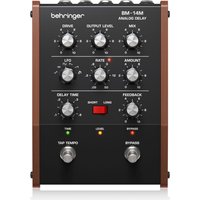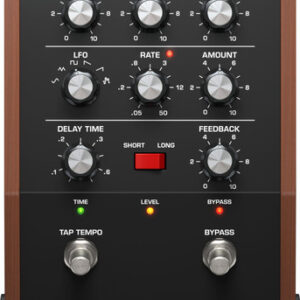
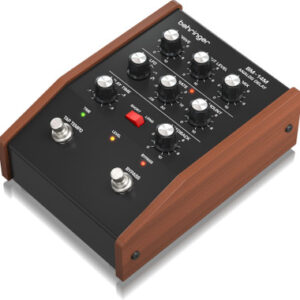

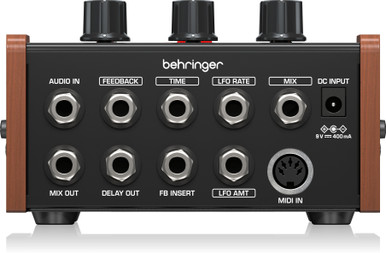
Based on one of the most unique and creative Delay pedals of the early 2000s, the Behringer BM-14 is the ultimate tool for shaping your ultimate delay from subtle echo right through to ambient delay from another dimension. Its classic analogue sound in combination with its unique delay LFO control easily makes this one of the most versatile delays ever created. With 6 LFO shapes on tap, the modulated delay sounds can easily go from everything from chorus to vibrato and even pitch shifting. With its thought-out I/O, tap-tempo, switchable normal and spillover bypass, drive and output control and timeless aesthetic, the Behringer BM-14 is perfect for guitars, synths and everything in-between and is built ready for the road.
Key Features
- Analogue Circuitry – The Behringer BM-14 Analogue Delay is as close to an authentic recreation as possible, featuring analogue circuitry for a truly vintage voiced sound design workstation, built for the modern world.
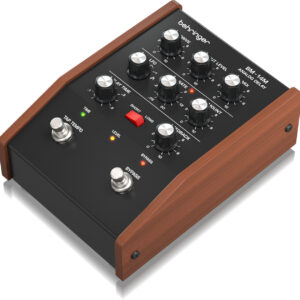
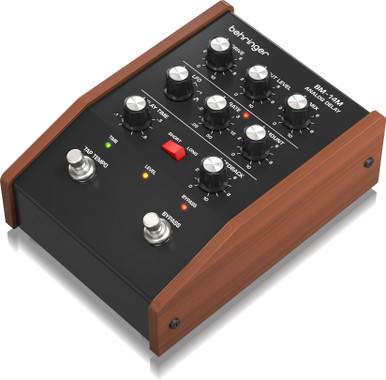
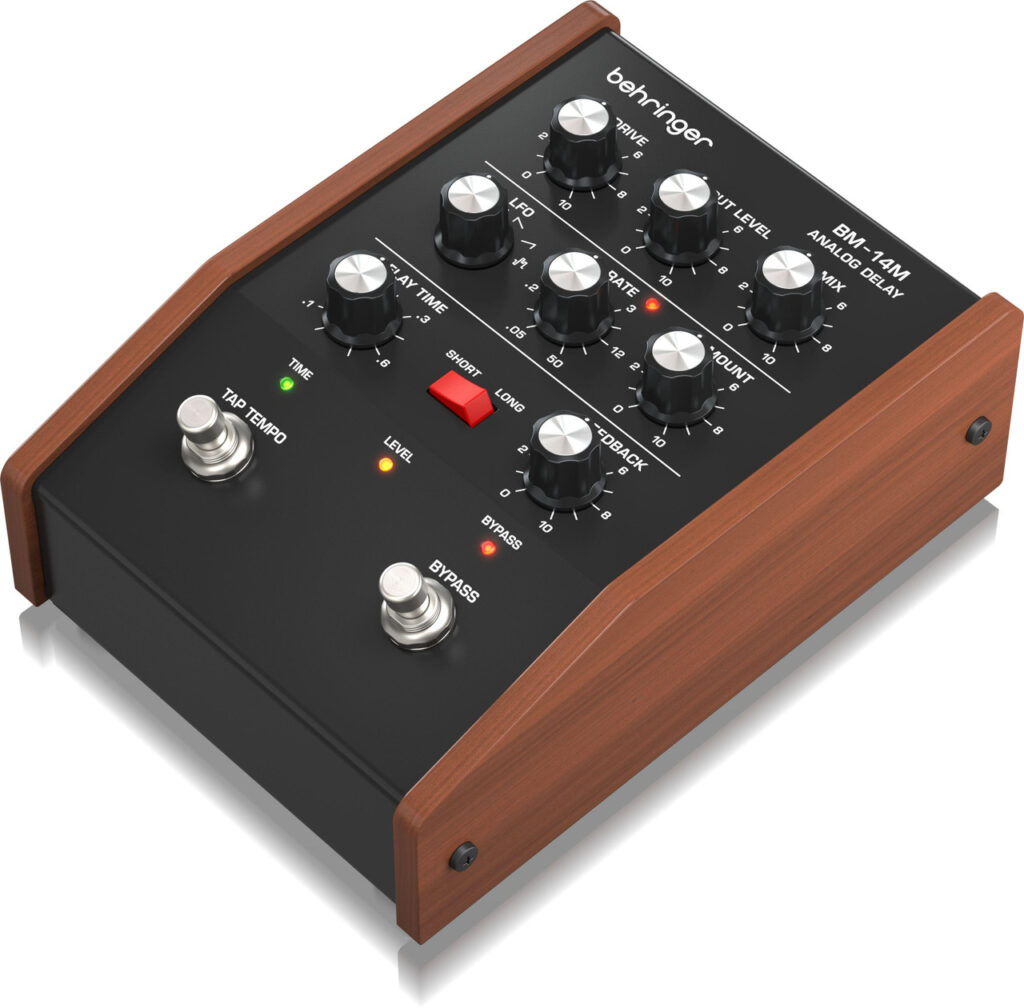
- Classic Aesthetics – Constructed in a tried and tested roadworthy solid metal enclosure and beautifully finished with wooden side panels, the BM-14 is built to withstand life on the road.
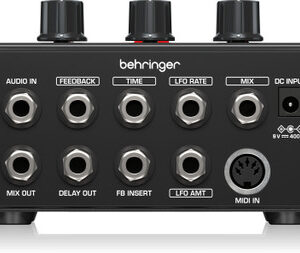
- Modular Style I/O – This delay’s versatile I/O allows you to push your creativity to the limits by controlling each of its parameters via an external expression pedal. Furthermore, the BM-14 can be combined with other CV pedals and devices or used with MIDI for nearly endless amounts of Delay possibilities. Its Mix and Delay outputs make any rig possible from straight in to complex wet/dry setups.
Specifications
Audio in
Audio Connections
- Connector: 1 x 1/4″ TS, unbalanced
- Impedance: 1 MΩ
Mix out
- Connector: 1 x 1/4″ TS, unbalanced
- Output impedance: 600 Ω
Delay out
- Connector: 1 x 1/4″ TS, unbalanced
- Output impedance: 600 Ω
FB insert (send/return)
- Connector: 1 x 1/4″ TRS, unbalanced
- Impedance: 440 Ω
- Input impedance: 140 kΩ
Control Connections
Feedback
- Connector: 1 x 1/4″ TRS
- Impedance: 180 kΩ, unbalanced
- CV input range: 0 V to +5 V
Time
- Connector: 1 x 1/4″ TRS
- Impedance: 34 kΩ, unbalanced
- CV input range: 0 V to +5 V
LFO rate
- Connector: 1 x 1/4″ TRS
- Impedance: 34 kΩ, unbalanced
- CV input range: 0 V to +5 V
LFO amt
- Connector: 1 x 1/4″ TRS
- Impedance: 34 kΩ, unbalanced
- CV input range: 0 V to +5 V
Mix
- Connector: 1 x 1/4″ TRS
- Impedance: 180 kΩ, unbalanced
- CV input range: 0 V to +5 V
- MIDI in: 2 x 5-pin DIN, 16 channels
Controls
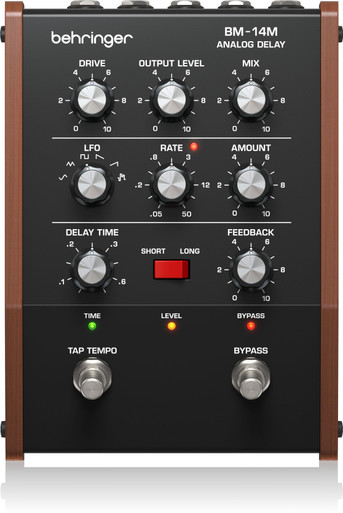
- Drive: 1 x rotary knob
- Output level: 1 x rotary knob
- Mix: 1 x rotary knob
- LFO: 1 x rotary knob
- Rate: 1 x rotary knob
- Amount: 1 x rotary knob
- Delay time: 1 x rotary knob
- Short/long: 1 x rocker switch
- Feedback: 1 x rotary knob
- Tap tempo: 1 x footswitch
- Bypass: 1 x footswitch
System
- Frequency response: 20 Hz to 20 kHz (+0 / -2 dB)
- Dynamic range: > 83 dB
- Signal-to-noise ratio: > 73 dB
- Overall gain: +33 Db
Power Supply / Voltage
- Power input: Standard 9 V DC, centre negative, > 400 mA (power supply not included)
- Power consumption: 1.8 W
Dimensions / Weight
- Dimensions (H x W x D): 85.9 x 147.6 x 196.9 mm (3.38 x 5.81 x 7.75″)
- Weight: 1,100 g (38.8 oz)