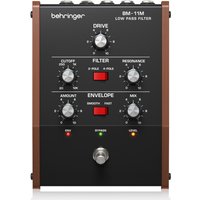
The Behringer BM-11 Low Pass Filter Pedal is designed for musicians and producers who want hands-on creative control over their sound. Its vintage-inspired analog filter delivers smooth and musical tones switching between 2-pole and 4-pole modes to suit subtle tonal shaping or extreme filtering effects.Envelope control lets players create dynamic responsive filter sweeps that react to performance nuances adding an expressive edge to live sets and studio work. A drive control shapes the input gain offering additional warmth and harmonic content to the signal.With USB/MIDI connectivity expression pedal input and a compact rugged housing the BM-11 is equally at home on pedalboards desktop setups and live rigs. Its a versatile tool for guitarists keyboardists and electronic musicians wanting rich controllable filter effects.
Behringer BM-11M Low Pass Filter Pedal
This is a New Behringer BM-11M Low Pass Filter Pedal from Behringer its found in our Wah & Filter Pedals on the Just Pedals menu. Read More below.
As an affiliate partner, we may earn a small commission when you buy through our links — at no extra cost to you.
Related videos

Brand
Behringer
Behringer was founded in 1989 by musician and sound engineer Uli Behringer, who began building equipment because he could not afford the studio gear he needed. The company has since grown into a broad audio supplier, and its JustPedals listings cover guitar, bass and utility units rather than effects alone. Examples include the DR600 digital reverb, EQ700 graphic equalizer, UT300 tremolo, BDI21 bass preamp, acoustic preamp and TU300 tuner. This spread makes model-level detail useful: check the instrument, circuit type and intended signal-chain role instead of assuming every Behringer listing is a guitar effect.
Category
Wah & Filter Pedals
Wah effects sweep a resonant band-pass or related filter through the frequency spectrum, creating the vowel-like movement associated with the treadle. Envelope filters move automatically in response to picking level, while fixed and sequenced filters use other control sources. Sweep range, resonance, direction, sensitivity and input loading determine whether the response is vocal, percussive, smooth or sharply synthetic.
Tags
Analogue
The signal is shaped by continuously varying electronic circuitry rather than being converted into a digital effect algorithm. Component choice, operating voltage and circuit tolerances influence headroom, noise, clipping texture and the small variations in response between designs.
MIDI
Sends, receives or responds to Musical Instrument Digital Interface messages rather than carrying the instrument audio itself. Program changes recall presets, continuous controllers move parameters, and MIDI clock or transport messages synchronise timing between devices.
USB
Provides a Universal Serial Bus connection for power, audio, MIDI, firmware or editing data. The supported USB class and connector do not by themselves show its purpose; channel count, sample format, host compatibility and power demand define the actual function.
Others Just Ordered :
- I Love A Happy Accident… – Animals Pedal

- Animals Pedal Vintage Van Driving is Very Fun Overdrive

- Animals Pedal Sunday Afternoon Is Infinity Bender

- Ninevolt Pedals | Bath Time Reverb (Animals Pedal)
- This Fuzz Pedal Makes No Sense… But It Sounds Incredible

- ANIME Pedals | Animals Pedal Custom Illustrated Series