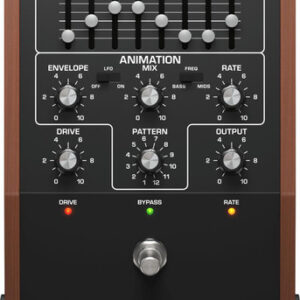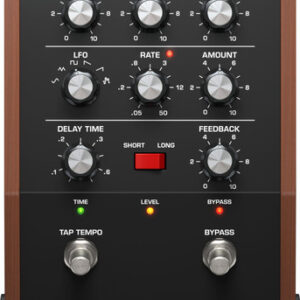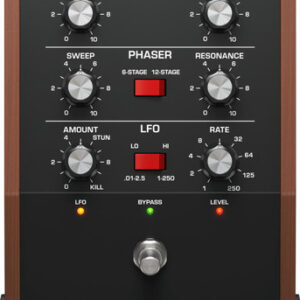
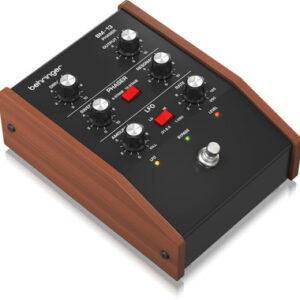

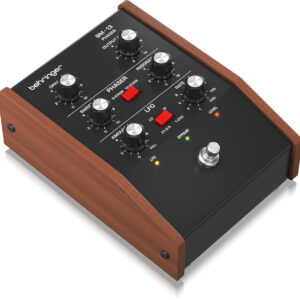
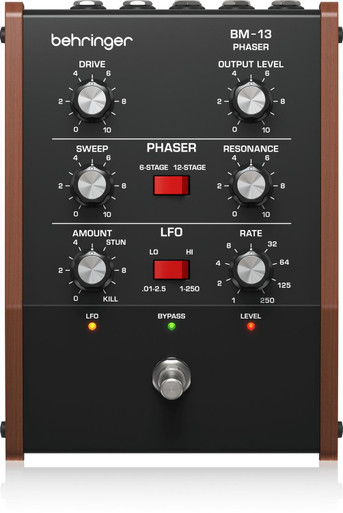
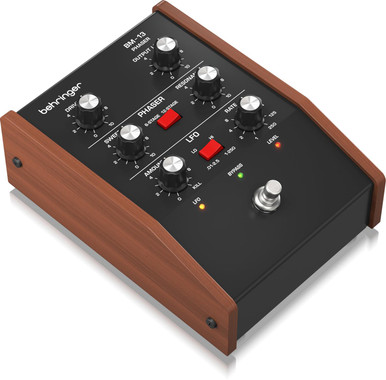
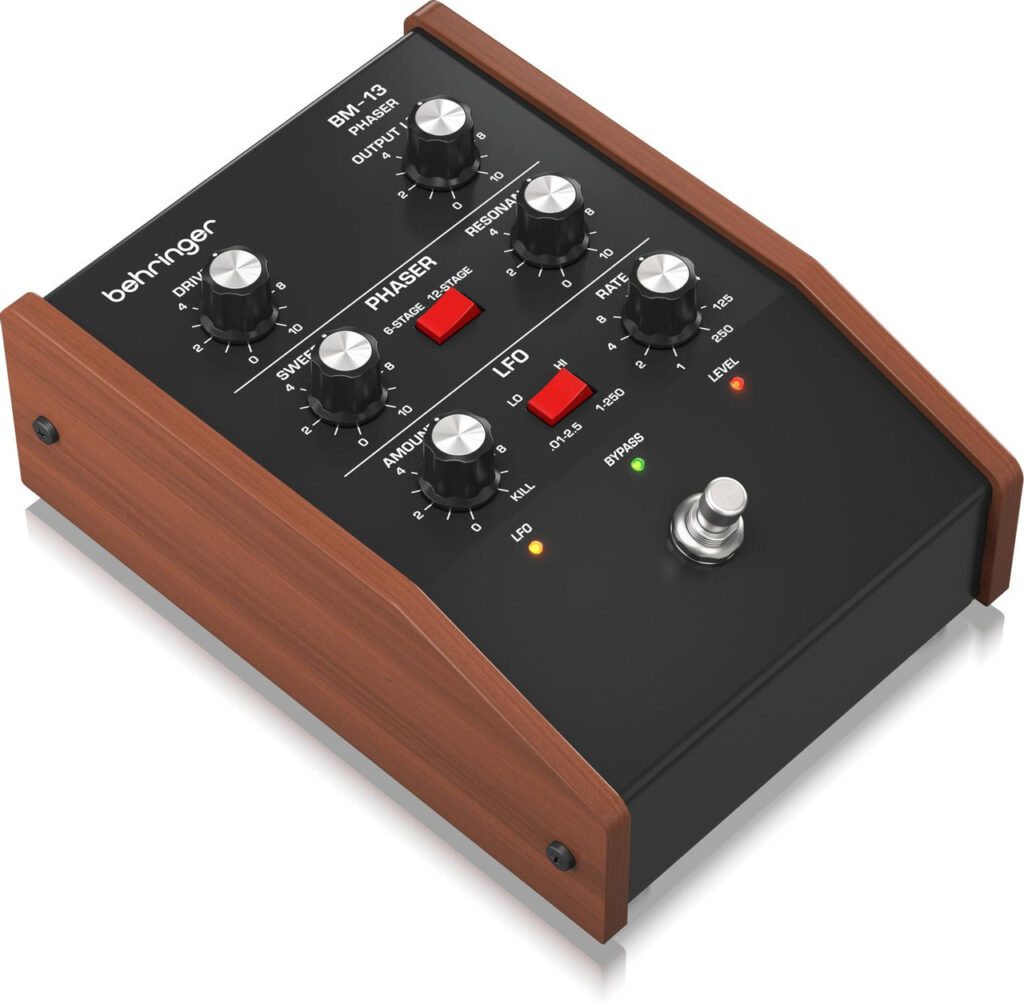
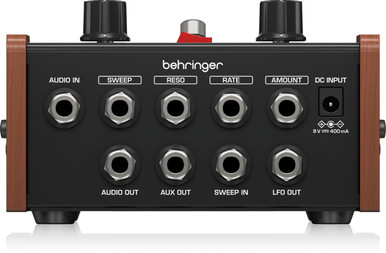
Based on one of the most unique and creative Phaser pedals of the ‘90s, the Behringer BM-13 is the ultimate tool for taking your sound to the next level with added depth, movement and dimension. Its switchable 6 or 12-stage design in combination with its versatile LFO controls ensures that this Phaser has everything covered from classic Phasers to Rotary-style sounds and even Ring-Mod-esque effects. With its thought-out I/O, drive and output control and timeless aesthetic, the Behringer BM-13 is perfect for guitars, synths and everything in-between and is built ready for the road.
Key Features
- Analogue Circuitry – Like the original, the Behringer BM-13 Phaser is an authentic recreation featuring analogue circuitry for a truly vintage voiced sound design workstation, built for the modern world.
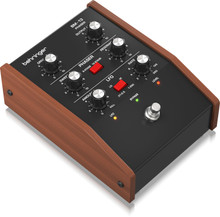
- Classic Aesthetics – Constructed in a tried and tested roadworthy solid metal enclosure and beautifully finished with wooden side panels, the BM-13 is built to withstand life on the road.
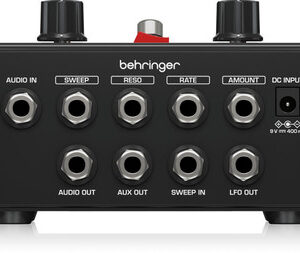
- Modular Style I/O – This Phaser’s versatile I/O allows you to push your creativity to the limits by controlling each of its parameters via an external expression pedal, furthermore the BM-13 can be combined with other CV pedals and devices thanks to its Sweep in and LFO Out inputs.
Specifications
Audio Connections
- Audio in: Connector, 1 x 1/4″ TS, unbalanced
- Impedance: 1 MΩ
Audio out
- Connector: 1 x 1/4″ TS, unbalanced
- Output impedance: 6.8 kΩ
Aux out
- Connector: 1 x 1/4″ TS, unbalanced
- Output impedance: 6.8 kΩ
- Control Connections
Sweep
- Connector: 1 x 1/4″ TRS
- Impedance: 40 kΩ, unbalanced
- CV input range: 0 V to +10 V
Reso
- Connector: 1 x 1/4″ TRS
- Impedance: 50 kΩ, unbalanced
- CV input range: 0 V to +5 V
Rate
- Connector: 1 x 1/4″ TRS
- Impedance: 34 kΩ, unbalanced
- CV input range: 0 V to +5 V
Amount
- Connector: 1 x 1/4″ TRS
- Impedance: 40 kΩ, unbalanced
- CV input range: 0 V to +5 V
Sweep in
- Connector: 1 x 1/4″ TRS
- Impedance: 47 kΩ, unbalanced
- CV input range: ±2.5 V
FLO out
- Connector: 1 x 1/4″ TRS
- Output impedance: 2.2 kΩ, unbalanced
- CV input range: ±2.8 V
Controls
- Drive: 1 x rotary knob
- Output level: 1 x rotary knob
- Sweep: 1 x rotary knob
- 6-stage / 12-stage: 1 x rocker switch
- Resonance: 1 x rotary knob
- Amount: 1 x rotary knob
- Hi / lo: 1 x rocker switch
- Rate: 1 x rotary knob
- Bypass: 1 x footswitch
System
- Frequency response: 20 Hz to 20 kHz (+0 / -0.3 dB)
- Dynamic range: > 73 dB, 20 Hz to 20 kHz
- Signal-to-noise ratio: > 63 dB
- Overall gain: 22 dBu
Power Supply / Voltage
- Power input: Standard 9 V DC, centre negative, > 400 mA (power supply not included)
- Power consumption: 0.75 W
Dimensions / Weight
- Dimensions (H x W x D): 85.9 x 147.6 x 196.9 mm (3.38 x 5.81 x 7.75″)
- Weight: 1,047 g (36.9 oz)