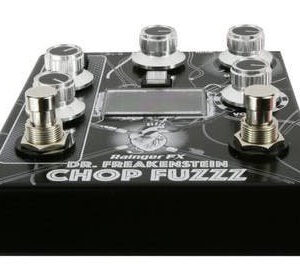
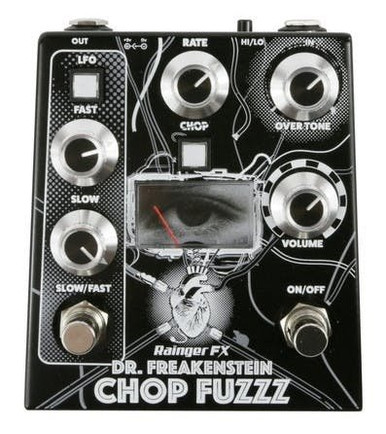
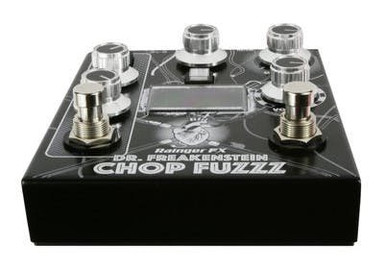
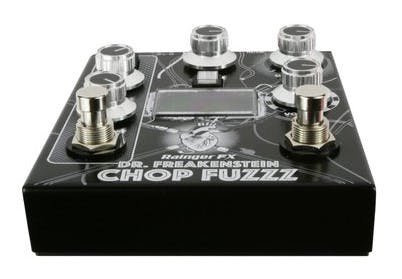
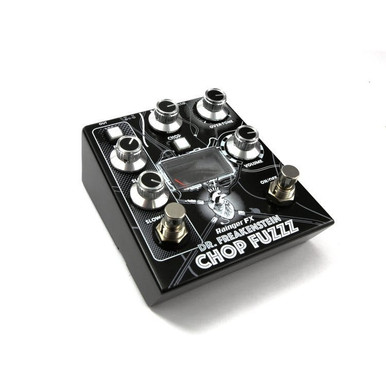
Rainger FX Dr. Freakenstein CHOP FUZZZ Guitar Pedal

Retailing in the region of £269.00

On the menu for January 2026 are the Rainger FX Guitar Pedals, freshly added and carefully selected. These New units are available to order online with fast, secure delivery from trusted UK retailers. Read on for full details, specifications, demos, videos, reviews, and the best places to buy the Rainger FX Guitar Pedals today.


Description

On the menu for January 2026 are the Rainger FX Guitar Pedals, freshly added and carefully selected. These New units are available to order online with fast, secure delivery from trusted UK retailers. Read on for full details, specifications, demos, videos, reviews, and the best places to buy the Rainger FX Guitar Pedals today.

This pedal is an incarnation with modification of the Rainger FX Dr Freakenstein dynasty.

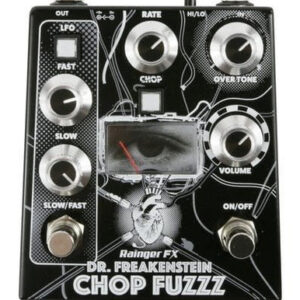
The Chop Fuzzz is an uncompromising all-analogue, full-on gated fuzz pedal – with a whole bunch of interesting ways of manipulating the signal.

As well as fuzz, the pedal has two types of modulation, a pressure-operated expression pedal (to do wah wah-like effects), a tunable drone facility that is capable of creating ring modulator tones – basically it’s a Multi-FX pedal.

Key Features

  • Built-In Noise Gate – It’s weirdly quiet when you’re not playing.
  • Built-In Squarewave Tremolo – When locked-on, in combination with the ‘LFO’ section it can create all kinds of slowly sweeping helicopter effects, or fast, bubbling synthy-sounds.
  • Control with a Synth – It can be controlled using 5v CV by sequencer or modular synth.
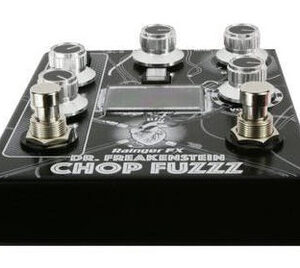
  • A Pedal Which Keeps An Eye on You – There’s a spooky ‘eye meter’, showing the input signal level, but also – using backlight illumination – the LFO and ‘Chop’ operation and Hi/Lo setting.

The fuzz circuit is the same massive distortion one used in the original Dr Freakenstein Fuzz (plus the three versions that followed, and the first Dr Freakenstein Chop Fuzz, and the six minipedal versions). It’s incredibly loud, with a ton of low-end, and searing highs available.

Overtone

This is like a wah wah with the tone of an extreme phaser. Set it using the knob, manipulate it in real time by foot with our Igor pressure pad controller (supplied), or with the CV input.

LFO

This modulates the signal in a slightly more ‘3D’ way than the ‘overtone’ sound. Moving in a triangle waveshape, the speed can be set using two knobs. ‘Slow’ has a low-speed range – for long, slowly-twisting cycles right up to fast wobbles, while the second one – ‘fast’ – is in the audio range; tune it in to a specific pitch (across several octaves) underneath the notes or chords that you’re playing.
Additional information

Weight 0.5 kg

Brand

Rainger FX

Rainger FX make inventive, quirky pedals that stand out both sonically and visually. Their designs push beyond traditional effects, offering everything from experimental distortions to dynamic filters and interactive noise-makers, often with unique features like external controllers or built-in LEDs. Bold, creative, and full of character, Rainger FX pedals are perfect for players who want unconventional tones and a playful, modern twist on the classic stompbox format.

Category

Guitar Pedals

Tags

Distortion

Distortion pedals take your clean guitar signal and transform it into something bigger, bolder, and full of attitude. By clipping the waveform, they add sustain, bite, and aggression, creating that thick, compressed tone that’s powered rock music for decades. From the growling crunch of classic hard rock to the tight, saturated roar of modern metal, distortion is all about energy and presence. It gives every note weight and authority, pushing your amp to its limits and beyond.

There are countless flavours of distortion, each with its own texture and edge. Some sound smooth and creamy, others raw and gnarly like tearing fabric. It’s the sonic equivalent of turning up the heat until the sound cooks — rich, sizzling, and perfectly seasoned to taste. Whether used for rhythm muscle or soaring leads, a good distortion pedal doesn’t just add volume; it adds personality, grit, and that unmistakable sense of power under your fingers.

Expression

Expression pedals allow real-time control over specific parameters on compatible guitar pedals, such as volume, delay time, modulation depth, or filter sweep. Used with an expression input, they let players shape effects dynamically with their foot, adding movement and performance control that cannot be achieved with fixed knob settings.

Fuzz

A fuzz pedal is one of the earliest and most aggressive forms of distortion, turning your clean guitar signal into a thick, saturated wall of sound. It works by clipping the waveform almost flat, creating a compressed, gritty tone full of harmonic overtones. The result is raw, unruly, and unmistakable — from the sputtering breakup of vintage germanium circuits to the searing sustain of modern silicon designs. Fuzz pedals react strongly to your guitar’s volume and pickup choice, making them dynamic tools for expressive players.

Whether you’re chasing the classic tones of Hendrix and the Smashing Pumpkins or exploring heavy, experimental textures, fuzz remains a favourite for its personality and unpredictability. It can sound smooth and sustaining, or wild and velcro-like, depending on how it’s set up. A good fuzz pedal cuts through the mix while adding thickness and attitude, turning any riff or lead line into something bold and unmistakably alive.

New

This is brand new, fresh in, and a UK warranty is included. New Gear always comes from trusted UK music retailers.

noise gate

Phaser

A phaser is a type of guitar effects pedal that creates a swirling, sweeping sound by modulating the phase of the audio signal. It works by splitting the incoming signal into two paths, shifting the phase of one path, and then recombining them. This creates peaks and troughs in the frequency spectrum, resulting in a distinctive, “phasing” effect characterized by moving notches in the frequency response.

Here’s how a phaser pedal typically works and some common features:

1. **Rate**: The rate control adjusts the speed at which the phase-shifting effect oscillates. Increasing the rate produces faster modulation, creating a more pronounced swirling effect, while decreasing the rate slows down the modulation for a smoother, more subtle effect.

2. **Depth**: The depth control adjusts the intensity or depth of the phase-shifting effect. Higher depth settings result in more pronounced peaks and troughs in the frequency response, while lower settings produce a more subtle modulation.

3. **Feedback (or Regeneration)**: Some phaser pedals feature a feedback control that determines the amount of modulated signal fed back into the effect. Increasing the feedback creates more pronounced peaks and troughs in the frequency spectrum, resulting in a more intense and resonant phasing effect.

4. **Stages**: Phasers typically have multiple stages (usually four, six, or eight), each of which contributes to the overall phase-shifting effect. More stages generally result in a more complex and textured phasing sound.

5. **Sweep (or Manual)**: The sweep control adjusts the center frequency of the phase-shifting effect. This allows you to focus the phasing effect on specific frequency ranges, altering the tonal character of the modulation.

6. **Resonance (or Feedback)**: Some phaser pedals feature a resonance control that emphasizes the peaks and troughs in the frequency response, creating a more pronounced and resonant effect. This control can add richness and depth to the phasing sound.

Phaser pedals are commonly used in various music genres, including rock, funk, and psychedelic music, to add movement, depth, and texture to guitar tones. They can be used to create swirling, swirling effects on rhythm parts, add dynamics to lead lines, or create atmospheric textures for ambient music. Overall, phaser pedals offer guitarists a versatile tool for shaping their tone and adding expressive modulation effects to their playing.

Pitch

Pitch pedals alter the frequency of your guitar signal, changing the perceived note or adding harmony. They can shift notes up or down by fixed intervals, create harmonies, or produce dive-bomb and whammy-style effects without a tremolo arm. Pitch shifters and harmonisers are great for thickening solos, simulating multiple guitars, or experimenting with creative, otherworldly sounds that expand your tonal range.

Synth

A synth pedal transforms your guitar signal into rich, layered tones that mimic the sounds of a synthesiser. Using pitch tracking and waveform generation, it can produce everything from deep bass lines to shimmering pads and futuristic leads. Synth pedals open up a wide creative range, blending the expressiveness of guitar playing with electronic textures, making them ideal for experimental sounds, ambient music, or adding a modern edge to classic riffs.

Tremolo

A tremolo pedal modulates the volume of your guitar signal up and down in a rhythmic pattern, creating a pulsing or wavering effect that can sound vintage and hypnotic or sharp and choppy depending on the settings. It’s one of the oldest effects in guitar history, famously used on classic amps from the 1950s and ’60s.

Most tremolo pedals let you control the speed, depth, and wave shape, allowing you to go from smooth, subtle swells to intense stuttering tones. It’s a simple but expressive effect that adds movement and character to your sound.

used

Wah

Wah refers to an expressive filter effect that sweeps through a range of frequencies, creating a vocal-like “wah” sound. Controlled in real time with a foot-operated treadle, it allows players to emphasise different parts of the frequency spectrum as they play. Wah pedals are commonly used for lead guitar, funk rhythm work, and expressive solos, responding closely to picking dynamics and foot movement.