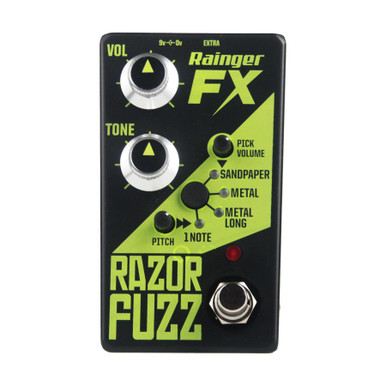

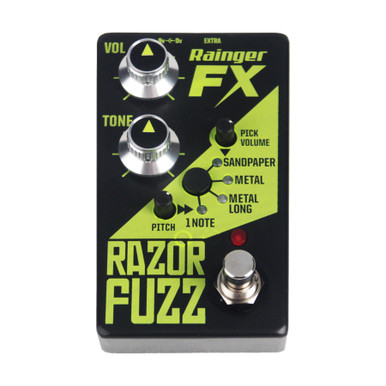
The Razor Fuzz is an intense, spitty, gated fuzzbox, with a ‘virtual plectrum’ facility; choose which one of four virtual plectrums you’d like to use!
Key Features
- Original Circuit – The Razor fuzz is built around a completely original analogue fuzz circuit in combination with a unique digital virtual pick attack effect for a smorgasbord of unique gated fuzz effects.
- A Little Extra – Engage the Extra button for increased gain, even more mid-range push and reduced bass.
- Rainger FX – Proudly designed and built in London since 2009, Rainger FX are renowned for their unique circuits, original designs and unrivalled build quality.
Fuzz
The fuzz circuitry is all analogue – our own original circuit – and designed to be really fun to play through. For a very high gain circuit, it’s surprisingly quiet when you don’t play, and is relatively uncompressed – and cleans up significantly when you roll your guitar’s volume down.
The ‘extra’ switch gives some extra gain to the fuzz, and adds a dash more hi-mid, with less bass.
Pick
Electric guitarists are notoriously obsessive about every aspect of their sound – not least the type of plectrum they use, and often this colours the attack of the note itself. We decided to investigate this further – in a digital, non-physical way…
Our pick-detection program has gone through many phases, and started with our Break Box pedal, progressing with the Pull Focus, and now to the Razor Fuzz (BTW each Break Box and Pull Focus we make now is updated with the latest code).
It’s great at noticing each picked note or chord, and has very little latency.
NOTE: if you roll down the guitar’s volume the Razor Fuzz pick detection may start to miss a few notes.
Pick Modes Available
The digital plectrums on offer are ‘sandpaper’ (a short white noise pulse), ‘metal’ (sounds like playing with a metal pick – but is a tiny burst of a simple tone, randomly changing), ‘metal long’ (the same as ‘metal’ but with a long decay), and ‘1-note’ (the same as ‘metal long’ but with a constant – tuneable – pitch).
NOTE: with the ‘plectrum volume’ knob all the way CCW the virtual plectrum part is totally silent. With it all the way CW it’s extremely noticeable.
- Sanpaper – ‘Sandpaper’ adds extra impact to low Metal-style chugged chords, and more attack to single notes.Think Brian May’s sixpence coin plectrum on steroids.
- Metal – ‘Metal’ is like false ‘pinched harmonics’ – turns a hi-gain fuzz solo into Hair Metal ‘25. Adds a sparkly Techno attack to each note.
- Metal Long – ‘Metal long’ adds a slightly mad edge to everything; mixed together with single notes gives a random ring modulator effect. Random thumb piano?
- 1-Note – ‘1-note’ tuned to the song’s key adds that note to everything you play – a pedal note over the top of a chord progression, a root note harmony to a lead line.
‘Metal long’ and ‘1-note’ give an overall impression of a piano player playing along with you, in a random/rock’n’roll Mike Garson (Bowie pianist) kind of way!!!!