
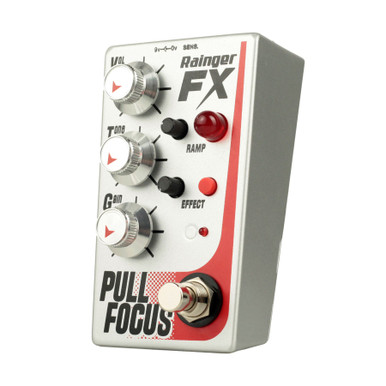
Here’s what Rainger FX say about the Rainger FX Pull Focus Distortion with Dynamic Reverb or Chorus Pedal:
The Pull Focus is a high gain distortion pedal, with either a reverb or chorus effect fading in after a short while. It has a noise gate too, which unobtrusively keeps the pedal silent when you’re not playing. The distortion is all analog, the reverb and chorus are digital. It’s a multi-effects pedal, of a very particular kind….
Distortion
The distortion is made from our favourite overdrive circuit, but going into the back end of the Tonebender circuit that we made for Colorsound when we did our collaboration on their Freakenbender pedal a while back. We worked hard to make it as balanced, versatile, powerful and silent as possible, ending up with an incredibly satisfying chunky tone. Full-range, not very scooped, tonally.
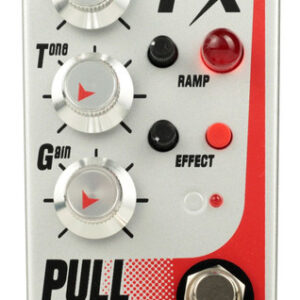
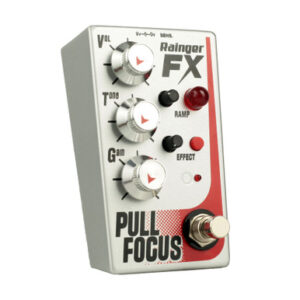
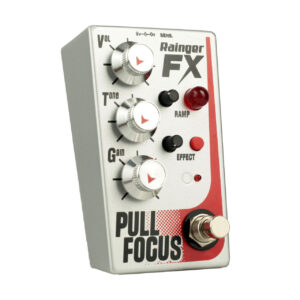
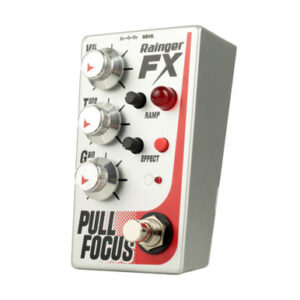
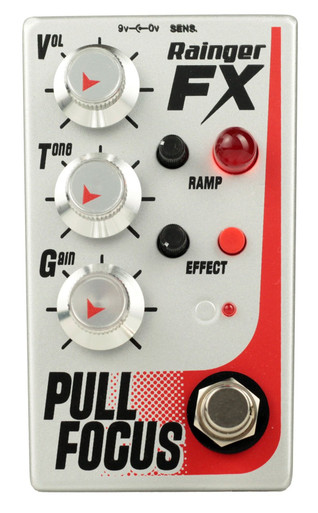
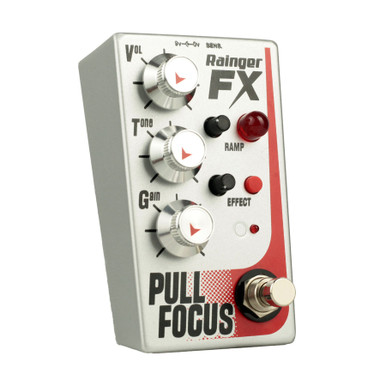
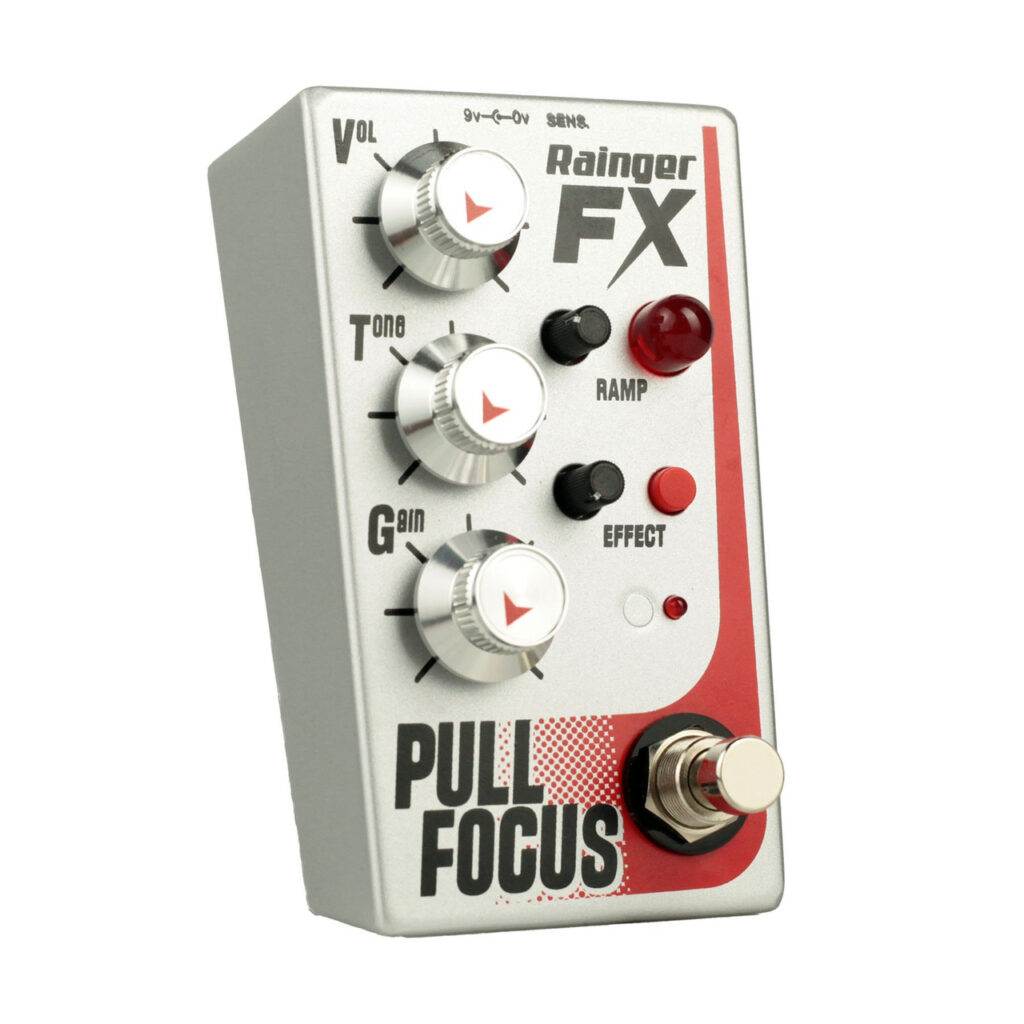
There are ‘volume’, ‘tone’, and ‘gain’ controls.
Fade In
Developed originally for our Break Box pedal, the Pull Focus has the same delayed fade-in for the chorus effect – but with an adjustable fade-in ramp; with the ‘ramp’ knob fully CCW the effect is in all the time, but as you start to turn it the effect takes a short while (less than a second?) to appear after the pick attack. As you turn it more, this delay time gradually increases – to around eight seconds maximum, until at fully CW it never actually comes in at all, ie in practice you can turn off that effect totally if you only want distortion.
Chorus Or Reverb
Press the ‘effect’ switch and the chorus sound is replaced by a spectacular digital reverb effect!
So with lots of short notes (eg fast soloing) the guitar is totally dry all the time, but intense and powerfully distorted. But play a long note or chord and it blooms into a huge spatial thing; all your long bent notes automatically grow into massive, swooping sounds, full of emotion and with the ambience of a hall-sized reverb! It’s incredibly fun and dynamic to play through!
However with the next note you play it dramatically snaps off hard – back to totally dry, close, and focussed. So the listener’s attention is drawn from up-close and in-your-face to a more distant reverbed sound – and then back; just as in film-making, a ‘pull focus’ leads the viewers attention from a face close by (a further-away face being blurred) to a face further away (the close-by one now being blurred).
The Pull Focus pedal is a very ‘3D’ effect, your guitar automatically moving from near to far away in an original and exciting way.
There’s a dual-purpose ‘effect’ knob, which – when using chorus – adjusts the speed of the modulation. When using reverb though this knob decides the depth and size of the reverberation. This goes from a cavernous effect right down to an almost-not-there small room-y thing; great for when you don’t want the obvious reverb mushroom cloud, but you’d like your long-held notes to seem…. somehow extra profound! But in a way that the audience may not even consciously register…
Active Sustain
This fading-in of the secondary effect is actually ‘active sustain’, a definite increase in your guitar signal level – as opposed to the usual dying away. On the chorus setting, this feels like a churning wave coming from behind to lift you forwards. With reverb it’s a monster growing out of your guitar!
The chorus speed goes from a very slow twist (think Jane’s Addiction/Smashing Pumpkins double-tracked?) through a mid-tempo obvious modulation (Bowie’s ‘Lodger’?) up to a fast psychotic wobble (Devo? Spongebob/Peewee Herman??)
There’s an on/off status LED, plus a large ‘ramp’ LED – which gives a visual indication of what’s going on sonically.
There’s a ‘quiet guitar boost’ switch – to ensure the noise gate and pick detection circuits work great whatever kind of instrument you’re using.
It’s true bypass, and housed in another deeply cool Rainger FX custom enclosure. Desk-style, a slight flare to it, and symmetrical – to help all our OCD musician friends.