Brand
Asheville Music Tools builds boutique pedals with a deep respect for analogue design and hands-on control. Based in North Carolina, the brand focuses on rich, immersive modulation and delay effects that feel alive and responsive under your fingers. Their circuits are crafted with precision, delivering depth, movement, and warmth that stands out without overwhelming your core tone.
Choose Asheville Music Tools when you want expressive, studio-grade textures with real character. From lush, dimensional repeats to evolving analogue modulation, their pedals reward experimentation while staying musical and refined — perfect for players who value detail and atmosphere in their sound.
Category
Tags
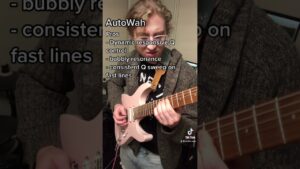
An envelope filter reacts to your playing dynamics, opening and closing its sweep based on how hard you pick. Dig in and it quacks, ease off and it softens — delivering that unmistakable funk snap, auto-wah bounce, and touch-sensitive groove that feels alive under your fingers. It’s expressive, rhythmic, and full of character.
Use it to bring movement to clean riffs, add vocal-like sweeps to bass lines, or inject serious funk into your rhythm playing. From subtle shimmer to full-on 70s squelch, an envelope filter turns your picking hand into the control knob.
While Ed Sheeran primarily relies on the natural sound of his acoustic guitar and vocals, he occasionally uses EQ (Equalization) to shape and enhance his tone during live performances or in the studio. EQ pedals or onboard preamps can allow him to adjust the frequency response of his guitar signal to suit the acoustics of different venues or to achieve specific tonal characteristics. Here’s how EQ might be utilized in Ed Sheeran’s setup:
1. **Tonal Shaping**: EQ can be used to adjust the balance of frequencies in the guitar signal, allowing Ed Sheeran to shape his tone to his liking. For example, he might boost the midrange frequencies to bring out the warmth and presence of his acoustic guitar, or cut certain frequencies to reduce any harshness or mud in the sound.
2. **Feedback Control**: In a live setting, EQ can help control feedback by notching out problematic frequencies that might cause the guitar signal to feed back through the amplification system. This can be particularly useful when performing in venues with challenging acoustics or high volume levels.
3. **Room Correction**: In situations where the venue’s acoustics are less than ideal, EQ can be used to compensate for any deficiencies in the sound. By adjusting the EQ settings, Ed Sheeran can tailor the guitar tone to sound more balanced and natural, regardless of the room’s acoustic properties.
4. **Matching Gear**: EQ can also be used to match the tone of Ed Sheeran’s guitar to the sound of other instruments or equipment in his setup. For example, he might adjust the EQ to complement the tonal characteristics of his vocal microphone or to blend seamlessly with backing tracks or other instruments.
Overall, while EQ may not be a central component of Ed Sheeran’s guitar effects setup, it can still play a valuable role in shaping his tone and ensuring that he achieves the desired sound in different performance environments. Whether used subtly for tonal shaping or more aggressively for feedback control, EQ allows Ed Sheeran to tailor his guitar tone to suit his musical vision and performance needs.
Expression pedals allow real-time control over specific parameters on compatible guitar pedals, such as volume, delay time, modulation depth, or filter sweep. Used with an expression input, they let players shape effects dynamically with their foot, adding movement and performance control that cannot be achieved with fixed knob settings.
A filter pedal shapes your tone by emphasising or cutting specific frequencies, letting you sculpt everything from subtle tonal shifts to bold, sweeping textures. Unlike traditional wah or envelope effects, filters can be static or controlled in different ways, giving you focused control over how bright, dark, sharp, or resonant your sound becomes.
Use a filter to tighten the low end, tame harsh highs, or create synth-like sweeps and rhythmic movement. Whether you’re refining your core tone or pushing into experimental territory, a filter pedal gives you precise control over the flavour of your sound.
This is brand new, fresh in, and a UK warranty is included. New Gear always comes from trusted UK music retailers.
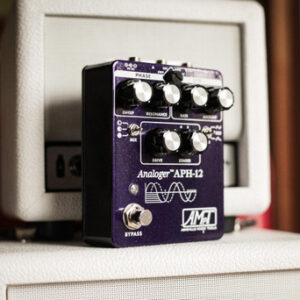
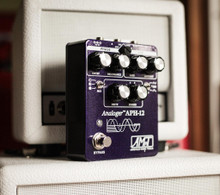
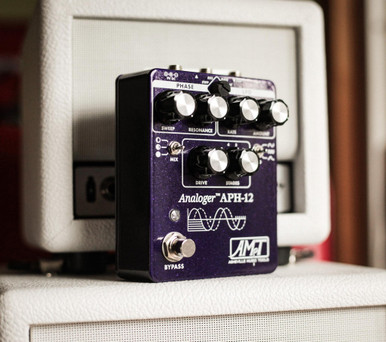
A phaser is a type of guitar effects pedal that creates a swirling, sweeping sound by modulating the phase of the audio signal. It works by splitting the incoming signal into two paths, shifting the phase of one path, and then recombining them. This creates peaks and troughs in the frequency spectrum, resulting in a distinctive, “phasing” effect characterized by moving notches in the frequency response.
Here’s how a phaser pedal typically works and some common features:
1. **Rate**: The rate control adjusts the speed at which the phase-shifting effect oscillates. Increasing the rate produces faster modulation, creating a more pronounced swirling effect, while decreasing the rate slows down the modulation for a smoother, more subtle effect.
2. **Depth**: The depth control adjusts the intensity or depth of the phase-shifting effect. Higher depth settings result in more pronounced peaks and troughs in the frequency response, while lower settings produce a more subtle modulation.
3. **Feedback (or Regeneration)**: Some phaser pedals feature a feedback control that determines the amount of modulated signal fed back into the effect. Increasing the feedback creates more pronounced peaks and troughs in the frequency spectrum, resulting in a more intense and resonant phasing effect.
4. **Stages**: Phasers typically have multiple stages (usually four, six, or eight), each of which contributes to the overall phase-shifting effect. More stages generally result in a more complex and textured phasing sound.
5. **Sweep (or Manual)**: The sweep control adjusts the center frequency of the phase-shifting effect. This allows you to focus the phasing effect on specific frequency ranges, altering the tonal character of the modulation.
6. **Resonance (or Feedback)**: Some phaser pedals feature a resonance control that emphasizes the peaks and troughs in the frequency response, creating a more pronounced and resonant effect. This control can add richness and depth to the phasing sound.
Phaser pedals are commonly used in various music genres, including rock, funk, and psychedelic music, to add movement, depth, and texture to guitar tones. They can be used to create swirling, swirling effects on rhythm parts, add dynamics to lead lines, or create atmospheric textures for ambient music. Overall, phaser pedals offer guitarists a versatile tool for shaping their tone and adding expressive modulation effects to their playing.
Rotary pedals recreate the swirling, moving sound of a rotating speaker cabinet, adding rich modulation and a sense of motion to guitar tones. They typically simulate the changing pitch and volume caused by spinning speakers, producing anything from subtle shimmer to deep, pulsating swirl. Rotary effects are often used for clean and lightly driven sounds to add depth, movement, and a classic, organ-inspired character.
A tremolo pedal modulates the volume of your guitar signal up and down in a rhythmic pattern, creating a pulsing or wavering effect that can sound vintage and hypnotic or sharp and choppy depending on the settings. It’s one of the oldest effects in guitar history, famously used on classic amps from the 1950s and ’60s.
Most tremolo pedals let you control the speed, depth, and wave shape, allowing you to go from smooth, subtle swells to intense stuttering tones. It’s a simple but expressive effect that adds movement and character to your sound.
Vibrato refers to a guitar pedal effect that modulates pitch slightly up and down, creating movement and a sense of wobble in the sound. Unlike tremolo, which changes volume, vibrato affects pitch only, producing anything from subtle shimmer to pronounced, warbling textures. It is often used to add character, depth, and vintage-style modulation to guitar tones.





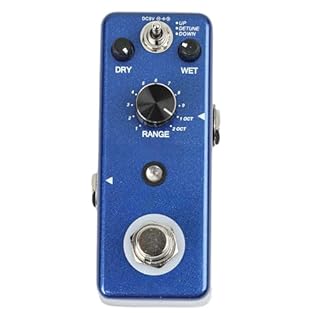
![[Versatile Sound Control] The pitch shifter effect pedal features dry, wet, and range controls, allowing you to fine-tune your sound for a more flexible and organic tone. whether you're looking for subtle shifts or dramatic pitch changes, this pedal ...](https://m.media-amazon.com/images/I/41ZpHjzd5fL._SL313_.jpg)