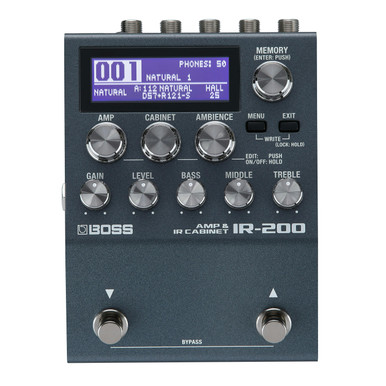
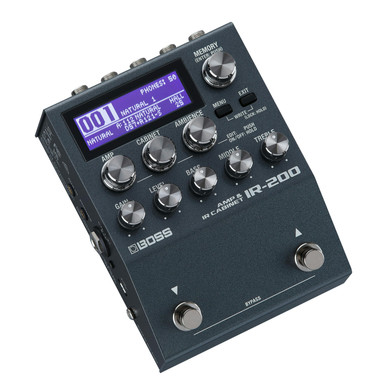
Boss IR-200 Amp & IR Cabinet Sim Pedal

Retailing in the region of £315.00

On the menu for January 2026 are the Boss Guitar Pedals, freshly added and carefully selected. These New units are available to order online with fast, secure delivery from trusted UK retailers. Read on for full details, specifications, demos, videos, reviews, and the best places to buy the Boss Guitar Pedals today.


Spread the love

Description

Spread the love

On the menu for January 2026 are the Boss Guitar Pedals, freshly added and carefully selected. These New units are available to order online with fast, secure delivery from trusted UK retailers. Read on for full details, specifications, demos, videos, reviews, and the best places to buy the Boss Guitar Pedals today.

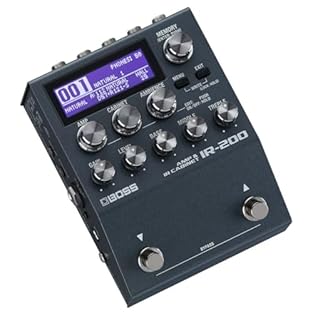
The IR-200 is a powerful new pedal-based amp simulator and impulse response loader and is the latest addition to Boss’ popular 200 series. Delivering next-level sound and performance for guitar and bass, the IR-200 transforms your pedalboard into a self-contained direct sound solution for live playing, studio recording, and home practice.

Offering incredible audio quality, authentic amp tones and extensive sound shaping, the IR-200 is loaded with over 150 high quality cab impulse responses from Boss and Celestion Digital. There are also an additional 128 slots for loading your own IRS too! The IR-200 is also packed with a host of useful stereo effects including modulation, delay and reverb, allowing you to add those finishing touches to your tone.

The pedalboard friendly IR-200 seamlessly integrates with you favourite stomp boxes allowing you to send your perfectly crafted tones directly to an amplifier, PA system, recording interface or headphones – or all of them simultaneously! It’s never been easier to take your favourite tones and go direct!

Key Features

  • 32-bit AD/DA, 32-bit floating-point processing, and 96 kHz sampling rate
  • 128 user IR slots with support for mono and stereo WAV files, up to 32-bit floating point/96 kHz resolution, and 200 or 500 ms length
  • Large onboard preset cab IR library with 144 BOSS IRs and 10 Celestion Digital IRs
  • Class-leading IR reproduction with two custom DSPs 
  • Eight guitar and three bass amp types to cover a wide range of styles
  • Run up to two IRs at once in mono or stereo
  • 128 memories for storing user setups
  • Two EQs in each memory plus two global EQs, all with selectable parametric or graphic operation
  • Room, Studio, and Hall ambience types
  • Effects loop with mono send and mono/stereo return, with selectable pre-cab or post-EQ positioning
  • Dedicated software for loading cab IRs and backing up memories
  • Versatile USB audio interface for recording and playback with music software on Mac and Windows computers and iOS devices
  • Deep external control support via footswitches, an expression pedal, and TRS MIDI

Specifications

  • Sampling Frequency: 96 kHz
  • AD Conversion: 32 bits + AF method (Adaptive Focus method is a proprietary method from Roland & BOSS that vastly improves the signal-to-noise (SN) ratio of the AD and DA converters).
  • DA Conversion: 32 bits
  • Processing: 32-bit floating point
  • Memory: 128
  • IR Cabinet Data Format: Mono/stereo, 96 kHz, 24 bits
  • Preset IR Cabinet: 154
  • User IR Cabinet Slot: 128
  • Normal Input Level: INPUT, RETURN: -10 dBu, AUX IN: -20 dBu
  • Maximum Input Level: INPUT, RETURN: +7dBu, AUX IN: 0 dBu
  • Input Impedance: INPUT, RETURN: 1 M ohm, AUX IN: 27 k ohms
  • Normal Output Level: OUTPUT (A/MONO, B), SEND, PHONES: -10 dBu
  • Maximum Output Level: OUTPUT (A/MONO, B), SEND, PHONES: +7dBu
  • Output Impedance: OUTPUT (A/MONO, B), SEND: 1k ohm, PHONES: 44 ohms
  • Recommended Load Impedance: OUTPUT (A/MONO, B), SEND: 10 k ohms or greater, PHONES: 44 ohms or greater
  • Controls: DOWN switch, UP switch, MENU button, EXIT button, MEMORY knob, AMP knob, CABINET knob, AMBIENCE knob, GAIN knob, LEVEL knob, BASS knob, MIDDLE knob, TREBLE knob
  • Display: Graphic LCD (132 x 32 dots, backlit LCD)
  • Connectors: INPUT, SEND, OUTPUT (A/MONO, B) jacks: 1/4-inch phone type, RETURN jack: 1/4-inch TRS phone type, AUX IN: Stereo miniature phone type, CTL 1, 2/EXP jack: 1/4-inch TRS phone type, MIDI (IN, OUT) connectors: Stereo miniature phone type, USB COMPUTER port: USB Micro-B type, DC IN jack
  • Power Supply: AC adaptor
  • Current Draw: 335 mA
  • Dimensions: 101 (W) x 138 (D) x 63 (H) mm / 4 (W) x 5-7/16 (D) x 2-1/2 (H) inches, 101 (W) x 138 (D) x 65 (H) mm / 4 (W) x 5-7/16 (D) x 2-9/16, (H) inches (including rubber feet)
  • Weight (excluding AC adaptor): 660 g (1 lb 8 oz)
  • Accessories: AC adaptor, Owner’s Manual, Leaflet “USING THE UNIT SAFELY”, Rubber foot x 4
Additional information

Weight 0.52 kg

Brand

Boss

Boss is a prominent manufacturer of guitar effects pedals, multi-effects units, and related musical equipment, known for their durability, reliability, and wide range of effects. Founded in 1973 as a division of the Roland Corporation, Boss quickly became synonymous with high-quality effects pedals that are popular among guitarists and musicians worldwide.

Boss pedals are renowned for their rugged construction, intuitive controls, and signature sound quality. The company offers a comprehensive lineup of effects pedals covering various categories, including distortion, overdrive, delay, modulation, and more. Iconic pedals like the DS-1 Distortion, the DS-2 Turbo Distortion, the DD-3 Digital Delay, and the MT-2 Metal Zone have become staples on countless pedalboards due to their versatility and reliability.

Category

Guitar Pedals

Tags

Amp Sim

Cab Sim

Delay

A delay pedal records your signal and plays it back after a set time, creating echoes that can range from tight, slapback repeats to long, atmospheric trails. It’s one of the most versatile effects, used to thicken tones, add rhythmic depth, or build spacious, ambient layers. Analogue delays offer warm, decaying repeats that blend naturally with your tone, while digital units provide pristine echoes with precise control over time, feedback, and mix levels.

From classic rockabilly and tape-style echoes to modern looping and shimmer effects, delay pedals have become essential tools for shaping sound. They can make solos soar, rhythms pulse, or transform simple chord progressions into cinematic textures. Whether used subtly to add dimension or boldly to create soundscapes, a good delay pedal can completely redefine the feel and atmosphere of your music.

EQ

While Ed Sheeran primarily relies on the natural sound of his acoustic guitar and vocals, he occasionally uses EQ (Equalization) to shape and enhance his tone during live performances or in the studio. EQ pedals or onboard preamps can allow him to adjust the frequency response of his guitar signal to suit the acoustics of different venues or to achieve specific tonal characteristics. Here’s how EQ might be utilized in Ed Sheeran’s setup:

1. **Tonal Shaping**: EQ can be used to adjust the balance of frequencies in the guitar signal, allowing Ed Sheeran to shape his tone to his liking. For example, he might boost the midrange frequencies to bring out the warmth and presence of his acoustic guitar, or cut certain frequencies to reduce any harshness or mud in the sound.

2. **Feedback Control**: In a live setting, EQ can help control feedback by notching out problematic frequencies that might cause the guitar signal to feed back through the amplification system. This can be particularly useful when performing in venues with challenging acoustics or high volume levels.

3. **Room Correction**: In situations where the venue’s acoustics are less than ideal, EQ can be used to compensate for any deficiencies in the sound. By adjusting the EQ settings, Ed Sheeran can tailor the guitar tone to sound more balanced and natural, regardless of the room’s acoustic properties.

4. **Matching Gear**: EQ can also be used to match the tone of Ed Sheeran’s guitar to the sound of other instruments or equipment in his setup. For example, he might adjust the EQ to complement the tonal characteristics of his vocal microphone or to blend seamlessly with backing tracks or other instruments.

Overall, while EQ may not be a central component of Ed Sheeran’s guitar effects setup, it can still play a valuable role in shaping his tone and ensuring that he achieves the desired sound in different performance environments. Whether used subtly for tonal shaping or more aggressively for feedback control, EQ allows Ed Sheeran to tailor his guitar tone to suit his musical vision and performance needs.

Expression

Expression pedals allow real-time control over specific parameters on compatible guitar pedals, such as volume, delay time, modulation depth, or filter sweep. Used with an expression input, they let players shape effects dynamically with their foot, adding movement and performance control that cannot be achieved with fixed knob settings.

MIDI

MIDI pedals use the Musical Instrument Digital Interface standard to communicate with other guitar pedals, effects units, and hardware. They allow control over presets, parameters, and switching across multiple devices from a single controller. MIDI integration makes it possible to build complex, synchronised pedal setups while keeping control simple and consistent.

New

This is brand new, fresh in, and a UK warranty is included. New Gear always comes from trusted UK music retailers.

Reverb

A reverb pedal is like the rich sauce that ties every flavour on the plate into one smooth experience. It adds depth, warmth, and atmosphere — the sonic equivalent of a perfectly reduced glaze that lingers on the tongue. Whether you’re after the subtle ambience of a cosy café (spring or plate reverb) or the grand echoes of a cathedral (hall or shimmer reverb), this is where your tone breathes and expands. A touch of reverb can turn a dry sound into something lush and inviting — but pour on too much, and it’s all you can taste. Used with finesse, it’s the finishing touch that transforms your tone from plain to unforgettable.

Available for Amazon Prime