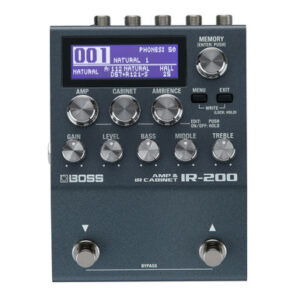
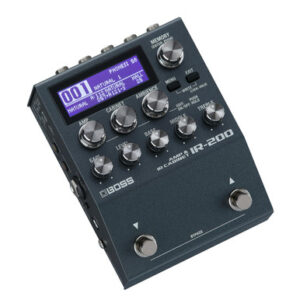

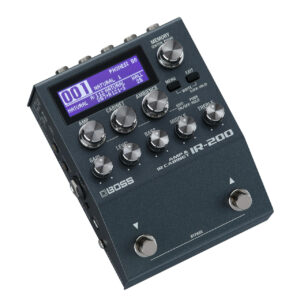
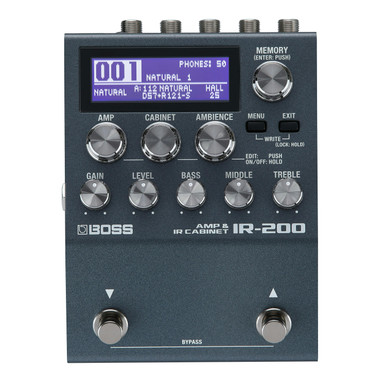
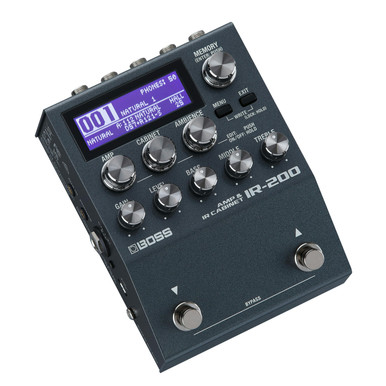
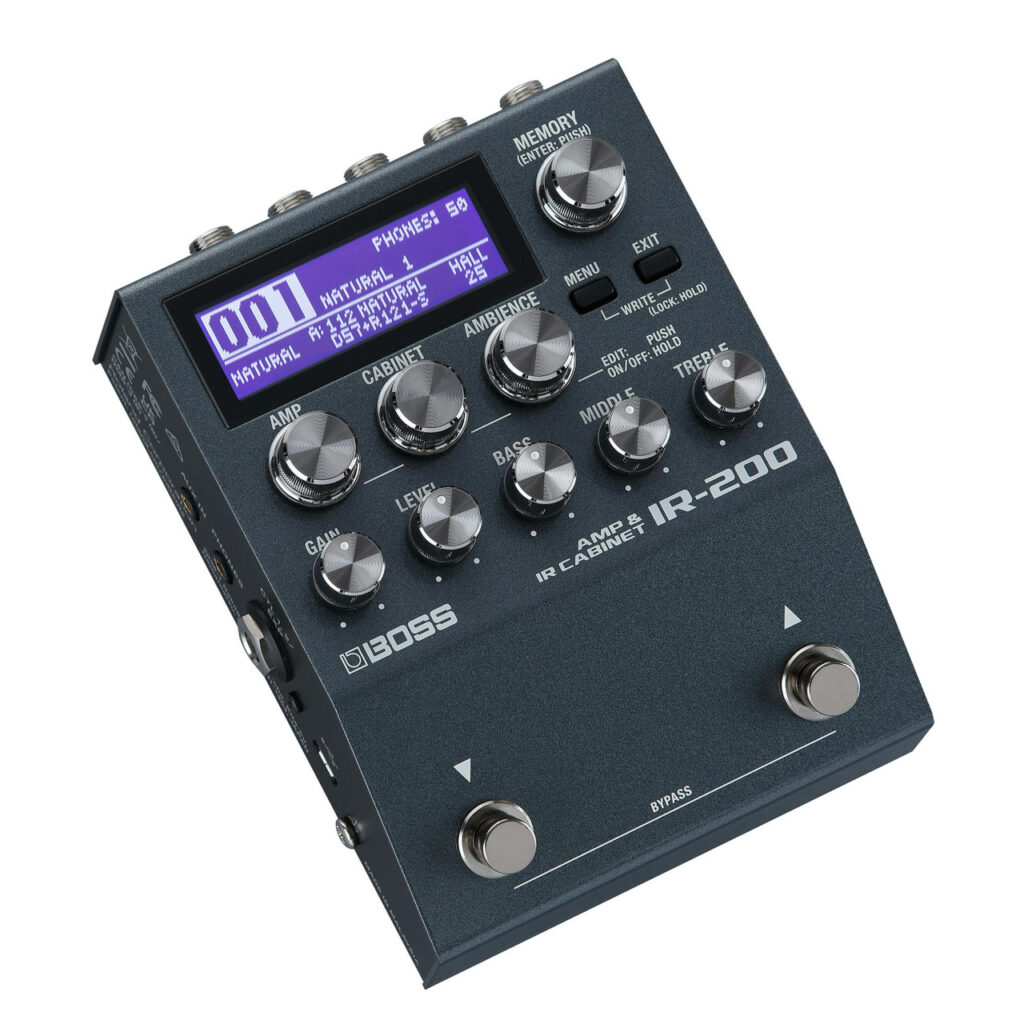
The IR-200 is a powerful new pedal-based amp simulator and impulse response loader and is the latest addition to Boss’ popular 200 series. Delivering next-level sound and performance for guitar and bass, the IR-200 transforms your pedalboard into a self-contained direct sound solution for live playing, studio recording, and home practice.
Offering incredible audio quality, authentic amp tones and extensive sound shaping, the IR-200 is loaded with over 150 high quality cab impulse responses from Boss and Celestion Digital. There are also an additional 128 slots for loading your own IRS too! The IR-200 is also packed with a host of useful stereo effects including modulation, delay and reverb, allowing you to add those finishing touches to your tone.
The pedalboard friendly IR-200 seamlessly integrates with you favourite stomp boxes allowing you to send your perfectly crafted tones directly to an amplifier, PA system, recording interface or headphones – or all of them simultaneously! It’s never been easier to take your favourite tones and go direct!
Key Features
- 32-bit AD/DA, 32-bit floating-point processing, and 96 kHz sampling rate
- 128 user IR slots with support for mono and stereo WAV files, up to 32-bit floating point/96 kHz resolution, and 200 or 500 ms length
- Large onboard preset cab IR library with 144 BOSS IRs and 10 Celestion Digital IRs
- Class-leading IR reproduction with two custom DSPs
- Eight guitar and three bass amp types to cover a wide range of styles
- Run up to two IRs at once in mono or stereo
- 128 memories for storing user setups
- Two EQs in each memory plus two global EQs, all with selectable parametric or graphic operation
- Room, Studio, and Hall ambience types
- Effects loop with mono send and mono/stereo return, with selectable pre-cab or post-EQ positioning
- Dedicated software for loading cab IRs and backing up memories
- Versatile USB audio interface for recording and playback with music software on Mac and Windows computers and iOS devices
- Deep external control support via footswitches, an expression pedal, and TRS MIDI
Specifications
- Sampling Frequency: 96 kHz
- AD Conversion: 32 bits + AF method (Adaptive Focus method is a proprietary method from Roland & BOSS that vastly improves the signal-to-noise (SN) ratio of the AD and DA converters).
- DA Conversion: 32 bits
- Processing: 32-bit floating point
- Memory: 128
- IR Cabinet Data Format: Mono/stereo, 96 kHz, 24 bits
- Preset IR Cabinet: 154
- User IR Cabinet Slot: 128
- Normal Input Level: INPUT, RETURN: -10 dBu, AUX IN: -20 dBu
- Maximum Input Level: INPUT, RETURN: +7dBu, AUX IN: 0 dBu
- Input Impedance: INPUT, RETURN: 1 M ohm, AUX IN: 27 k ohms
- Normal Output Level: OUTPUT (A/MONO, B), SEND, PHONES: -10 dBu
- Maximum Output Level: OUTPUT (A/MONO, B), SEND, PHONES: +7dBu
- Output Impedance: OUTPUT (A/MONO, B), SEND: 1k ohm, PHONES: 44 ohms
- Recommended Load Impedance: OUTPUT (A/MONO, B), SEND: 10 k ohms or greater, PHONES: 44 ohms or greater
- Controls: DOWN switch, UP switch, MENU button, EXIT button, MEMORY knob, AMP knob, CABINET knob, AMBIENCE knob, GAIN knob, LEVEL knob, BASS knob, MIDDLE knob, TREBLE knob
- Display: Graphic LCD (132 x 32 dots, backlit LCD)
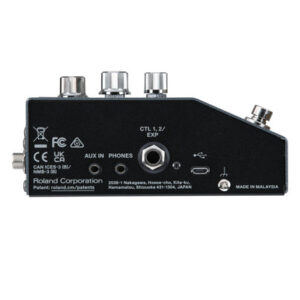
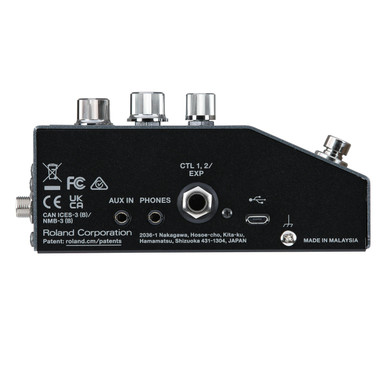
- Connectors: INPUT, SEND, OUTPUT (A/MONO, B) jacks: 1/4-inch phone type, RETURN jack: 1/4-inch TRS phone type, AUX IN: Stereo miniature phone type, CTL 1, 2/EXP jack: 1/4-inch TRS phone type, MIDI (IN, OUT) connectors: Stereo miniature phone type, USB COMPUTER port: USB Micro-B type, DC IN jack
- Power Supply: AC adaptor
- Current Draw: 335 mA
- Dimensions: 101 (W) x 138 (D) x 63 (H) mm / 4 (W) x 5-7/16 (D) x 2-1/2 (H) inches, 101 (W) x 138 (D) x 65 (H) mm / 4 (W) x 5-7/16 (D) x 2-9/16, (H) inches (including rubber feet)
- Weight (excluding AC adaptor): 660 g (1 lb 8 oz)
- Accessories: AC adaptor, Owner’s Manual, Leaflet “USING THE UNIT SAFELY”, Rubber foot x 4