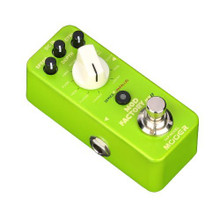
Mooer Mod Factory MK 2 Modulation Pedal

Retailing in the region of £59.00

On the menu for January 2026 are the Mooer Guitar Pedals, freshly added and carefully selected. These New units are available to order online with fast, secure delivery from trusted UK retailers. Read on for full details, specifications, demos, videos, reviews, and the best places to buy the Mooer Guitar Pedals today.


Spread the love

Description

Spread the love

On the menu for January 2026 are the Mooer Guitar Pedals, freshly added and carefully selected. These New units are available to order online with fast, secure delivery from trusted UK retailers. Read on for full details, specifications, demos, videos, reviews, and the best places to buy the Mooer Guitar Pedals today.

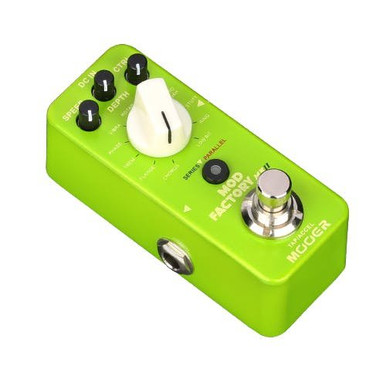
Mooer, kings of micro pedals, are back with an update to their whacky Mod Factory pedal in the MKII. Featuring a whole host of modulation effects, it's worth squeezing this small package into your pedalboard.

Loads of effects, little pedal

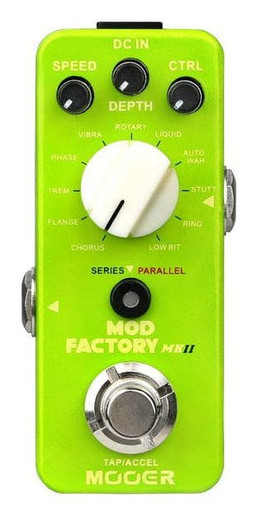
The MKII operates as a chorus, flanger, phaser and more, housing 11 effects across four dials for ultimate control. Using the main knob, select your desired sound, which includes unique liquid, rotary, stutt and auto-wah effects. The new low bit and ring settings are taken directly from the Mod Factory Pro, where they proved very popular choices. Using the dials at the top of the pedal, adjust the speed and depth of the modulation, while the CTRL knob will change the parameters of the chosen modulation.

Guitarists after something to experiment with will love the new acceleration and tap tempo to change the speed of the effects on the fly using the main on/off switch, great for wowing a crowd with big swells. 

Clean and tidy

Another improvement over the original is that each effect is clearly printed out with its full name on the pedal rather than the previous model's abbreviations. This makes switching quicker and no longer do you have to study the manual to get an idea of what it does. Mooer has also adjusted the signal to noise ratio, so each effect is crisper and doesn't muddy the tone of the guitar. True bypass means turning on/off is a clean process too.  

Here's what Mooer say about the Mod Factory MKII:

MOD FACTORY MKII contains 11 algorithms straight out of our award-winning MOD FACTORY PRO.  All the usual suspects are there such as Chorus, Flange, Trem and Phase but it also sports a cool new low-bit effect and ring modulator that have proven very popular with the PRO version.

Following feedback from end users, the signal to noise ratio has been greatly improved over the original and your guitar tone will remain full and present when you turn the pedal on.

To enhance the experience even further, real-time tap tempo and acceleration functions have been added and can be accessed via the soft touch, momentary footswitch.

MOD FACTORY MKII also has an option for SERIES/PARALLEL. The SERIES/PARALLEL switch toggles between serial and parallel internal signal chain routing. This effectively provides 2 very different sounds from each modulation type.

Features

*Digital Multi Modulation pedal with 11 different algorithms

*SERIES/PARALLEL routing control

*TAP TEMPO control

*ACCELERATION feature​
 

Specification
Input: 1/4” mono audio jack.(Impedance: 470Ω)
Output: 1/4” mono audio jack(Impedance: 100 Ω)
Power requirements: 9V DC 
Current Draw: 160mA
Dimensions: 93.5mm(D) x 42mm(W) x 52mm(H)
Weight: 146g
Additional information

Weight 0.5 kg

Brand

Mooer

Mooer is a Chinese company that produces affordable, compact guitar effects pedals and other music equipment.

Established in 2010, Mooer quickly gained popularity for its “Micro-Series” pedals, which are small but deliver a wide range of effects, from overdrive and distortion to reverb, delay, and modulation. Despite their budget-friendly price, Mooer pedals are appreciated for their solid build quality, ease of use, and impressive sound.

The company also offers multi-effects units, amplifiers, and accessories, catering to both beginner and experienced musicians who seek reliable gear without breaking the bank. Mooer’s products are widely used by guitarists worldwide, particularly those who value portability and versatility in their setups.

Category

Guitar Pedals

Tags

Chorus

Flanger

A flanger is a type of guitar effects pedal used to create a swirling, whooshing sound by modulating the phase of an audio signal. It works by combining the original signal with a slightly delayed and modulated version of itself. As the two signals interact, they create peaks and troughs in the frequency spectrum, resulting in the characteristic “jet plane” or “swooshing” sound associated with flanging.

Key features of a flanger pedal include:

1. **Rate**: Controls the speed at which the delayed signal is modulated. Higher rates produce faster modulation, while lower rates create slower, more subtle effects.

2. **Depth**: Adjusts the intensity of the modulation effect. Higher depth settings result in more pronounced sweeps, while lower settings produce a gentler effect.

3. **Manual (or Range)**: Sets the center frequency of the modulation. This control allows you to focus the effect on specific frequency ranges, altering the tonal character of the flanging.

4. **Feedback (or Regeneration)**: Determines the amount of modulated signal that is fed back into the effect. Increasing feedback can create more pronounced peaks and troughs, resulting in a more intense effect.

Flanger pedals are commonly used in various music genres, including rock, metal, and psychedelic music, to add movement, depth, and texture to guitar tones. They can be used subtly to add a touch of modulation and dimension to a guitar sound, or more prominently to create dramatic swirling effects. Overall, flanger pedals offer guitarists a versatile tool for shaping and enhancing their tone, adding a dynamic and expressive element to their playing.

New

This is brand new, fresh in, and a UK warranty is included. New Gear always comes from trusted UK music retailers.

Phaser

A phaser is a type of guitar effects pedal that creates a swirling, sweeping sound by modulating the phase of the audio signal. It works by splitting the incoming signal into two paths, shifting the phase of one path, and then recombining them. This creates peaks and troughs in the frequency spectrum, resulting in a distinctive, “phasing” effect characterized by moving notches in the frequency response.

Here’s how a phaser pedal typically works and some common features:

1. **Rate**: The rate control adjusts the speed at which the phase-shifting effect oscillates. Increasing the rate produces faster modulation, creating a more pronounced swirling effect, while decreasing the rate slows down the modulation for a smoother, more subtle effect.

2. **Depth**: The depth control adjusts the intensity or depth of the phase-shifting effect. Higher depth settings result in more pronounced peaks and troughs in the frequency response, while lower settings produce a more subtle modulation.

3. **Feedback (or Regeneration)**: Some phaser pedals feature a feedback control that determines the amount of modulated signal fed back into the effect. Increasing the feedback creates more pronounced peaks and troughs in the frequency spectrum, resulting in a more intense and resonant phasing effect.

4. **Stages**: Phasers typically have multiple stages (usually four, six, or eight), each of which contributes to the overall phase-shifting effect. More stages generally result in a more complex and textured phasing sound.

5. **Sweep (or Manual)**: The sweep control adjusts the center frequency of the phase-shifting effect. This allows you to focus the phasing effect on specific frequency ranges, altering the tonal character of the modulation.

6. **Resonance (or Feedback)**: Some phaser pedals feature a resonance control that emphasizes the peaks and troughs in the frequency response, creating a more pronounced and resonant effect. This control can add richness and depth to the phasing sound.

Phaser pedals are commonly used in various music genres, including rock, funk, and psychedelic music, to add movement, depth, and texture to guitar tones. They can be used to create swirling, swirling effects on rhythm parts, add dynamics to lead lines, or create atmospheric textures for ambient music. Overall, phaser pedals offer guitarists a versatile tool for shaping their tone and adding expressive modulation effects to their playing.

Rotary

Rotary pedals recreate the swirling, moving sound of a rotating speaker cabinet, adding rich modulation and a sense of motion to guitar tones. They typically simulate the changing pitch and volume caused by spinning speakers, producing anything from subtle shimmer to deep, pulsating swirl. Rotary effects are often used for clean and lightly driven sounds to add depth, movement, and a classic, organ-inspired character.

Wah

Wah refers to an expressive filter effect that sweeps through a range of frequencies, creating a vocal-like “wah” sound. Controlled in real time with a foot-operated treadle, it allows players to emphasise different parts of the frequency spectrum as they play. Wah pedals are commonly used for lead guitar, funk rhythm work, and expressive solos, responding closely to picking dynamics and foot movement.