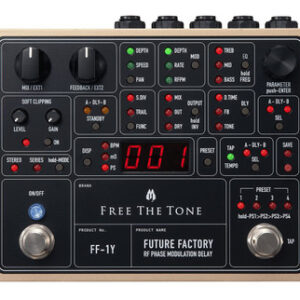

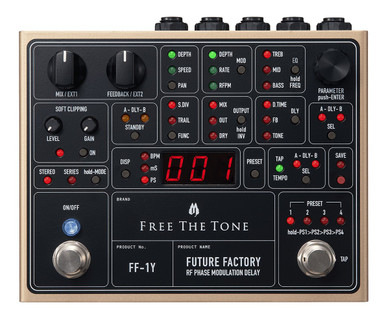
Here's what Free The Tone say about the Future Factory
“Creation of a new sound” ― this was the motto for the development of Free The Tone “Future Factory” FF-1Y. Many digital delay units that implement a modulation function have been introduced to date. In general, the phase of a low frequency oscillator (LFO) used in these modulation circuits changes regularly at a preset cycle. However in our Future Factory, we succeeded in creating a new modulation sound with a unique method in which signal’s phase changes at random when the signal crosses a certain attenuation level. This creates an unprecedented effect in which a fluctuating spacious sound seems to float in the air. (This function works best when used in Stereo mode.)
The FF-1Y has a dedicated 3-band equalizer for delay sound. Tonal adjustments of delay sound are indispensable for handling various musical phrases. This 3-band EQ can select a frequency to match the instrument to be used. This is a useful feature for guitarists and bassists, as well as saxophonists, violinists, DJ’s, or keyboardists.
For the users who will mainly use this unit in Monaural mode, we added a soft clipping circuit to one channel of the delay. By distorting the delay sound and adding it to the dry sound you can create an unprecedented, musical sound. The delay sound’s bandwidth is narrowed but harmonic overtones are added. This enables the creation of a sound similar to that made by vintage devices.
The Future Factory incorporates two delay modules that can be used as a stereo delay or easily used in Monaural mode by connecting them in series.
This unparalleled delay effect unit Future Factory FF-1Y is the fruit of Free The Tone’s continuous pursuit of sound quality and new functionality, and the culmination of our latest creative endeavors. This delay unit will surely stimulate your imagination and inspire you to create new and original sounds.
Key Features
- 3-Band Equalizer
- Soft Clipping
- Dual Delay Units
- 32-bit High-Precision DSP
- Dual Delay Units connectable in parallel or series
- Built-in HTS Circuit and Analog Mixer
- Instrument and Line Input Level Switching
- Delay Phase Invert
- Trail Function
- Tap Input
- Preset Switching (1–4)
- MIDI Support
Specifications
- Number of presets: 128
- Input impedance: min. 500 kΩ
- Output load impedance: min. 1 kΩ
- Max. input level: INST +3.5dBm / LINE +11dBm
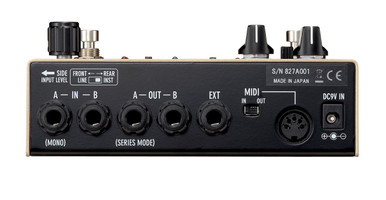
- Terminals: Standard 1/4" phone jacks (A-IN, B-IN, A-OUT, B-OUT, EXT), DC9V input jack (for AC adapter connection), DIN 5-pin connector (IN or OUT selective)
- Power supply: Dedicated AC adapter
- Current consumption: approx. 350 mA (max.)
- Dimensions: 145.4 (W) x 120.5 (D) x 60 (H) mm (incl. protuberances such as jacks, etc.)
- Weight: approx. 470g