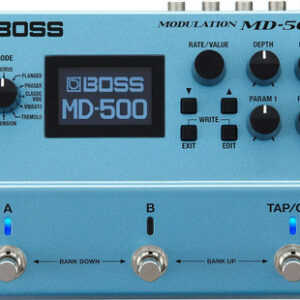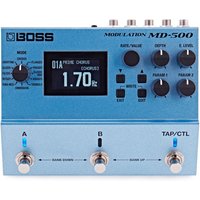
Boss MD-500 Modulation Effects Processor

£379.00

On the menu for January 2026 are the Boss Guitar Pedals, freshly added and carefully selected. These New units are available to order online with fast, secure delivery from trusted UK retailers. Read on for full details, specifications, demos, videos, reviews, and the best places to buy the Boss Guitar Pedals today.


Spread the love

Description

Spread the love

On the menu for January 2026 are the Boss Guitar Pedals, freshly added and carefully selected. These New units are available to order online with fast, secure delivery from trusted UK retailers. Read on for full details, specifications, demos, videos, reviews, and the best places to buy the Boss Guitar Pedals today.

Powered by advanced BOSS technology, the ultra-versatile MD-500 delivers nearly any type of modulation effect a musician could want, and then some. Included are 28 different algorithms with intensive programming parameters, offering a nearly limitless sound palette to create with. And with class-defying 32-bit AD/DA, 32-bit floating point processing, and 96 kHz sampling rate throughout, you’ll enjoy pristine sound quality that extends beyond the capabilities of the very best studio hardware.

Effects in the MD-500 include many new Prime types developed with cutting-edge BOSS tech, plus authentic sonic recreations of vintage classics like the CE-1 Chorus Ensemble, Roland Dimension D, ‘70s script phaser, ‘80s tri-chorus, and numerous others. With the ability to use two patches at once with A/B Simul mode, the MD-500 can likely cover all your mod needs with one convenient pedal. And by inserting drive pedals in the MD-500’s flexible external loop, it’s easy to place mod effects before, after, or around the loop as needed for the very best sound.

  • Studio-level sound with first-in-class 32-bit AD/DA, 32-bit floating point processing, and 96 kHz sampling rate
  • 12 modes and 28 modulation types, all with deep editing parameters
  • Classic mod effects and BOSS originals, newly enhanced with cutting-edge technology
  • A/B Simul mode for using two patches at once, with your choice of series/parallel connection and mixed or split A/B output
  • Insert Loop function allows you to use mod effects before, after, or around drive pedals
  • Graphic LCD and intensive real-time control options
  • 297 onboard patch memories and hands-on controls
  • Selectable buffered-bypass or true-bypass operation
  • MIDI I/O for interfacing with MIDI control devices
  • USB-MIDI for connecting to the MD-500 Editor/Librarian or a DAW (to be available in early July 2017)
  • Runs on four AA-size batteries or PSA-series AC adapter

Twelve Modes and 28 Mod Effect Types

The MD-500 includes 12 modes with 28 different mod effect algorithms, and every one of them has been newly developed specifically for this pedal. All the go-to standards are here: chorus, vibrato, flanger, phaser, tremolo, rotary, classic vibe, and ring mod. Auto wah and touch wah effects are on hand too, plus BOSS originals like Slicer and Overtone. Slicer fans will welcome the ability to program custom patterns, an additional feature to the original SL-20 Slicer pedal. And with the MD-500’s spot-on recreation of Roland’s Dimension D from the 1980s, you can add amazing width and depth with one of the most revered studio rack effects of all time.

Prime Tone

For the MD-500, standard effects like chorus, flanger, phaser, and others have been refreshed with BOSS’s advanced new Prime algorithms. Using ultra-fast, high-powered DSP and the latest technology, BOSS engineers have reimagined these essential effects for enhanced expression, extended range, and maximum transparency. With an array of adjustable parameters per type, you have a massive range of sound-shaping potential at your fingers. Some effects even have all-new parameters never seen in BOSS effects before, such as the “Bell” and “Sweetness” settings included in the Prime Chorus algorithm.

Extraordinary Sound

The MD-500 features 32-bit/96 kHz AD/DA, exceeding all industry standards for pedal-based effects. All internal processing is 32-bit floating point and runs at a 96 kHz sampling rate as well, delivering pristine sonic quality that goes beyond the highest-level digital processors used in top pro studios. And with selectable true-bypass or buffered-bypass operation, you can choose the best setting to suit the needs of any pedalboard setup.

Advanced Interface, Intuitive Operation

The MD-500 is equipped with a large LCD that clearly shows the patch name and other vital performance information. It also makes it easy to view and adjust the unit’s deep editing parameters and advanced control features. With the grab-and-go panel knobs, you have top-level access to essential adjustments like depth and effect level, plus two parameter controls that change dynamically with the selected effect type. And via USB, you can connect with the free MD-500 Editor/Librarian on your computer for remote editing, patch backup, and more.

Extraordinary Sound

The MD-500 features 32-bit/96 kHz AD/DA, exceeding all industry standards for pedal-based effects. All internal processing is 32-bit floating point and runs at a 96 kHz sampling rate as well, delivering pristine sonic quality that goes beyond the highest-level digital processors used in top pro studios. And with selectable true-bypass or buffered-bypass operation, you can choose the best setting to suit the needs of any pedalboard setup.
Advanced Interface, Intuitive Operation

The MD-500 is equipped with a large LCD that clearly shows the patch name and other vital performance information. It also makes it easy to view and adjust the unit’s deep editing parameters and advanced control features. With the grab-and-go panel knobs, you have top-level access to essential adjustments like depth and effect level, plus two parameter controls that change dynamically with the selected effect type. And via USB, you can connect with the free MD-500 Editor/Librarian on your computer for remote editing, patch backup, and more.
A/B Simul Mode and Insert Loop Function

A/B Simul mode further extends the MD-500’s versatility by letting you run two patches at once. A selectable series or parallel connection enables all sorts of tone-shaping possibilities, and you can even send each effect to its own separate output if you like. The MD-500 also features an external loop that lets you insert gain and drive pedals and set the ideal effect order on a per-patch basis. For example, you can place a phaser or classic vibe before a drive pedal in one patch, and a chorus or flanger after the drive in the next. And when you’re in A/B Simul mode, it’s even possible to position the loop between two different mod effects.

Intensive Real-Time Control

With its freely assignable switches and extensive real-time control support, the MD-500 delivers unmatched expression and performance flexibility. By default, the A, B, and TAP/CTL switches offer control for patch/bank selection and bypass, plus tap tempo or real-time adjustment of one or more parameters. If you like, the switches can be customized to access three different mod patches, A/B Simul mode, and other functions. Via the rear-panel CTL 1,2/EXP jack, you can plug in up to two footswitches for further control, or an expression pedal to adjust wah, effect rate, and other parameters. MIDI I/O is also included, enabling further creative possibilities with advanced setups.

MD-500 Modes and Algorithms

  • Chorus—Four types: Prime, CE-1 Chorus, CE-1 Vibrato, and TRI-CHO.
  • Flanger—Two types: Prime G (for guitar) and Prime B (for bass).
  • Phaser— Three types: Prime G (for guitar), Prime B (for bass), and Script.
  • Classic Vibe—Two types: Chorus (mixed output) and Vibrato (effect-only output).
  • Vibrato—Two types: Prime and Scanner (tonewheel organ-style vibrato).
  • Tremolo—Four types: Prime T and Prime P, plus Twin and Deluxe amp-style tremolo.
  • Dimension—Models the legendary Roland SDD-320 Dimension D rack unit; includes the original four sound modes and an all-new fifth mode, plus a user setting for saving any combination of modes.
  • Ring Mod—Classic ring modulation effects, plus Intelligent mode for enhanced clarity when playing scales.
  • Rotary—Vintage rotating speaker effect with slow and fast speeds.
  • Filter—Auto wah and touch wah (with independent types optimized for guitar and bass), plus pattern filter type.
  • Slicer—Original BOSS effect derived from the popular SL-20 Slicer, with programmable options not available in the SL-20 pedal.
  • Overtone—Original BOSS effect based on the MO-2 Multi Overtone pedal; uses MDP tech to alter the input signal’s pitch and harmonic characteristics, allowing you to create unique new sound textures.

Specifications

  • Sampling Frequency: 96 kHz
  • AD/DA Conversion: 32 bits
  • Processing: 32-bit floating point

12 modes

  • CHORUS
  • FLANGER
  • PHASER
  • CLASSIC VIBE
  • VIBRATO
  • TREMOLO
  • DIMENSION
  • RING MOD
  • ROTARY
  • FILTER
  • SLICER
  • OVERTONE

Memory: 198 (99 banks x 2 [A] [B]), 297 (99 banks x 3 [A] [B] [C])

Nominal Input Level: INPUT A/MONO, B: -10 dB

Maximum Input Level: INPUT A/MONO, B: +8 dBu

Input Impedance: INPUT A/MONO, B: 1 M ohm

Nominal Output Level: OUTPUT A/MONO, B: -10 dBu

Maximum Output Level: OUTPUT A/MONO, B: +8 dBu

Output Impedance: OUTPUT A/MONO, B: 2 k ohms

Recommended Load Impedance: OUTPUT A/MONO, B: 20 k ohms or greater

Bypass: Buffered bypass or True bypass (with relays)

Controls: A switch, B switch, TAP/CTL switch DOWN button, UP button, EXIT button, EDIT button MODE knob, RATE/VALUE knob, DEPTH knob, E.LEVEL knob, PARAM 1 knob, PARAM 2 knob

Display: Graphic LCD (128 x 64 dots, backlit LCD)

Connectors: INPUT (A/MONO, B) jacks, OUTPUT (A/MONO, B) jacks: 1/4-inch phone type, CTL 1,2/EXP jack: 1/4-inch TSR phone type USB COMPUTER port: USB type B, MIDI (IN, OUT) connectorsDC IN jack

Power Supply: Alkaline battery (AA, LR6) x 4, AC adaptor (sold separately)

Current Draw: 225 mA

Dimensions

  • 170 (W) x 138 (D) x 62 (H) mm
  • 6-3/4 (W) x 5-7/16 (D) x 2-1/2 (H) inches

Weight (including battery)

  • 1.0 kg
  • 2 lbs 4 oz

Options (sold separately)

  • Footswitch: FS-5U, FS-5L
  • Dual Footswitch: FS-6, FS-7
  • Expression Pedal: FV-500H, FV-500L, EV-30, Roland EV-5

* 0 dBu = 0.775 Vrms


Additional information

Weight 17.4 kg

Brand

Boss

Boss is a prominent manufacturer of guitar effects pedals, multi-effects units, and related musical equipment, known for their durability, reliability, and wide range of effects. Founded in 1973 as a division of the Roland Corporation, Boss quickly became synonymous with high-quality effects pedals that are popular among guitarists and musicians worldwide.

Boss pedals are renowned for their rugged construction, intuitive controls, and signature sound quality. The company offers a comprehensive lineup of effects pedals covering various categories, including distortion, overdrive, delay, modulation, and more. Iconic pedals like the DS-1 Distortion, the DS-2 Turbo Distortion, the DD-3 Digital Delay, and the MT-2 Metal Zone have become staples on countless pedalboards due to their versatility and reliability.

Category

Guitar Pedals

Tags

Chorus

Expression

Expression pedals allow real-time control over specific parameters on compatible guitar pedals, such as volume, delay time, modulation depth, or filter sweep. Used with an expression input, they let players shape effects dynamically with their foot, adding movement and performance control that cannot be achieved with fixed knob settings.

Flanger

A flanger is a type of guitar effects pedal used to create a swirling, whooshing sound by modulating the phase of an audio signal. It works by combining the original signal with a slightly delayed and modulated version of itself. As the two signals interact, they create peaks and troughs in the frequency spectrum, resulting in the characteristic “jet plane” or “swooshing” sound associated with flanging.

Key features of a flanger pedal include:

1. **Rate**: Controls the speed at which the delayed signal is modulated. Higher rates produce faster modulation, while lower rates create slower, more subtle effects.

2. **Depth**: Adjusts the intensity of the modulation effect. Higher depth settings result in more pronounced sweeps, while lower settings produce a gentler effect.

3. **Manual (or Range)**: Sets the center frequency of the modulation. This control allows you to focus the effect on specific frequency ranges, altering the tonal character of the flanging.

4. **Feedback (or Regeneration)**: Determines the amount of modulated signal that is fed back into the effect. Increasing feedback can create more pronounced peaks and troughs, resulting in a more intense effect.

Flanger pedals are commonly used in various music genres, including rock, metal, and psychedelic music, to add movement, depth, and texture to guitar tones. They can be used subtly to add a touch of modulation and dimension to a guitar sound, or more prominently to create dramatic swirling effects. Overall, flanger pedals offer guitarists a versatile tool for shaping and enhancing their tone, adding a dynamic and expressive element to their playing.

MIDI

MIDI pedals use the Musical Instrument Digital Interface standard to communicate with other guitar pedals, effects units, and hardware. They allow control over presets, parameters, and switching across multiple devices from a single controller. MIDI integration makes it possible to build complex, synchronised pedal setups while keeping control simple and consistent.

New

This is brand new, fresh in, and a UK warranty is included. New Gear always comes from trusted UK music retailers.

Phaser

A phaser is a type of guitar effects pedal that creates a swirling, sweeping sound by modulating the phase of the audio signal. It works by splitting the incoming signal into two paths, shifting the phase of one path, and then recombining them. This creates peaks and troughs in the frequency spectrum, resulting in a distinctive, “phasing” effect characterized by moving notches in the frequency response.

Here’s how a phaser pedal typically works and some common features:

1. **Rate**: The rate control adjusts the speed at which the phase-shifting effect oscillates. Increasing the rate produces faster modulation, creating a more pronounced swirling effect, while decreasing the rate slows down the modulation for a smoother, more subtle effect.

2. **Depth**: The depth control adjusts the intensity or depth of the phase-shifting effect. Higher depth settings result in more pronounced peaks and troughs in the frequency response, while lower settings produce a more subtle modulation.

3. **Feedback (or Regeneration)**: Some phaser pedals feature a feedback control that determines the amount of modulated signal fed back into the effect. Increasing the feedback creates more pronounced peaks and troughs in the frequency spectrum, resulting in a more intense and resonant phasing effect.

4. **Stages**: Phasers typically have multiple stages (usually four, six, or eight), each of which contributes to the overall phase-shifting effect. More stages generally result in a more complex and textured phasing sound.

5. **Sweep (or Manual)**: The sweep control adjusts the center frequency of the phase-shifting effect. This allows you to focus the phasing effect on specific frequency ranges, altering the tonal character of the modulation.

6. **Resonance (or Feedback)**: Some phaser pedals feature a resonance control that emphasizes the peaks and troughs in the frequency response, creating a more pronounced and resonant effect. This control can add richness and depth to the phasing sound.

Phaser pedals are commonly used in various music genres, including rock, funk, and psychedelic music, to add movement, depth, and texture to guitar tones. They can be used to create swirling, swirling effects on rhythm parts, add dynamics to lead lines, or create atmospheric textures for ambient music. Overall, phaser pedals offer guitarists a versatile tool for shaping their tone and adding expressive modulation effects to their playing.

Rotary

Rotary pedals recreate the swirling, moving sound of a rotating speaker cabinet, adding rich modulation and a sense of motion to guitar tones. They typically simulate the changing pitch and volume caused by spinning speakers, producing anything from subtle shimmer to deep, pulsating swirl. Rotary effects are often used for clean and lightly driven sounds to add depth, movement, and a classic, organ-inspired character.

Tremolo

A tremolo pedal modulates the volume of your guitar signal up and down in a rhythmic pattern, creating a pulsing or wavering effect that can sound vintage and hypnotic or sharp and choppy depending on the settings. It’s one of the oldest effects in guitar history, famously used on classic amps from the 1950s and ’60s.

Most tremolo pedals let you control the speed, depth, and wave shape, allowing you to go from smooth, subtle swells to intense stuttering tones. It’s a simple but expressive effect that adds movement and character to your sound.

used

Vibrato

Vibrato refers to a guitar pedal effect that modulates pitch slightly up and down, creating movement and a sense of wobble in the sound. Unlike tremolo, which changes volume, vibrato affects pitch only, producing anything from subtle shimmer to pronounced, warbling textures. It is often used to add character, depth, and vintage-style modulation to guitar tones.

Wah

Wah refers to an expressive filter effect that sweeps through a range of frequencies, creating a vocal-like “wah” sound. Controlled in real time with a foot-operated treadle, it allows players to emphasise different parts of the frequency spectrum as they play. Wah pedals are commonly used for lead guitar, funk rhythm work, and expressive solos, responding closely to picking dynamics and foot movement.

Available for Amazon Prime