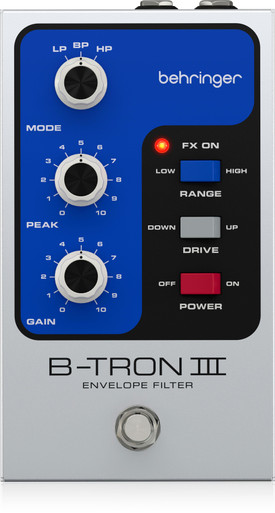
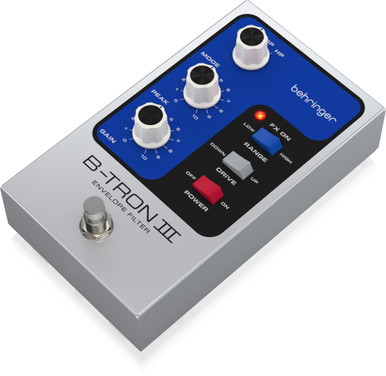
Behringer B-TRON Envelope Filter Vintage Auto-Wah Pedal

£69.99

This is the Behringer B-TRON Envelope Filter Vintage Auto-Wah Pedal from Behringer, listed in Wah & Filter Pedals on Just Pedals. Read More below.

View Just
more
and

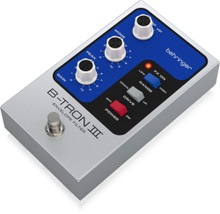
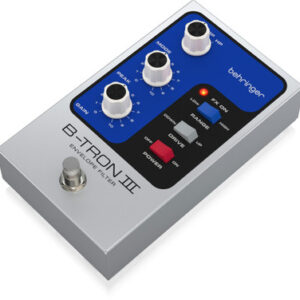
The Behringer B-TRON III Envelope Filter is a faithful recreation of the iconic auto-wah pedal that defined the funky sounds of the 1970s. Whether you play guitar, bass, or keyboards, this versatile pedal reacts dynamically to your playing, delivering rich, expressive “Wah” and vowel-like tones.

Key Features

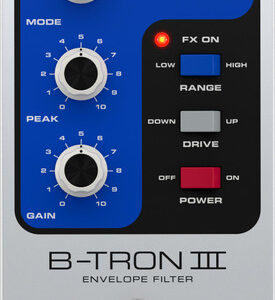
  • Classic Auto-Wah Filtering – Recreates vintage envelope filter sounds with low-pass, band-pass, and high-pass modes, allowing for expressive funk tones and high-frequency sizzle.
  • Versatile Range & Drive Modes – Switch between low and high frequency emphasis, and choose Up or Down drive settings to achieve either traditional Wah or cocked “Wow” sounds.
  • Wide Dynamic Input & Gain Control – Handles instruments with a +30 dBu input range and offers up to +40 dB gain, making it suitable for both subtle filtering and bold tonal shaping.

Featuring three selectable filter types – low-pass, band-pass, and high-pass – the B-TRON III lets you dial in anything from a deep, funky quack to a sizzling high-end bite. The Range switch further tailors the sound, offering both low (for warm, vowel-like articulation) and high (for pronounced overtones) settings.

Additionally, the Drive switch provides Up and Down modes, letting you choose between a traditional sweeping Wah or a cocked “Wow” effect. Designed for powerful performance and tonal flexibility, the B-TRON III boasts an impressive gain range of +40 dB, ensuring a wide input dynamic range for professional use. Compact and robust, it runs on a standard 9V DC power supply and is built to handle the demands of the stage and studio alike.

Specifications

  • Instrument Input: 1 x 1/4″ TS jack, unbalanced
  • Input Impedance: 1 MΩ
  • Maximum Input Level: +30 dBu
  • Amp Output: 1 x 1/4″ TS jack, unbalanced
  • Output Impedance: <600 Ω
  • Maximum Output Level: +13 dBu
  • Filter Mode: Lo-Pass, Band-Pass, Hi-Pass (rotary switch)
  • Shape (Q) Range: 1.5 to 14, adjustable
  • Gain: Up to +40 dB
  • Range Switch: Low/High
  • Drive Switch: Up/Down
  • Power Supply: 9V DC, centre negative (>100 mA)
  • Power Consumption: 0.25 W
  • Dimensions: 61 x 100 x 171 mm (2.41 x 3.94 x 6.73″)
  • Weight: 0.68 kg (1.5 lbs)

Related videos

Brand

Behringer

Behringer is a prominent manufacturer of audio equipment, including mixers, amplifiers, signal processors, synthesizers, and digital effects units, known for their affordability and wide range of products. Founded in 1989 by Uli Behringer, the company has grown rapidly to become one of the largest manufacturers of audio equipment in the world.

Behringer’s product lineup covers a broad spectrum of audio equipment, catering to musicians, audio engineers, DJs, and live sound professionals. The company offers a variety of mixers, ranging from compact analog mixers for home studios to digital mixers with advanced features for live sound and recording applications.

In addition to mixers, Behringer produces a wide range of amplifiers, including guitar amps, bass amps, and powered PA speakers, as well as signal processors such as equalizers, compressors, and effects units. Behringer synthesizers, like the DeepMind series, have also gained popularity for their affordability and impressive sound quality.

Behringer is known for its commitment to providing high-quality audio equipment at affordable prices, making professional-grade gear accessible to a wide range of musicians and audio enthusiasts. However, the brand has also faced criticism and controversy over issues related to intellectual property rights and product cloning. Despite this, Behringer’s extensive product lineup continues to be popular among musicians and audio professionals seeking reliable and affordable audio solutions.

Category

Wah & Filter Pedals

Wah effects sweep a resonant band-pass or related filter through the frequency spectrum, creating the vowel-like movement associated with the treadle. Envelope filters move automatically in response to picking level, while fixed and sequenced filters use other control sources. Sweep range, resonance, direction, sensitivity and input loading determine whether the response is vocal, percussive, smooth or sharply synthetic.

Tags

Bass

Voiced or equipped to retain low-frequency fundamentals and the higher headroom of a bass signal. Clean blends, crossovers and bass-specific filter ranges can preserve weight and articulation while the effected portion adds harmonics, movement or ambience.