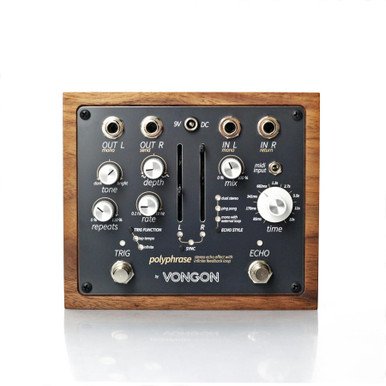
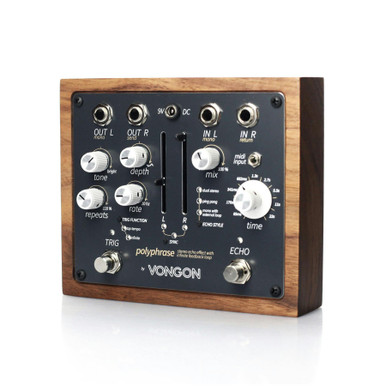
Vongon Polyphrase Stereo Echo with Infinite Feedback Loop Pedal

Retailing in the region of £479.00

Also available on Amazon, eBay & Reverb

On the menu for January 2026 are the Vongon Guitar Pedals, freshly added and carefully selected. These New units are available to order online with fast, secure delivery from trusted UK retailers. Read on for full details, specifications, demos, videos, reviews, and the best places to buy the Vongon Guitar Pedals today.


Description

On the menu for January 2026 are the Vongon Guitar Pedals, freshly added and carefully selected. These New units are available to order online with fast, secure delivery from trusted UK retailers. Read on for full details, specifications, demos, videos, reviews, and the best places to buy the Vongon Guitar Pedals today.

Here's what Vongon say about the Polyphrase

Polyphrase is a stereo echo and looping device inspired by early proto-digital delays of the 1970ʼs like the Lexicon Prime Time. As sophisticated as it is easy-to-use, Polyphrase is capable of everything from rich, dubby rhythmic repeats, to metallic resonant flanges. It is unique in being able to generate loops as long as 22 seconds, opening up a new palette of sonic possibilities for the avant-garde, ambient, or adventurous musician.

Polyphrase features two independent sliders for left and right delay times that can be locked into an infinite feedback loop which will produce an ever-changing sample of audio as each channel overlaps with another. This makes Polyphrase a tool for exploration capable of achieving the same kind of harmonic oscillation found on Steve Reichʼs seminal tape piece “Piano Phase”.

The time knob interacts with the left and right faders by providing nine different maximum delay times starting at 85 milliseconds, and doubling in value as the parameter is increased up to 22 seconds. Each
new delay section is cross faded into the signal path, an important design consideration that avoids any pitch shifting artefacts and is useful for creating new and unexpected musical phrases when used with high
repeat settings.

Three echo styles are available, and each style configures its own dedicated routing for the delay feedback path. “Dual stereo” provides two independent echoes, and they can either be stacked in mono, or
routed out of each stereo channel. In “ping pong” mode, each delay feeds back into the other, creating either a classic stereo ping pong sound (with each repeat bouncing between the le and right channel), or a
multi-tap delay effect (when used in mono). The last mode is a mono delay – it routes the feedback path to the IN R, OUT R jacks so that you can use external effects in the echoʼs feedback path.

The tone control is a bipolar equalizer (EQ) situated in the feedback path of the echo. At 12 o'clock, the EQ has no effect on the audio. Turning the knob clockwise cuts low end – making each repeat brighter than
the previous. Turning the tone knob in the counter clockwise direction cuts high frequencies – it creates darker repeats, which makes Polyphrase capable of achieving similar timbre to the storied analogue,
bucket-brigade delays.

The echo signal can be pitch modulated with the rate and depth controls for a sine wave style chorus / vibrato, or with a random wave for detuning effects similar to aging tape echoes. Finally, Polyphrase has a fully featured midi input that provides tempo sync, full remote control of all parameters on the faceplate, and access to 9 onboard user preset slots.

Key Features

  • Delay times from 5 milliseconds to 22 seconds
  • Two delay lines that can be used in stereo or stacked in mono
  • Infinite feedback
  • External feedback path
  • Tone control in the feedback path
  • Echo pitch modulation with sine or random style waveform
  • Tap tempo
  • Midi tempo sync
  • 9 onboard user presets accessible via midi program change (PC) messages
  • Remote control of all parameters on the faceplate via midi continuous controller (CC) messages
  • 3 gain configurations for line level, instrument level, or low instrument level
  • Housed in a single block of walnut, CNC routed, hand sanded & polished 

Specifications

  • 141mm x 121mm x 45mm
  • 1/4” mono jacks
  • Input impedance: 1MΩ
  • Output impedance: <1kΩ
  • Current draw: 200mA
  • So-touch foot switches
  • Buffered bypass

Additional information

Weight 1 kg

Brand

Vongon

Vongon design innovative, beautifully built pedals and instruments that blend vintage inspiration with modern digital creativity. Their effects focus on lush textures, dreamy modulation, and expressive sound shaping, often with a unique interface that encourages experimentation. With a distinctive aesthetic and a warm, musical character, Vongon pedals appeal to players who want atmospheric tones and a more exploratory approach to guitar effects.

Category

Guitar Pedals

Tags

Chorus

Delay

A delay pedal records your signal and plays it back after a set time, creating echoes that can range from tight, slapback repeats to long, atmospheric trails. It’s one of the most versatile effects, used to thicken tones, add rhythmic depth, or build spacious, ambient layers. Analogue delays offer warm, decaying repeats that blend naturally with your tone, while digital units provide pristine echoes with precise control over time, feedback, and mix levels.

From classic rockabilly and tape-style echoes to modern looping and shimmer effects, delay pedals have become essential tools for shaping sound. They can make solos soar, rhythms pulse, or transform simple chord progressions into cinematic textures. Whether used subtly to add dimension or boldly to create soundscapes, a good delay pedal can completely redefine the feel and atmosphere of your music.

EQ

While Ed Sheeran primarily relies on the natural sound of his acoustic guitar and vocals, he occasionally uses EQ (Equalization) to shape and enhance his tone during live performances or in the studio. EQ pedals or onboard preamps can allow him to adjust the frequency response of his guitar signal to suit the acoustics of different venues or to achieve specific tonal characteristics. Here’s how EQ might be utilized in Ed Sheeran’s setup:

1. **Tonal Shaping**: EQ can be used to adjust the balance of frequencies in the guitar signal, allowing Ed Sheeran to shape his tone to his liking. For example, he might boost the midrange frequencies to bring out the warmth and presence of his acoustic guitar, or cut certain frequencies to reduce any harshness or mud in the sound.

2. **Feedback Control**: In a live setting, EQ can help control feedback by notching out problematic frequencies that might cause the guitar signal to feed back through the amplification system. This can be particularly useful when performing in venues with challenging acoustics or high volume levels.

3. **Room Correction**: In situations where the venue’s acoustics are less than ideal, EQ can be used to compensate for any deficiencies in the sound. By adjusting the EQ settings, Ed Sheeran can tailor the guitar tone to sound more balanced and natural, regardless of the room’s acoustic properties.

4. **Matching Gear**: EQ can also be used to match the tone of Ed Sheeran’s guitar to the sound of other instruments or equipment in his setup. For example, he might adjust the EQ to complement the tonal characteristics of his vocal microphone or to blend seamlessly with backing tracks or other instruments.

Overall, while EQ may not be a central component of Ed Sheeran’s guitar effects setup, it can still play a valuable role in shaping his tone and ensuring that he achieves the desired sound in different performance environments. Whether used subtly for tonal shaping or more aggressively for feedback control, EQ allows Ed Sheeran to tailor his guitar tone to suit his musical vision and performance needs.

Looper

A looper pedal records and plays back sections of your playing, allowing you to layer sounds and build full arrangements on your own. By capturing short or long phrases, you can create rhythm parts, harmonies, or entire backing tracks in real time. Most loopers offer basic controls for record, overdub, and playback, while advanced models include multiple tracks, tempo syncing, and memory storage for saving your loops.

Loopers are invaluable for practice, songwriting, and live performance. They help you explore ideas, refine timing, and experiment with textures — from solo acoustic performances to complex ambient soundscapes. A good looper pedal becomes an instrument in itself, letting you improvise, arrange, and perform with creativity and freedom, turning one guitar into an entire band.

MIDI

MIDI pedals use the Musical Instrument Digital Interface standard to communicate with other guitar pedals, effects units, and hardware. They allow control over presets, parameters, and switching across multiple devices from a single controller. MIDI integration makes it possible to build complex, synchronised pedal setups while keeping control simple and consistent.

New

This is brand new, fresh in, and a UK warranty is included. New Gear always comes from trusted UK music retailers.

Pitch

Pitch pedals alter the frequency of your guitar signal, changing the perceived note or adding harmony. They can shift notes up or down by fixed intervals, create harmonies, or produce dive-bomb and whammy-style effects without a tremolo arm. Pitch shifters and harmonisers are great for thickening solos, simulating multiple guitars, or experimenting with creative, otherworldly sounds that expand your tonal range.

used

Vibrato

Vibrato refers to a guitar pedal effect that modulates pitch slightly up and down, creating movement and a sense of wobble in the sound. Unlike tremolo, which changes volume, vibrato affects pitch only, producing anything from subtle shimmer to pronounced, warbling textures. It is often used to add character, depth, and vintage-style modulation to guitar tones.