
Description
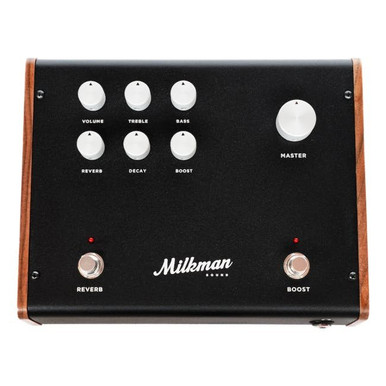
On the menu for January 2026 are the Milkman Guitar Pedals, freshly added and carefully selected. These New units are available to order online with fast, secure delivery from trusted UK retailers. Read on for full details, specifications, demos, videos, reviews, and the best places to buy the Milkman Guitar Pedals today.
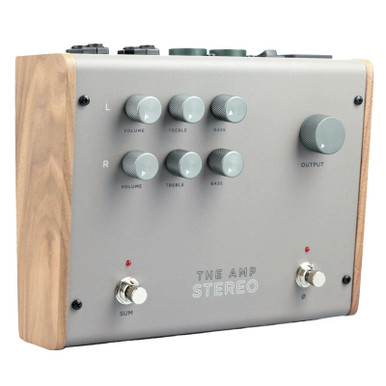
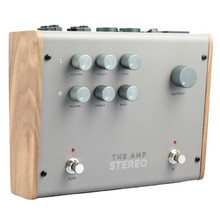
Milkman Sound has expanded its popular line of pedalboard amplifiers with the mighty The Amp Stereo. This newly-designed, fully stereo amplifier design boasts many extra features that will surely make this an essential part of any musician's toolkit — particularly players who want a compact and portable rig right at their feet with multiple options.
With The Amp Stereo, there's now an elegant, analogue, and easy to use end-of-the-chain solution for guitarists using stereo effects (like delays, reverbs and modulations FX) — featuring Milkman's cab sim sweetener, a stereo headphone amplifier, and two powerful channels of amplification! On top of the stereo functionality, The Amp Stereo can be run as two independent amplifiers each powering separate channels of audio. Just use the built-in footswitches to sum to mono and fix phase issues potentially created by wet/dry guitar setups or cabinets with reverse polarity.
The two outputs can also run into separate cabinets varying in impedance and wattage. For example, a 4 ohm bass cabinet can be powered by one side, and an 8 ohm guitar cabinet by the other. Ultimately, Milkman's The Amp Stereo has been designed to maximise headroom and serve as a foundation for all manner of instruments and effects. And like all Milkman products, The Amp Stereo is built by hand in California with the finest components available.
Controls
Left:
- Volume: This knob controls the input gain for the right channel of The Amp Stereo.
- Treble: High Frequency EQ adjustment.
- Bass: Low Frequency EQ adjustment.
Right:
- Volume: This knob controls the input gain for the left channel of The Amp Stereo.
- Treble: High Frequency EQ adjustment.
- Bass: Low Frequency EQ adjustment.
Output: The single large knob controls how much of the signal from both preamps goes to the output. Think of this less like a master volume, and more like the master fader on a mixing console. This is the only level control for the various outputs.
Footswitches
- Sum: When this switch is depressed and the LED is lit, the two preamps will be summed together. If you are using a stereo input, then it will create a mono summed signal that comes out of both channels. If you are using only one input, it will sum to both channels.
- Ø: When the phase switch is depressed and the LED is lit, the output of the right side will invert. This can be useful for aligning phase if something in your signal chain flips phase, or if both speaker cabinets are not wired the same.
Rear Panel Features
The rear panel has all of the inputs and outputs for The Amp Stereo, with the exception of the headphone amplifier which is on the front:
- Input: Plug your guitar or instruments in here. The input impedance of The Amp Stereo is 1 Mohm, so it will have enough headroom for all guitars and line instruments.
- Sim Off: Use this switch to toggle the cab sim EQ on and off. The cab Sim is an analogue EQ-based sweetener on 2 outputs: the balanced TRS output, and headphones.
- Balanced Out: This is a line level balanced output on dual TRS connectors. Connecting to a balanced 1/4" TRS input is preferred for lowest noise, but if your interface mixer or amplifier only has unbalanced TS 1/4" inputs, The Amp Stereo's balanced out can feed that input with a 6 db loss in level and minimal degradation in fidelity as long as the TS cable length is kept to a minimum.
- GND Lift: There may be a situation where you are using more than one output at once and creating a ground loop between various pieces of equipment. The Balanced Out has a ground lift switch to isolate ground at the TRS balanced output. If you hear excessive hum when using the line outputs, try lifting ground to reduce noise.
- Speaker: You can power a 4, 8, or 16 ohm speaker load from each output. At 4 ohms, The Amp Stereo will put out 200 watts per output. At 8 ohms, each output is rated at 100 watts, and at 16 ohms, each output is rated at 50 watts. It is 100% safe to operate The Amp Stereo with no speaker load attached.
- Power Switch: The Amp Stereo will power on when the power switch is rocked into the on position.
- Power Input: The Amp Stereo can support any power input between 100 VAC and 240 VAC. This makes it ideal for international travel. There is no switch to change input voltage — The Amp automatically detects the input voltage and adjusts its internal voltages accordingly.


![[Rich and Delicate Sound] With FVACM technology and high-precision 24bit/44.1kHz audio processing, Arena2000 guitar effects greatly reduces the "plastic taste" of the digital effect, making the tone more layered, allowing you to play real emotions wi...](https://m.media-amazon.com/images/I/41EVsqKcvjL._SL313_.jpg)