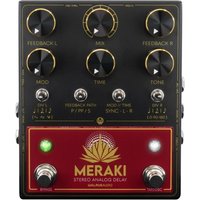
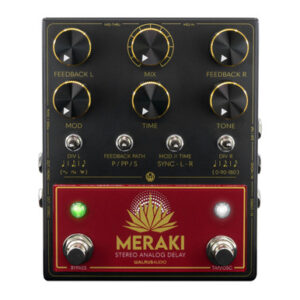
The Walrus Audio Meraki Stereo Analog Delay Pedal is an exceptional music accessory for all guitar enthusiasts. With its eight MN3005 bucket brigade chips it delivers warm rich repeats for an immersive audio experience. Capable of 1200ms delay time it offers parallel ping-pong and series delay modes providing an extensive range of sound possibilities. Additionally the independent controls for the delay times and modulation of the left and right channels allow creating syncopated repeats or classic repeat sounds. Not just that the Walrus Audio Meraki Stereo Analog Delay Pedal is equipped with a variety of controls such as mix feedback left/right mod depth/rate time and tone for precise adjustments. It also features MIDI implementation for digitally manipulating controls like time modulation tap tempo and more. The device also comes with options of true-bypass or buffered bypass for trails. Moreover the tap tempo and expression control offer dynamic control over time or modulation depth. This pedal with its advanced features and superior quality promises an unmatched music experience.
Walrus Audio Meraki Stereo Analog Delay Pedal
This is a New Walrus Audio Meraki Stereo Analog Delay Pedal from Walrus Audio its found in our Delay Pedals on the Just Pedals menu. Read More below.
As an affiliate partner, we may earn a small commission when you buy through our links — at no extra cost to you.
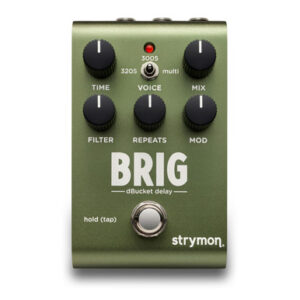
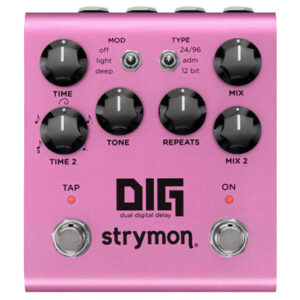
Related videos

Brand
Walrus Audio
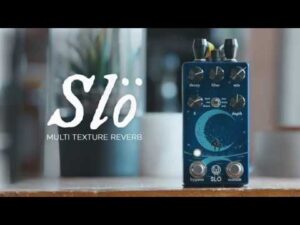
Walrus Audio describes itself as a collective of artists, musicians and engineers, bringing circuit design together with distinctive pedal artwork. The company says its effects are hand-built and manufactured in the USA. JustPedals listings illustrate the variety: ARP-87 multi-function delay, Slö ambient reverb, Julia analog chorus and vibrato, and Polychrome flanger. Some models focus on direct, compact controls, while others provide broader modulation or atmospheric textures. Compare each model’s modes, stereo connections and control options; the artwork is a signature of the brand, while the circuit determines how it fits a rig.
Category
Delay Pedals
Delay records the incoming signal for a chosen interval and repeats it after the original note. Feedback returns repeats to the delay line, while tone, filtering, modulation and saturation determine whether echoes remain clear, darken progressively, wobble like tape or degrade like analogue bucket-brigade circuits. Delay time and rhythmic subdivisions govern the spacing and musical pattern of the repeats.
Tags
Analogue
The signal is shaped by continuously varying electronic circuitry rather than being converted into a digital effect algorithm. Component choice, operating voltage and circuit tolerances influence headroom, noise, clipping texture and the small variations in response between designs.
Buffered Bypass
Keeps an active buffer in the signal path when the effect is bypassed. The buffer converts a high-impedance input to a lower-impedance output, helping long cables and multiple pedals retain level and high frequencies, although its headroom and noise remain part of the path.
MIDI
Sends, receives or responds to Musical Instrument Digital Interface messages rather than carrying the instrument audio itself. Program changes recall presets, continuous controllers move parameters, and MIDI clock or transport messages synchronise timing between devices.
Stereo
Processes, creates or passes two audio channels. True stereo preserves separate left and right inputs, while mono-to-stereo effects generate spatial differences internally; routing, phase behaviour and whether trails remain stereo determine the resulting image. Some outputs sum to mono when only one socket is connected, which can change level or modulation depth.
Tap Tempo
Measures repeated foot taps and converts their interval into an effect rate or delay time. Subdivisions translate that pulse into dotted, triplet or other rhythmic values, while averaging and range limits influence how quickly and accurately the tempo settles.
Others Just Ordered :
- I Love A Happy Accident… – Animals Pedal

- Animals Pedal Vintage Van Driving is Very Fun Overdrive

- Animals Pedal Sunday Afternoon Is Infinity Bender

- Ninevolt Pedals | Bath Time Reverb (Animals Pedal)
- This Fuzz Pedal Makes No Sense… But It Sounds Incredible

- ANIME Pedals | Animals Pedal Custom Illustrated Series