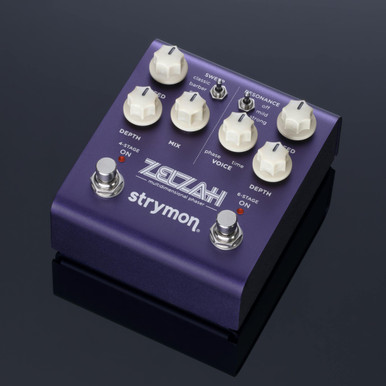
Strymon Zelzah Multidimensional Phaser Pedal

£329.00

On the Menu for January 2026 are the Strymon Guitar Pedals. These are fresh in, hand picked by the chef, & cooked to perfection. A tasty number we can deliver straight to your door, serving orders quickly and securely. For more info on Strymon New Guitar Pedals, please read on for full details, demos, videos, reviews & to order online


Spread the love

Description

Spread the love

The Strymon Guitar Pedals are fresh in for Jan. The Just Pedals Chef is dishing up hot gear all over the UK, served straight to your door, quickly and securely, For more info on tasty Strymon New Guitar Pedals, please read on for full details, ingredients, reviews and where to order in the UK.

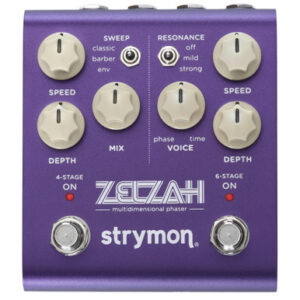
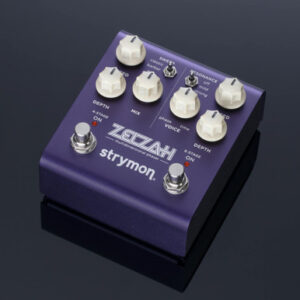
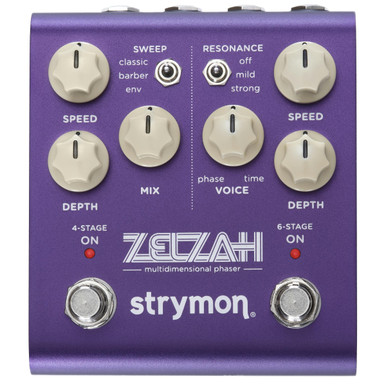
Strymon has expanded its acclaimed family of effects pedals with the Zelzah multidimensional phaser. Boasting two independent 4-stage and 6-stage phaser circuits that can be used separately: one at a time or simultaneously in series, parallel or split configurations — the Strymon Zelzah takes you on a spellbinding sonic experience by producing some of the most exquisite, spiralling and luscious modulation sounds we’ve ever heard — perfectly voiced with plenty of vibe!

A World of Modulation

The 4-stage phaser on the left side of the Zelzah offers 3 sweep modes that capture an array of nostalgic, vintage phaser and vibrato tones. Strymon call their Zelzah a “way back machine” for a reason! The 6-stage phaser algorithm (right side) can seamlessly venture into flanger and chorus territory via its versatile ‘Voice’ control, accompanied by a thoughtful resonance switch that richly alters the intensity.

Flexible 2-in-1 Design

As the Strymon Zelzah is essentially two different phasers in a single enclosure, you can configure it in a number of ways to maximise your pedalboard’s real-estate — becoming the only modulation pedal you may ever need. Dial in a chorus on one side and a barber-pole phaser on the other, or create a soaring flanger with a pulsating tremolo next door. Use the two sides independently, or together to achieve musical nirvana!

Key Features

  • Two independent effects that can be configured and controlled separately and used one at a time or simultaneously in series, parallel, or split configurations.
  • Vintage 4-stage phaser with three phaser sweep modes: classic, barber, and envelope.
  • Groundbreaking new 6-stage phaser algorithm with a continuous range from classic pure 6-stage phasing to flanging and chorus, all with adjustable resonance.
  • True stereo operation means, under the hood, each half of the pedal has two phasers running side by side (two 4-stage and two 6-stage)  or in series, with independently adjustable stereo spread for each.
  • All controls are carefully voiced to produce musically-useful sounds at any setting.
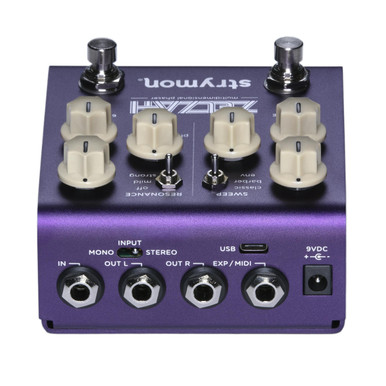
  • Adjustable input level switch to allow for both instrument and line level signals.
  • Selectable buffered or true bypass.
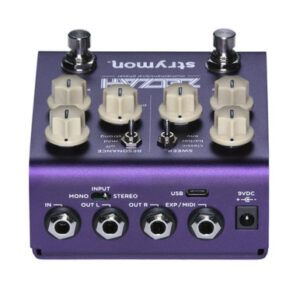
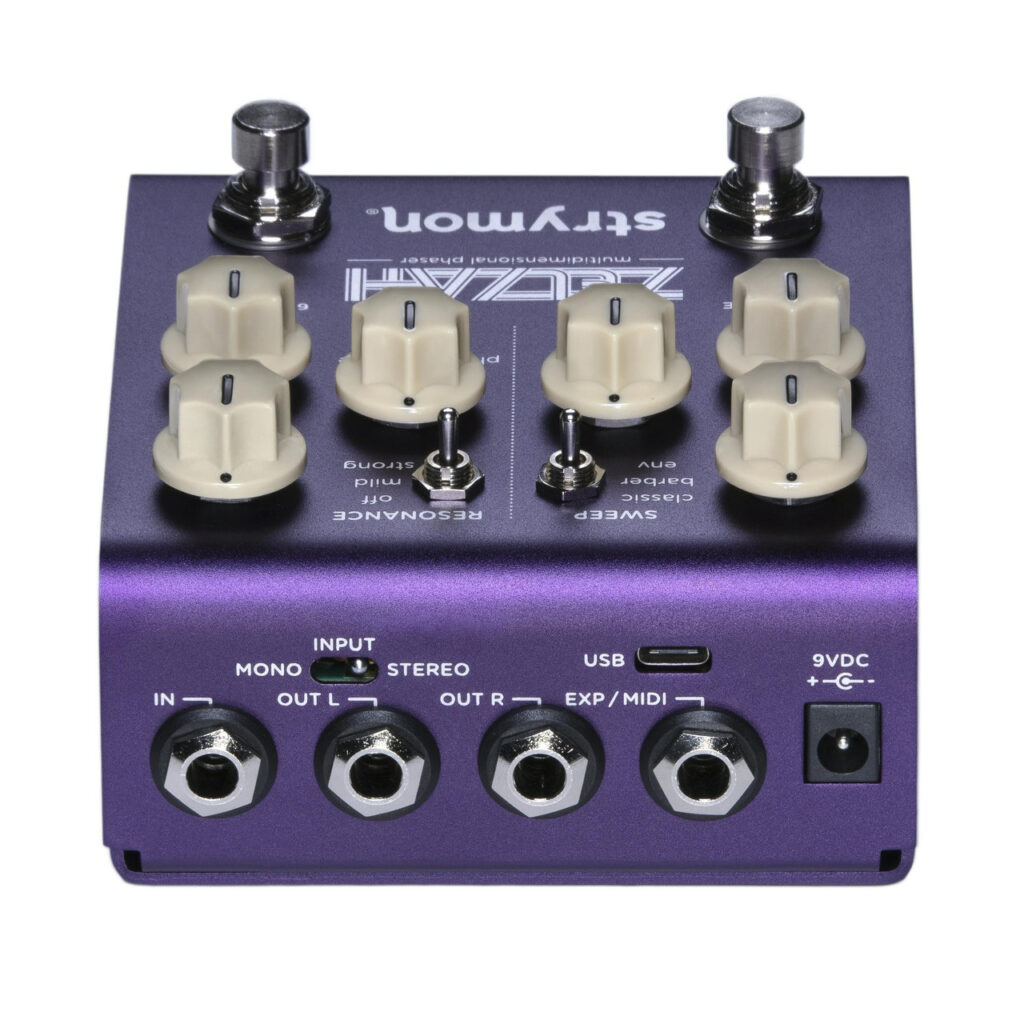
  • Full-featured MIDI implementation via TRS or USB supporting MIDI CCs, MIDI clock sync, and access to 300 preset locations.
  • High impedance, ultra low-noise discrete Class A JFET TRS stereo input.
  • Low impedance independent TS stereo outputs.
  • Expression pedal input allows the connection of a TRS expression pedal, MiniSwitch, MultiSwitch Plus, or TRS MIDI connection.
  • USB jack for controlling via MIDI from a computer or for performing firmware updates.
  • Independent on/off footswitch for each phaser.
  • Premium JFET analogue front end.
  • Ultra low noise, high performance 24-bit 96kHz A/D and D/A converters provide uncompromising audio quality.
  • Strong and lightweight anodised dark purple aluminium chassis.

Specifications

  • 480MHz ARM Superscalar processor
  • 32-bit floating point processing
  • 20Hz to 20kHz frequency response
  • Audio Input Impedance: 1M Ohm
  • Audio Output Impedance: 100 Ohm
  • Power requirements: maximum 9-volts DC centre-negative, with a minimum of 300mA of current
  • Dimensions: 4.5” (D) x 4” (W) x 1.75” (H)
  • Designed and built in the USA

Ingredient Allergy Warning : Product may contain nuts.

Additional information

Weight 0.62 kg

Brand

Strymon

Strymon is an American company renowned for producing high-end, digitally-powered guitar effects pedals that deliver studio-quality sound. Founded in 2009 as a part of Damage Control Engineering, Strymon quickly gained a reputation for its innovative approach to effects, particularly in areas like delay, reverb, and modulation. Their pedals are known for their pristine sound quality, versatility, and deep customization options, often utilizing powerful digital signal processing (DSP) to emulate and enhance analogue sounds. Strymon’s products, such as the Timeline delay, BigSky reverb, and Mobius modulation, are highly regarded by both professional and amateur musicians for their ability to create rich, complex soundscapes. The pedals also feature intuitive controls and rugged construction, making them a staple on pedalboards worldwide.

Category

Guitar Pedals

Tags

Chorus

envelope filter

Expression

Expression pedals allow real-time control over specific parameters on compatible guitar pedals, such as volume, delay time, modulation depth, or filter sweep. Used with an expression input, they let players shape effects dynamically with their foot, adding movement and performance control that cannot be achieved with fixed knob settings.

Flanger

A flanger is a type of guitar effects pedal used to create a swirling, whooshing sound by modulating the phase of an audio signal. It works by combining the original signal with a slightly delayed and modulated version of itself. As the two signals interact, they create peaks and troughs in the frequency spectrum, resulting in the characteristic “jet plane” or “swooshing” sound associated with flanging.

Key features of a flanger pedal include:

1. **Rate**: Controls the speed at which the delayed signal is modulated. Higher rates produce faster modulation, while lower rates create slower, more subtle effects.

2. **Depth**: Adjusts the intensity of the modulation effect. Higher depth settings result in more pronounced sweeps, while lower settings produce a gentler effect.

3. **Manual (or Range)**: Sets the center frequency of the modulation. This control allows you to focus the effect on specific frequency ranges, altering the tonal character of the flanging.

4. **Feedback (or Regeneration)**: Determines the amount of modulated signal that is fed back into the effect. Increasing feedback can create more pronounced peaks and troughs, resulting in a more intense effect.

Flanger pedals are commonly used in various music genres, including rock, metal, and psychedelic music, to add movement, depth, and texture to guitar tones. They can be used subtly to add a touch of modulation and dimension to a guitar sound, or more prominently to create dramatic swirling effects. Overall, flanger pedals offer guitarists a versatile tool for shaping and enhancing their tone, adding a dynamic and expressive element to their playing.

Guitar Pedals

Your pedal is like a signature dish for your sound — a flavour-packed creation that transforms the bland ingredients of your guitar into something unforgettable. Each one adds its own seasoning, texture, and heat, turning a simple meal into a feast of tone.

These tasty little boxes sit in a row, like plates on a buffet, letting you mix and match flavours as you play. With one tap of your foot, you can swap sweet for spicy, subtle for smoky, and serve up something completely new. From the comfort food of warm overdrive to the fiery kick of fuzz, from smooth jazz sauce to heavy-metal spice, pedals give players a full menu of options to express their taste.  And just like with food, once you’ve tried one dish, you’ll want to sample them all.

Collecting, trading, and discovering new flavours soon becomes part of the joy of being a tone-loving gourmet geek with a guitar.

MIDI

MIDI pedals use the Musical Instrument Digital Interface standard to communicate with other guitar pedals, effects units, and hardware. They allow control over presets, parameters, and switching across multiple devices from a single controller. MIDI integration makes it possible to build complex, synchronised pedal setups while keeping control simple and consistent.

New

This is brand new, fresh in, and a UK warranty is included. New Gear always comes from trusted UK music retailers.

Phaser

A phaser is a type of guitar effects pedal that creates a swirling, sweeping sound by modulating the phase of the audio signal. It works by splitting the incoming signal into two paths, shifting the phase of one path, and then recombining them. This creates peaks and troughs in the frequency spectrum, resulting in a distinctive, “phasing” effect characterized by moving notches in the frequency response.

Here’s how a phaser pedal typically works and some common features:

1. **Rate**: The rate control adjusts the speed at which the phase-shifting effect oscillates. Increasing the rate produces faster modulation, creating a more pronounced swirling effect, while decreasing the rate slows down the modulation for a smoother, more subtle effect.

2. **Depth**: The depth control adjusts the intensity or depth of the phase-shifting effect. Higher depth settings result in more pronounced peaks and troughs in the frequency response, while lower settings produce a more subtle modulation.

3. **Feedback (or Regeneration)**: Some phaser pedals feature a feedback control that determines the amount of modulated signal fed back into the effect. Increasing the feedback creates more pronounced peaks and troughs in the frequency spectrum, resulting in a more intense and resonant phasing effect.

4. **Stages**: Phasers typically have multiple stages (usually four, six, or eight), each of which contributes to the overall phase-shifting effect. More stages generally result in a more complex and textured phasing sound.

5. **Sweep (or Manual)**: The sweep control adjusts the center frequency of the phase-shifting effect. This allows you to focus the phasing effect on specific frequency ranges, altering the tonal character of the modulation.

6. **Resonance (or Feedback)**: Some phaser pedals feature a resonance control that emphasizes the peaks and troughs in the frequency response, creating a more pronounced and resonant effect. This control can add richness and depth to the phasing sound.

Phaser pedals are commonly used in various music genres, including rock, funk, and psychedelic music, to add movement, depth, and texture to guitar tones. They can be used to create swirling, swirling effects on rhythm parts, add dynamics to lead lines, or create atmospheric textures for ambient music. Overall, phaser pedals offer guitarists a versatile tool for shaping their tone and adding expressive modulation effects to their playing.

Tremolo

A tremolo pedal modulates the volume of your guitar signal up and down in a rhythmic pattern, creating a pulsing or wavering effect that can sound vintage and hypnotic or sharp and choppy depending on the settings. It’s one of the oldest effects in guitar history, famously used on classic amps from the 1950s and ’60s.

Most tremolo pedals let you control the speed, depth, and wave shape, allowing you to go from smooth, subtle swells to intense stuttering tones. It’s a simple but expressive effect that adds movement and character to your sound.

used

Vibe

Vibrato

Vibrato refers to a guitar pedal effect that modulates pitch slightly up and down, creating movement and a sense of wobble in the sound. Unlike tremolo, which changes volume, vibrato affects pitch only, producing anything from subtle shimmer to pronounced, warbling textures. It is often used to add character, depth, and vintage-style modulation to guitar tones.

Available for Amazon Prime