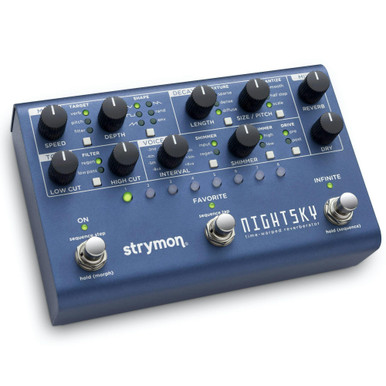
Strymon NightSky Time-Warped Reverberator Pedal

Retailing in the region of £399.00

On the menu for January 2026 are the Strymon Guitar Pedals, freshly added and carefully selected. These New units are available to order online with fast, secure delivery from trusted UK retailers. Read on for full details, specifications, demos, videos, reviews, and the best places to buy the Strymon Guitar Pedals today.


Spread the love

Description

Spread the love

On the menu for January 2026 are the Strymon Guitar Pedals, freshly added and carefully selected. These New units are available to order online with fast, secure delivery from trusted UK retailers. Read on for full details, specifications, demos, videos, reviews, and the best places to buy the Strymon Guitar Pedals today.

Strymon are the modern masters of digital effects. Their latest reverb workstation, NightSky, is one of the most comprehensive ambient stompboxes we've ever seen – offering unparalleled levels of tweakability and a myriad of gorgeous ethereal sounds.

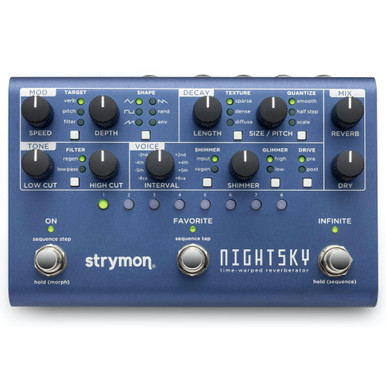
Boasting 3 selectable reverb types, an 8-step sequencer, immersive stereo connectivity, Mod/Tone/Decay/Voice sections, pre/post Drive effects and the ability to store 300 presets via MIDI – there really aren't many reverb pedals on the market that push the envelope as much as the magnificent Strymon NightSky!

Time-Warped Ambient Tones

The Strymon NightSky gives you the power to create vast and engulfing soundscapes, even from just a few notes on your instrument! It goes far beyond what traditional reverb stomps can deliver; allowing you to apply mind-bending pitch and harmonic manipulation with synth-esque filter sweeps. Strymon may be synonymous with guitarists, but its NightSky can transform any instrument into a mesmerising ambient machine.

Tactile Interface

NightSky is a feature-packed sound design platform with a superbly tactile interface. Providing real-time continuous control of reverb pitch/processing rate/core size, harmonics, a synth-like resonant filter with multiple modulation waveshapes and even a step sequencer with variable glide – you will have never encountered a device like this before. Make it the ambient centrepiece of your pedalboard and unlock more creativity from your playing, with no menu-diving to distract you!

Warp Core Reverb

Strymon's NightSky uses a 'Variable Process Rate' for its reverb core, letting you achieve some truly spellbinding sounds. Enabling you to simultaneously change the size of the reverb as well as the pitch, you can dial-in the the pitch change to be completely smooth or quantised to a variety of flourishing musical scales. Plus – it can be sequenced!

Harmonic Sculpture Machine

'Shimmer' allows you to shift NightSky's harmonic structure by selectable musical intervals – a fantastic feature for experimentalists. You can also add 'Glimmer' to dynamically enhance the harmonic spectrum for a more extreme effect.

A dynamic 'Drive' function is another noteworthy appointment, which generates saturated overdriven harmonics to distort reverb tails pre or post. You can then affect the resulting signal with NightSky’s synth-derived variable-resonance low-pass filter. This level of sonic-sculpting potential makes the Stymon NightSky an absolute game-changer!

Easy Preset Access

Despite NightSky's unrivalled amount of features, its easy-to-use interface makes on-the-fly ambient adjustments easy and also provides quick access to you favourite presets. Multiple buttons on the front panel let you choose from 16 stored patches that you can customise at any time. If that's not enough though, there's a whopping 300 preset locations available via MIDI!

Key Features

  • Three selectable reverb types offer a wide variety of ambient textures
  • MOD and Tone sections: various waveforms to modulate the reverb or tone filters/sculpt hi and low EQ of the reverb
  • VOICE section to enhance the aural spectrum of the reverb
  • Adjustable SHIMMER for adding pitch shifting of up to +/- 1 octave to the reverb
  • GLIMMER dynamically enhances high or low frequency harmonics for synth-like textures
  • MORPH allows you to footswitch-glide from one set of knob positions to another at any speed you choose!
  • Pre or Post DRIVE to add saturated overdriven harmonics to the reverb
  • Adjustable reverb core size to +/- the space for reflections plus independent REVERB and DRY level controls
  • 8-step sequencer to program rhythmic pitch variations of the reverb over time!
  • Access to 16 presets from the front panel and 300 presets via MIDI
  • High impedance ultra low-noise discrete Class A JFET preamp stereo inputs/low impedance stereo outs
  • Input Level switch allows for both instrument and line level signals
  • On, Favorite, and Infinite footswitches

Specifications

  • True Bypass (electromechanical relay switching) or selectable transparent Analog Buffered Bypass
  • Strong and lightweight anodized dark blue aluminum chassis
  • 9V DC power supply included
  • Power requirements: maximum 9 volts DC center-negative, with a minimum of 300mA of current
  • Dimensions: 4.5″ (Depth) x 7″ (Width) x 1.75″ (Height)
  • Designed and built in the USA

Additional information

Weight 1 kg

Brand

Strymon

Strymon is an American company renowned for producing high-end, digitally-powered guitar effects pedals that deliver studio-quality sound. Founded in 2009 as a part of Damage Control Engineering, Strymon quickly gained a reputation for its innovative approach to effects, particularly in areas like delay, reverb, and modulation. Their pedals are known for their pristine sound quality, versatility, and deep customization options, often utilizing powerful digital signal processing (DSP) to emulate and enhance analogue sounds. Strymon’s products, such as the Timeline delay, BigSky reverb, and Mobius modulation, are highly regarded by both professional and amateur musicians for their ability to create rich, complex soundscapes. The pedals also feature intuitive controls and rugged construction, making them a staple on pedalboards worldwide.

Category

Guitar Pedals

Tags

envelope filter

EQ

While Ed Sheeran primarily relies on the natural sound of his acoustic guitar and vocals, he occasionally uses EQ (Equalization) to shape and enhance his tone during live performances or in the studio. EQ pedals or onboard preamps can allow him to adjust the frequency response of his guitar signal to suit the acoustics of different venues or to achieve specific tonal characteristics. Here’s how EQ might be utilized in Ed Sheeran’s setup:

1. **Tonal Shaping**: EQ can be used to adjust the balance of frequencies in the guitar signal, allowing Ed Sheeran to shape his tone to his liking. For example, he might boost the midrange frequencies to bring out the warmth and presence of his acoustic guitar, or cut certain frequencies to reduce any harshness or mud in the sound.

2. **Feedback Control**: In a live setting, EQ can help control feedback by notching out problematic frequencies that might cause the guitar signal to feed back through the amplification system. This can be particularly useful when performing in venues with challenging acoustics or high volume levels.

3. **Room Correction**: In situations where the venue’s acoustics are less than ideal, EQ can be used to compensate for any deficiencies in the sound. By adjusting the EQ settings, Ed Sheeran can tailor the guitar tone to sound more balanced and natural, regardless of the room’s acoustic properties.

4. **Matching Gear**: EQ can also be used to match the tone of Ed Sheeran’s guitar to the sound of other instruments or equipment in his setup. For example, he might adjust the EQ to complement the tonal characteristics of his vocal microphone or to blend seamlessly with backing tracks or other instruments.

Overall, while EQ may not be a central component of Ed Sheeran’s guitar effects setup, it can still play a valuable role in shaping his tone and ensuring that he achieves the desired sound in different performance environments. Whether used subtly for tonal shaping or more aggressively for feedback control, EQ allows Ed Sheeran to tailor his guitar tone to suit his musical vision and performance needs.

Filter

MIDI

MIDI pedals use the Musical Instrument Digital Interface standard to communicate with other guitar pedals, effects units, and hardware. They allow control over presets, parameters, and switching across multiple devices from a single controller. MIDI integration makes it possible to build complex, synchronised pedal setups while keeping control simple and consistent.

New

This is brand new, fresh in, and a UK warranty is included. New Gear always comes from trusted UK music retailers.

Octave

An octave pedal shifts your guitar signal up or down by one or more octaves, blending the altered pitch with your original sound to create a fuller, more complex tone. It can add a deep, bass-like layer underneath your playing or a shimmering high octave on top for lead lines and solos. Classic analogue octave pedals often produce slightly gritty, organic sounds, while modern digital versions track more precisely and can offer multiple octave ranges.

Octave pedals are great for thickening single-note riffs, creating synth-style textures, or even mimicking bass parts when playing alone. They pair well with fuzz or overdrive pedals for massive, harmonically rich tones. Whether you’re after vintage Hendrix-style octave fuzz or a modern polyphonic sound that tracks chords cleanly, an octave pedal opens up a world of creative possibilities and adds real weight and character to your tone.

Pitch

Pitch pedals alter the frequency of your guitar signal, changing the perceived note or adding harmony. They can shift notes up or down by fixed intervals, create harmonies, or produce dive-bomb and whammy-style effects without a tremolo arm. Pitch shifters and harmonisers are great for thickening solos, simulating multiple guitars, or experimenting with creative, otherworldly sounds that expand your tonal range.

Preamp

A preamp pedal shapes and boosts your guitar’s signal before it reaches your amp or recording interface, giving you control over tone, gain, and headroom. It acts as the first stage of amplification, adding warmth, clarity, and character while preparing your signal for the next part of the chain. Some preamps emulate the response of classic valve circuits, while others offer clean, transparent tone shaping ideal for acoustic instruments or direct recording setups.

Used on its own, a preamp pedal can serve as the foundation of your tone, providing a consistent core sound wherever you play. When combined with other effects, it enhances dynamics and helps each pedal sound more defined and natural. Whether you’re looking to push your amp harder, bring life to a dull signal, or refine your sound for the studio, a good preamp pedal adds presence, punch, and musicality to any rig.

Reverb

A reverb pedal is like the rich sauce that ties every flavour on the plate into one smooth experience. It adds depth, warmth, and atmosphere — the sonic equivalent of a perfectly reduced glaze that lingers on the tongue. Whether you’re after the subtle ambience of a cosy café (spring or plate reverb) or the grand echoes of a cathedral (hall or shimmer reverb), this is where your tone breathes and expands. A touch of reverb can turn a dry sound into something lush and inviting — but pour on too much, and it’s all you can taste. Used with finesse, it’s the finishing touch that transforms your tone from plain to unforgettable.

Synth

A synth pedal transforms your guitar signal into rich, layered tones that mimic the sounds of a synthesiser. Using pitch tracking and waveform generation, it can produce everything from deep bass lines to shimmering pads and futuristic leads. Synth pedals open up a wide creative range, blending the expressiveness of guitar playing with electronic textures, making them ideal for experimental sounds, ambient music, or adding a modern edge to classic riffs.

Available for Amazon Prime