
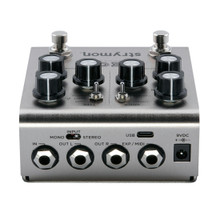
Description
Fresh on the menu for 2026 are the Strymon Guitar Pedals, freshly added and carefully selected. These New units are available to order online with fast, secure delivery from trusted UK retailers. Read on for full details, specifications, demos, videos, reviews, and the best places to buy the Strymon Guitar Pedals today.
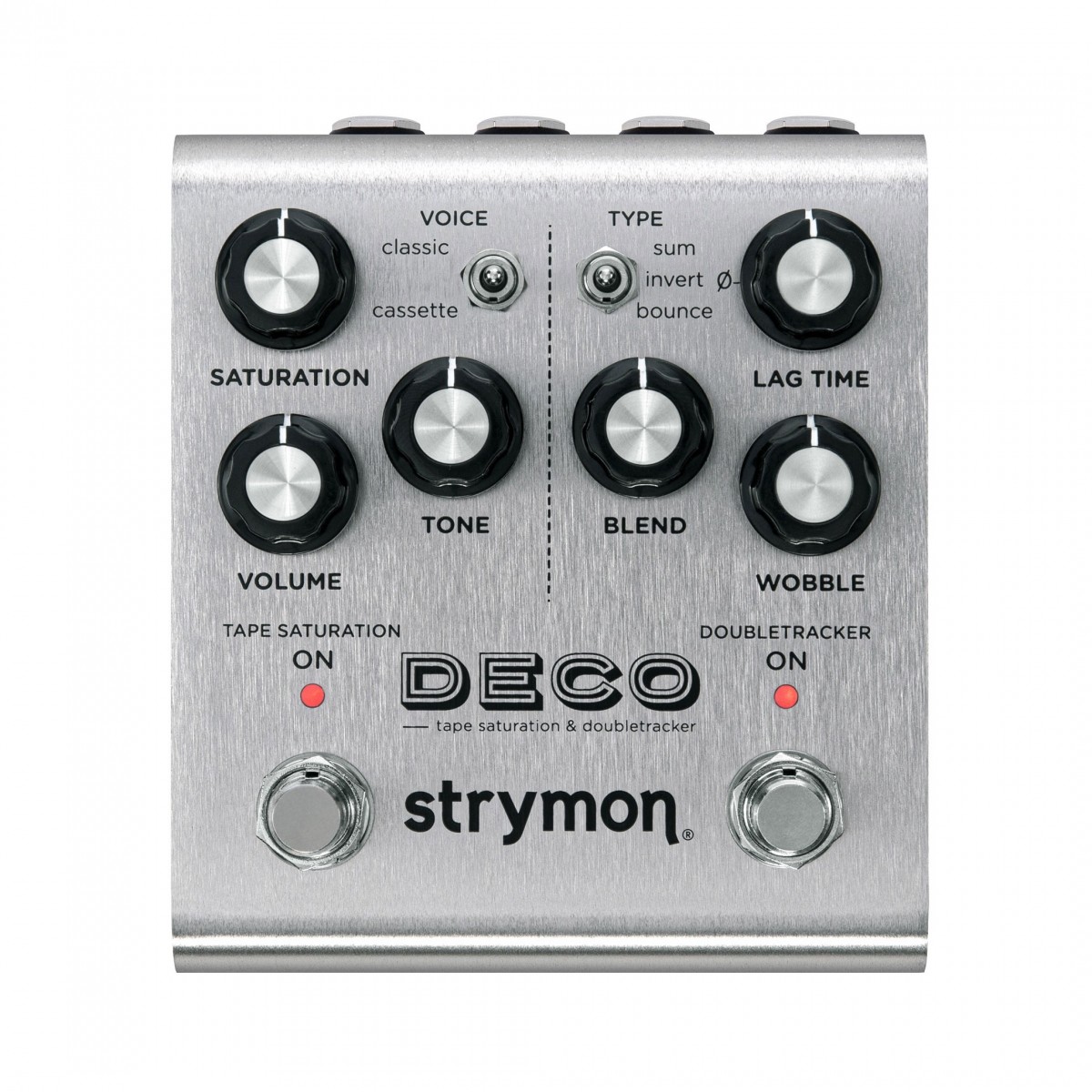
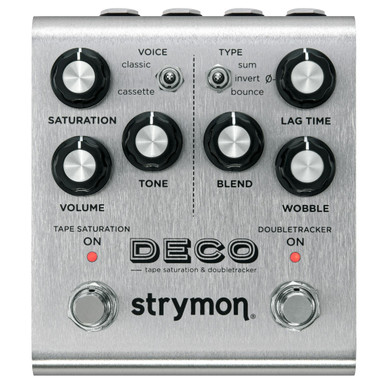
The Strymon Deco is not so much your typical effects pedal, but rather a tape simulation machine in a box, adding lush tape saturation and a “widening” effect to your sound. The Deco’s tape saturation smooths out your sound with tape-style compression, while the doubletracker feature thickens up your tone with subtle tape-driven transparent overdrive.
New for 2022, Strymon have updated the Deco with a number of improvements and technological advancements, making it even better than before (if that is even possible)! The Deco V2 now features an all-new cassette tape voicing feature for increased sonic flexibility and a tone control that allows you to set the level of tape saturation to your tastes. The Deco puts the much-loved vintage tape effects from the earliest recording studios right at your feet, in a pedalboard-friendly package.
Other upgrades include full MIDI implementation, a premium analogue JFET input circuit and a new and improved user interface, all whilst boasting the same great features that made the original Deco so popular!
Key Features
- MIDI – The Deco’s full MIDI implementation allows to you control every parameter remotely via MIDI commands, giving you complete control over the effect.
- True & Buffered Bypass – Chose between an electromechanical relay switched true bypass, which will keep your bypassed signal 100% untouched, or a high-quality buffered bypass that gives your signal a boost when using long cables runs.
- JFET Input – A high impedance ultra-low noise discrete Class A JFET preamp input delivers uncompromised dynamics and feel with a super-responsive touch.
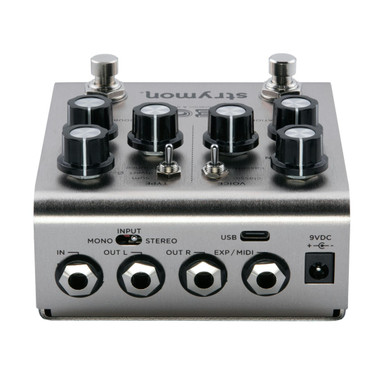
- Stereo In & Out – Deco features full stereo in/out capabilities allowing you to experience an immersive, wide stereo image in your stereo rig or recording environment.
- Line/Instrument Level – Deco’s adjustable input signal level makes it versatile option on stage and in the studio, for a number of a different instruments including synthesizers and keyboards.
Here’s what Strymon say about the Deco Tape Saturation & Double Tracker V2
Tape Saturation
Give your sound the smooth and warm qualities of analogue tape, along with the enhanced touch sensitivity and playing dynamics that are intrinsic to the inner workings of tape machines. Achieve incredible transparency at low levels, with reduced high frequency spikes and a harmonically rich low end. Turn up the Saturation to increase the amount of tape drive, dynamic compression and distortion.
Deco is perfectly suited for a last-in-chain, “always on” sweetening effect. Everything sounds better on tape. Want to push the limits of tape beyond what was originally possible? Use Deco as a tape-style transparent overdrive—crank the Saturation all the way up to “peg the meters” and gently overload the machine’s input.
Doubletracker
Go back to the early days of recording studios, where a few creative audio engineers discovered a new world of augmented sound by pushing the limits of studio tape machines. By inventing automatic doubletracking, they introduced echo, flanging, and chorus to the world of recorded music. Intensify and widen your sound with Deco’s Doubletracker controls. Turn the Lag Time to obtain classic slapback tape echo, spacious doubletrack chorusing, and mind-bending tape flanging.
Add random modulation with the Wobble control and go from very subtle movement to more extreme undulations—just like having a recording engineer vary the speed of the machine. Add warm dimensionality and luscious tape saturation to your signal. Teleport the tones of yesteryear to your board. Deco is a jack of all trades capable of creating a huge range of beautiful, distinctive, and enveloping vintage sounds.
Tape Saturation Controls
Deco’s Tape Saturation side features controls for dialing in everything from light, transparent saturation all the way to smooth, overdriven tape distortion.
The Saturation knob allows for a wide range of tones that range from subtle saturation and compression at lower levels, to transparent tape overdrive at its upper limits. An adjustable Volume control for Deco’s Tape Saturation lets you raise the output volume when using Deco as a boost, or dial it back to achieve unity gain.
Our new generation of Deco features a dedicated Tone knob that lets you adjust the tone of your Tape Saturation, from darker to brighter. The new generation of Deco also introduces a Voice switch for an expanded range of available sounds. The Voice switch has two settings:
- Classic: produces the response and saturation characteristics of 2-track mastering reel to reel tape machines.
- Cassette: employs an auto level control (ALC) process common to many high-end cassette tape recorders, resulting in a musically compressed, fat tone and a great-feeling response.
Blend Type
Adjusts phase and internal routing to customize tone and low-end response:
- Sum: decks are in phase
- Invert: Lag Deck is phase inverted
- Bounce: right Lag Deck is bounced to left input for stereo ping-pong or mono double-echo
Lag Time
Simply by turning Deco’s Lag Time knob, you can unlock a whole variety of organic, tape based modulation and delay effects. When adjusting the delay offset between Deco’s reference deck and the Lag Deck with the Lag Time knob, you can achieve everything from tape flanging at lower settings (-.3 to 3ms), increase that a bit for lush tape chorusing (3 to 50ms), followed by snappy slapback delay at longer delay times (50 to 150ms), all the way to spaced out tape echoes (150 to 500ms).
Doubletracker Controls
In addition to Lag Time, Deco’s Doubletracker features additional controls to help you achieve a wide variety of tape based effects. The Blend control sets the mix level between Deco’s Lag Deck and Reference Deck, and can be lowered to hear more of the Reference Deck for less doubletracking, or raised if you want to hear more of the doubletracking effect.
Deco’s Wobble knob adds random tape speed based modulations to the Lag Deck. Go from very subtle movement to more extreme undulations — just like having a recording engineer vary the speed of the machine. Wobble is super handy to increase the depth of the modulation effect you hear when Lag Time is set to act as a tape flanger/chorus, or use it to add modulation to the Lag Deck when set as a slapback or tape echo.
Wide Stereo
Deco gives you the option for extremely wide stereo imaging to broaden and intensify the sound of your stereo rig. Wide Stereo Mode sends the mono input (summed if using a stereo input) to the Left channel through the Reference Deck, and to the right channel via the delayed Lag Deck to create an adjustable stereo spread. The Blend control acts like a pan control by adjusting the relative levels of the two tape decks.
Auto-Flange
Press and hold the Doubletracker Bypass footswitch to achieve a recording studio-inspired through-zero flange effect. This engages a “virtual audio engineer” manning the faders and tape reels to create a smooth and predictable through-zero flange experience on the fly. After releasing the footswitch, the controls are smoothly returned to their previous settings.
Specifications
Ins, Outs, and Switches
- High impedance ultra low-noise discrete Class A JFET TRS stereo input.
- Low impedance independent TS stereo outputs.
- Expression pedal input allows the connection of a TRS expression pedal, MiniSwitch, MultiSwitch Plus, or TRS MIDI connection.
- USB jack for controlling via MIDI from a computer or for performing firmware updates.
- Dedicated Tape Saturation On/Off & Doubletracker On/Off footswitches
Audio Quality
- Premium JFET analogue front end
- Ultra low noise, high performance 24-bit 96kHz A/D and D/A converters provide uncompromising audio quality
- 520MHz ARM Superscalar processor
- 32-bit floating point processing
- 20Hz to 20kHz frequency response
- Audio Input Impedance: 1M Ohm
- Audio Output Impedance: 100 Ohm
More
- Strong and lightweight anodized dark grey aluminum chassis
- Power requirements: maximum 9 volts DC center-negative, with a minimum of 300mA of current.
- Dimensions: 4.5” deep x 4” wide x 1.75” tall (11.4 cm deep x 10.2 cm wide x 4.4 cm tall)
- Designed and built in the USA