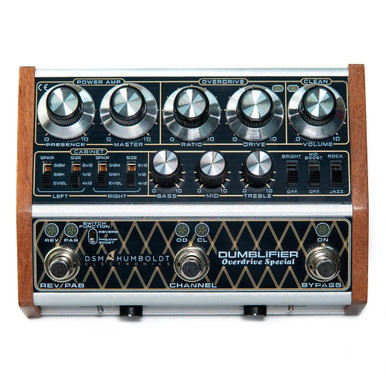
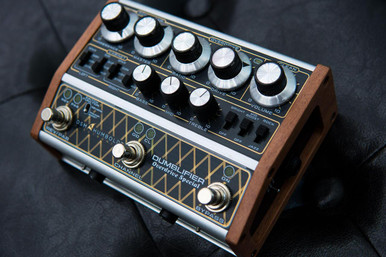

Description
Fresh on the menu for 2026 are the DSM & Humboldt Guitar Pedals, freshly added and carefully selected. These New units are available to order online with fast, secure delivery from trusted UK retailers. Read on for full details, specifications, demos, videos, reviews, and the best places to buy the DSM & Humboldt Guitar Pedals today.
For decades, guitarists around the world have dreamed of capturing the magic of the mythical Dumble Overdrive Special. Until now, the only way to approximate this experience has been through digital modelling—solutions that may reproduce the sound, but always fall short of replicating what truly makes these amps legendary: the feel under your fingers.
The Dumblifier Overdrive Special by DSM Humboldt Electronics breaks that barrier. By using our proven analogue amplifier modelling technology, we have not only recreated the tone but also the unique compression and touch response that makes every note bloom, sustain, and sing—just like on the original amps.
The Dumblifier is based on a painstaking analysis of every bit of information, schematics, videos, recordings and testing actual Dumble amps, specifically the 70’s Dumble Overdrive Special. A legendary amp used by the most exigent players, each amp was tailored specifically for the owner. However, they all shared a common structure and design philosophy that produced a very special, compressed and punchy characteristic response, which we carefully replicated stage by stage.
Sound-wise, the ODS is an extremely versatile amp; the clean tones are pristine and punchy and at higher levels, the clipping is smooth and fat. The Overdrive channel is silky and every note sings in response to your playing style. But the most impressive thing that we experienced with real Dumbles, was the note recovery rate, a punchy attack with a very long sustain that invites you to hang on to the notes as they ring, varying the harmonic content, getting infinite sustain very easily. We managed not only to achieve the tones, but also this incredible FEEL of the amps.
Stereo Cabinet Simulation
For each channel (left and Right) you can select the Speaker type and the Cabinet Type –
- Speaker Type:
- G12M: Greenback Speaker, defined highs and ready to Rock.
- G12H: Cream Back, smooth and jazzy.
- EV12L: Sparkly, detailed, and with a lot of bite.
- Cab Type:
- 2×12: Open Back 2×12 with present Mids and round overall response with extended low end.
- 1×12: Open Back 1×12 Combo. Less boomy, presence in the higher midrange.
- 4×12: Closed Back Stack. Strong resonant low end and flatter response.
Favourite combinations
- EV12L+2×12: Clear and punchy, nice SRV strat tones, with defined attack, but with extra note weight.
- G12H + 2×12: Super smooth lead tones, incredible for jazz fusion solos.
- G12M + 4×12: Aggressive, more “marshall-like” rock tones.
- G12M +1×12: More balanced, versatile rock tones, clarity in the mix.
Key Features
- 2 channels: CLEAN and OVERDRIVE. The clean Channel is in series with the Overdrive Channel, so the Clean level affects the gain of the Overdriven tones. Both Channels share the EQ and preamp tone switches. The Overdrive Channel has Gain and Ratio controls. The Ratio controls the level of the OD channel to balance it with the Clean Channel Level.
- PAB Boost: The PAB (Pre-Amp-Boost) is a staple feature on every Dumble ODS amp. It bypasses the tone stack, adding around 10dB (depending on the EQ settings) to the preamp gain. Note: The Tonestack is defeated when the PAB is activated.
- Bright Switch: Boosts the high frequencies at lower Clean levels. At full clean level, it has no effect.
- Mid Boost Switch: Boosts the mid and low mid range, producing a full-bodied tone, very nice with single coils!
- Rock/ Jazz Switch: Changes the behaviour of the tone stack. Rock is a classic FMV tonestack, and Jazz is a Baxandall-James configuration. Jazz mode has less gain, but increased band independence and range.
- Power amp section: The Dumblifier replicates the nuances of the Dumble power amp design. The clean Level and RATIO volumes set the input gain into the power amp, so you can adjust the power amp compression and drive by setting the Power Amp Master Level in conjunction with the Ratio and Clean Level. Higher preamp levels and low master gives more compression and vice versa. The presence controls the amount of mid-hi and high frequencies. It has a wide range in order to adapt the pedal to different types of amplifiers. Turn it down if the amplifier is bright, turn it up if the amp is dark, or using it into the FX return of an amp.
- Stereo FX loop: The FX loop has a mono send from the amplifier’s output, and a dual return. For mono effects, use the left (mono) return.
- Stereo Reverb: After the FX loop, a stereo reverb effect is applied to the signal. You can control the amount of reverb with the REVERB knob in the front of the pedal, and select 3 types of reverb (Room, Ethereal, and Plate). The Reverb can be switched On and Off with the REV/PAB footswitch when the footswitch function switch is on the “REV” position.
Specifications
- Input boost switch: The Dumble ODS features a JFET boost input. The Input Boost switch gives you the option to boost -8dB (Low) or +12dB (High). Low-output guitars benefit from a low boost to get the most of the Dumblifier. Also, on high boost, you can use the clean channel as a crunch channel and clean it up with the guitar volume knob.
- Aux select switch: Selects if the Aux signal is reproduced only on the headphones or also on the outputs.
- DI out: DI out Left and Right. The Cabinet simulation is always activated on these outputs.
- TR Outs (R&L): The TR outputs have switches to select if the cabinet simulation is included or not. Use Cab bypass if connecting to a guitar amplifier (input or FX return) or if using an external cabinet simulation. Use a Cabinet simulation if using a flat (FRFR) response amplifier, or into a mixing console or recording board.
- HEAVY DUTY, custom-made anodised aluminium enclosure with a sandblasted finish. Wooden side panels add a unique touch and premium feel.
- LOW POWER CONSUMPTION: 200mA / 9V center negative
- COMPACT SIZE: 13,5×11,5×6.5 cms — 5,5x 4,4×2.5 inches
- Weight: 420g