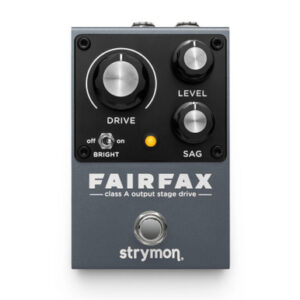
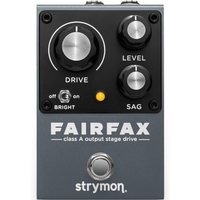
Strymon Fairfax Class A Output Stage Drive Pedal

Retailing in the region of £199.99

On the menu for January 2026 are the Strymon Guitar Pedals, freshly added and carefully selected. These New units are available to order online with fast, secure delivery from trusted UK retailers. Read on for full details, specifications, demos, videos, reviews, and the best places to buy the Strymon Guitar Pedals today.


Spread the love

Description

Spread the love

On the menu for January 2026 are the Strymon Guitar Pedals, freshly added and carefully selected. These New units are available to order online with fast, secure delivery from trusted UK retailers. Read on for full details, specifications, demos, videos, reviews, and the best places to buy the Strymon Guitar Pedals today.

Unlike many units we associate with gain and overdrive, Fairfax isn’t really a distortion pedal. Instead, it’s a complete miniature amplifier in 100% analogue form, based upon a little-known device from the 60s that powered a number of classic rock anthems.

The sound and feel are extremely tube-like, with added harmonics and saturation coming from a clever circuit that emulates the critical behaviour of a tube amp’s output transformer. It’s a drive pedal that feels completely natural to play, retains the natural sound of your guitar, and glues notes together in a truly organic way.

The Story

Fairfax was inspired by the original Garnet Amplifiers Herzog® unit designed for Randy Bachman in 1965. Bachman wanted the sustain of a cello for his electric guitar, so he started running the speaker output of a small combo amplifier into the input of another larger amplifier while chasing that sound.

Unfortunately, that scenario has a tendency to blow up the combo amplifier (sometimes in dramatic fashion!), so Bachman enlisted Gar Gilles to design a device that would behave in a similar way but not actually catch fire. Gar’s design ended up being a small tube amp based around a 12ax7 and 6v6 tube, with a built-in speaker load so that it wouldn’t blow up. The result is the classic sustaining lead sound from songs like “American Woman” by The GuessWho.

More Than A Drive Pedal

Fairfax began as an engineering experiment, with the goal being to recreate all of the critical elements of the original circuit fully in the analogue domain, but small enough to fit into a pedal enclosure. With JFETs in place of the tube stages and an ingenious custom circuit that emulates the characteristics of the output transformer (which is integral to the sound), Fairfax delivers the real-deal performance of the original unit, without the need for a 250V tube power supply.

There’s even a variable Sag circuit that behaves just like a real tube amp does, by dynamically varying the amount of available current to the preamp and power amp sections independently, based upon how much signal is being sent to the power amp and how hard the guitar is played. At low Sag values, the behaviour is mild and closer to a solid state rectifier, and at max value,s the JFETs can go crazy and unbias – which gates the input, leading to spitting and chortling sounds more commonly associated with gated fuzzes.

In order for Fairfax to behave like a real amplifier, it needed a ton of operating voltage, so a transformer-based power supply converts the 9VDC input voltage to 40V internally. This gives Fairfax the power that it needs for high headroom and amp-like feel, allowing for a wide range of tones.

At lower Gain settings, Fairfax remains sweet, gently pushing the input to your amp with additional harmonic richness. At higher Gain levels, the sound can become angular, compressed and much more aggressive, depending on the guitar that’s driving it, and the large range of gain on tap allows Fairfax to be used in nearly any setup imaginable.

Works The Way You Need It To

Because it’s based upon a tube amp design, Fairfax plays well with all different types of amplifiers and amp modellers. The creamy sustain brings something new to both clean and naturally dirty amplifiers.

We’ve even included an internal jumper that determines the power-up state, so if you plan on using Fairfax with a pedal loop switcher, you can choose to have it turn on automatically when powered up. This saves you the step of turning the pedal on manually every time, which is a lifesaver on a dark stage or with a complex setup.

The Controls

The Level Control sets the output level for the pedal. Lower settings send less total output signal to your amplifier, no matter where the other two knobs are set.

The Drive Control determines the amount of preamp gain. Working in tandem with the Level control, you can determine precisely how you’d like to drive your amplifier – with a bunch of crunch dialled in, as a clean boost, or anything in between.

The variable Sag control allows you to fine-tune the behaviour of the Sag circuit, where the amount of Sag is dependent on both the level being sent to the power amp section and on your playing style. It’s fully dynamic, meaning that light playing may not change the sag/compression character much at al,l even at high settings, while digging in hard with big strings might produce more artefacts even at much lower pot values.

The Bright switch determines the high-frequency contour. With the switch set to ‘Off’ high frequencies are attenuated somewhat, smoothing out the frequency response. Set to ‘On’, the high frequencies are left untouched, giving you a brighter response with more treble.

Series A

Killer code only sounds killer when it’s hosted inside of an ideal analogue environment, and even though we’re primarily known for our DSP prowess, our stuff wouldn’t sound the way that it does without our strong analogue team.

The analogue guys are always coming up with interesting designs, so we’ve launched the ‘Series A’ line of pure analogue pedals to give them an outlet, with Fairfax being the first to be released.

The designs you’ll be seeing in ‘Series A’ are intended to offer something different from traditional Strymon offerings, with minimal use of MIDI, USB, presets or any other type of external modern enhancements. These will be pedals that are unabashedly analog, which means it could get really interesting! Keep an eye out for more ‘Series A’ pedals as we go forward.

Key Features

  • Complete tube amp circuit fully recreated in 100% analogue
  • Custom analogue circuits recreate multiple tube stages and the critical output transformer
  • Input voltage converted to 40V internally via galvanically isolated power supply
  • Controls for Drive, Level and a variable Sag control
  • Bright switch allows fine-tuning of the high frequency response
  • Wide range of natural sounding and tube amp-like gain for maximum versatility
  • Sag circuit allows mild Sag effects at lower settings and spitting and gated sounds at max

Specifications

  • Input Impedance: 1M Ohm
  • Output Impedance: 100 Ohms
  • Circuit: Analogue
  • Max. Input Level +20dBu
  • Audio: Mono
  • Signal/Noise: 114dB typical
  • Bypass: True Bypass (electromechanical relay switching)
  • Dimensions: 4.38 x 2.83 x 1.57 inches 11.1 x 7.2 x 4.0 cm
  • Power: 9VDC, center negative, 500mA min. (sold separately)

Additional information

Weight 0.8 kg

Brand

Strymon

Strymon is an American company renowned for producing high-end, digitally-powered guitar effects pedals that deliver studio-quality sound. Founded in 2009 as a part of Damage Control Engineering, Strymon quickly gained a reputation for its innovative approach to effects, particularly in areas like delay, reverb, and modulation. Their pedals are known for their pristine sound quality, versatility, and deep customization options, often utilizing powerful digital signal processing (DSP) to emulate and enhance analogue sounds. Strymon’s products, such as the Timeline delay, BigSky reverb, and Mobius modulation, are highly regarded by both professional and amateur musicians for their ability to create rich, complex soundscapes. The pedals also feature intuitive controls and rugged construction, making them a staple on pedalboards worldwide.

Category

Guitar Pedals

Tags

Boost

Compressor

Distortion

Distortion pedals take your clean guitar signal and transform it into something bigger, bolder, and full of attitude. By clipping the waveform, they add sustain, bite, and aggression, creating that thick, compressed tone that’s powered rock music for decades. From the growling crunch of classic hard rock to the tight, saturated roar of modern metal, distortion is all about energy and presence. It gives every note weight and authority, pushing your amp to its limits and beyond.

There are countless flavours of distortion, each with its own texture and edge. Some sound smooth and creamy, others raw and gnarly like tearing fabric. It’s the sonic equivalent of turning up the heat until the sound cooks — rich, sizzling, and perfectly seasoned to taste. Whether used for rhythm muscle or soaring leads, a good distortion pedal doesn’t just add volume; it adds personality, grit, and that unmistakable sense of power under your fingers.

MIDI

MIDI pedals use the Musical Instrument Digital Interface standard to communicate with other guitar pedals, effects units, and hardware. They allow control over presets, parameters, and switching across multiple devices from a single controller. MIDI integration makes it possible to build complex, synchronised pedal setups while keeping control simple and consistent.

New

This is brand new, fresh in, and a UK warranty is included. New Gear always comes from trusted UK music retailers.

Overdrive

Like a golden layer of melted cheese — warm, gooey, and just put it all over. It adds just the right amount of richness and grit, turning a clean signal into something smooth and savoury. Designed to mimic the natural breakup of a tube amp pushed to its sweet spot, overdrive delivers the flavour of classic rock and blues in every bite. From creamy mid-gain warmth to crisp edge-of-breakup sparkle, it’s the comfort food of guitar tone — simple, satisfying, and endlessly versatile. Whether it’s a mild crunch or a full-bodied roar, overdrive is where good taste begins.

Preamp

A preamp pedal shapes and boosts your guitar’s signal before it reaches your amp or recording interface, giving you control over tone, gain, and headroom. It acts as the first stage of amplification, adding warmth, clarity, and character while preparing your signal for the next part of the chain. Some preamps emulate the response of classic valve circuits, while others offer clean, transparent tone shaping ideal for acoustic instruments or direct recording setups.

Used on its own, a preamp pedal can serve as the foundation of your tone, providing a consistent core sound wherever you play. When combined with other effects, it enhances dynamics and helps each pedal sound more defined and natural. Whether you’re looking to push your amp harder, bring life to a dull signal, or refine your sound for the studio, a good preamp pedal adds presence, punch, and musicality to any rig.

Switcher

Switcher refers to a guitar pedal or pedalboard unit that allows multiple pedals or signal paths to be controlled from a single device. A switcher can turn several pedals on or off at once, change signal order, or recall preset combinations, helping players manage complex pedal setups cleanly and reliably, especially in live situations.

used

Available for Amazon Prime