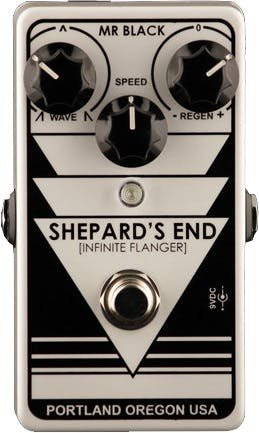
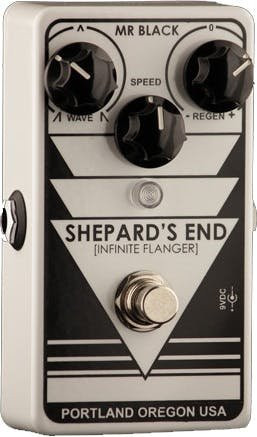
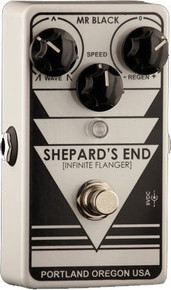
Mr Black Shepards End Flanger Pedal

Retailing in the region of £169.99

On the menu for January 2026 are the Mr. Black Guitar Pedals, freshly added and carefully selected. These New units are available to order online with fast, secure delivery from trusted UK retailers. Read on for full details, specifications, demos, videos, reviews, and the best places to buy the Mr. Black Guitar Pedals today.


Spread the love

Description

Spread the love

On the menu for January 2026 are the Mr. Black Guitar Pedals, freshly added and carefully selected. These New units are available to order online with fast, secure delivery from trusted UK retailers. Read on for full details, specifications, demos, videos, reviews, and the best places to buy the Mr. Black Guitar Pedals today.

Mr Black make some of the most interesting pedals in the world. They don’t just look at how to improve an effect, they look at how they can create something new and unique to them. Their latest release the Shepard’s End is unlike any flanger effect you would have heard before as it is an infinite flanger. This means it never stops going up and never stops going down it does either continuously even through the zero point for that extra bit of impact.

Barber Pole Flanger

This is the worlds first barber pole zero flanger. What does this mean? It means that while a normal flanger goes up and then down within a certain range the Shepard’s End goes up or down continually. This produces a really powerful flanger effect that can cover the subtle to the extreme and it can even reach the loved zero point where both up and down phase with each other to create a really over the top effect.

Three Controls, Incredible Possibilities.

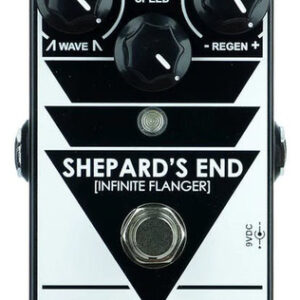
With just three controls you really can take full advantage of this magical circuit. The Wave control sets the movement of the wave to up or down and somewhere in the middle is the zero point. The Regen control which when turned clockwise gives you full phaser like sounds and turned counter clockwise offers up very hollow almost tubular like tones. Finally the speed control is what finishes off this pedal and it has a massive range. You can easily take this pedal from a real, dragging slow effect to so fast you can’t tell where each movement of the flange begins.

Here’s what Mr Black say about the Shepards End Flanger

This is:  the world’s first Barber Pole Through-Zero Flanger.

So what is a ” barber pole through-zero flanger-“
Well, essentially, the Shepard’s End is a flanger, but its unlike any flanger you’ve ever heard, played or experienced.  While the term “Barber Pole” sounds neat-o-speed-o, what it really means is that this flanger does not have a beginning, or an end to its cycle.  WHAT-!

You know how most flangers go up, then back down-  Well, this one doesn’t do that.  Nope.  It goes up, continually.  It goes down, continually.  It can even go through the zero-point (that amazing over the top wooshing sound you hear on so many records), continually.  This just depends on how you set the controls.  And they’re pretty easy to use.

As if that weren’t enough, you get both positive (swishy, phaser-y sounds) and negative (tubular, hollow, sucking-into-itself sounds) regeneration control.  Or, just raw through-zero flanging at its finest as you have heard on so many recordings.

From draggingly slow to space-ray-gun fast.  And its all in one little knob called “Speed”

This is the future.  This is the past.  This is, the Shepard’s End.

Specifications

  • True, infinite through-zero flanging
  • Additive or subtractive regeneration
  • True-bypass
  • 9VDC power (2.1mm negative center pin adapter) or internal 9V battery

Controls:
WAVE: Adjusts shape of flange wave

  • Full CCW: Upward Cycle
  • Middle: “Through-zero” Cycle
  • Full CW: Downward Cycle

SPEED: Adjusts speed of sweep

  • Full CCW: Really slow
  • Full CW: Lazers

REGEN: Adjusts regeneration

  • Full CCW: Max. negative regen
  • Middle: No regen
  • Full CW: Max. positive regen

BYPASS SWITCH: Toggles on/off

  • LED on: TO INFINITY!!
  • LED off: bypass.

Tech stuff:
 Input impedance: ~500K
 Output impedance: ~2K
 Bypass: True-Bypass
 Current draw: <60mA
 Power requirement: 9VDC adapter or 9V battery


Additional information

Weight 0.5 kg

Category

Guitar Pedals

Tags

Flanger

A flanger is a type of guitar effects pedal used to create a swirling, whooshing sound by modulating the phase of an audio signal. It works by combining the original signal with a slightly delayed and modulated version of itself. As the two signals interact, they create peaks and troughs in the frequency spectrum, resulting in the characteristic “jet plane” or “swooshing” sound associated with flanging.

Key features of a flanger pedal include:

1. **Rate**: Controls the speed at which the delayed signal is modulated. Higher rates produce faster modulation, while lower rates create slower, more subtle effects.

2. **Depth**: Adjusts the intensity of the modulation effect. Higher depth settings result in more pronounced sweeps, while lower settings produce a gentler effect.

3. **Manual (or Range)**: Sets the center frequency of the modulation. This control allows you to focus the effect on specific frequency ranges, altering the tonal character of the flanging.

4. **Feedback (or Regeneration)**: Determines the amount of modulated signal that is fed back into the effect. Increasing feedback can create more pronounced peaks and troughs, resulting in a more intense effect.

Flanger pedals are commonly used in various music genres, including rock, metal, and psychedelic music, to add movement, depth, and texture to guitar tones. They can be used subtly to add a touch of modulation and dimension to a guitar sound, or more prominently to create dramatic swirling effects. Overall, flanger pedals offer guitarists a versatile tool for shaping and enhancing their tone, adding a dynamic and expressive element to their playing.

New

This is brand new, fresh in, and a UK warranty is included. New Gear always comes from trusted UK music retailers.

Phaser

A phaser is a type of guitar effects pedal that creates a swirling, sweeping sound by modulating the phase of the audio signal. It works by splitting the incoming signal into two paths, shifting the phase of one path, and then recombining them. This creates peaks and troughs in the frequency spectrum, resulting in a distinctive, “phasing” effect characterized by moving notches in the frequency response.

Here’s how a phaser pedal typically works and some common features:

1. **Rate**: The rate control adjusts the speed at which the phase-shifting effect oscillates. Increasing the rate produces faster modulation, creating a more pronounced swirling effect, while decreasing the rate slows down the modulation for a smoother, more subtle effect.

2. **Depth**: The depth control adjusts the intensity or depth of the phase-shifting effect. Higher depth settings result in more pronounced peaks and troughs in the frequency response, while lower settings produce a more subtle modulation.

3. **Feedback (or Regeneration)**: Some phaser pedals feature a feedback control that determines the amount of modulated signal fed back into the effect. Increasing the feedback creates more pronounced peaks and troughs in the frequency spectrum, resulting in a more intense and resonant phasing effect.

4. **Stages**: Phasers typically have multiple stages (usually four, six, or eight), each of which contributes to the overall phase-shifting effect. More stages generally result in a more complex and textured phasing sound.

5. **Sweep (or Manual)**: The sweep control adjusts the center frequency of the phase-shifting effect. This allows you to focus the phasing effect on specific frequency ranges, altering the tonal character of the modulation.

6. **Resonance (or Feedback)**: Some phaser pedals feature a resonance control that emphasizes the peaks and troughs in the frequency response, creating a more pronounced and resonant effect. This control can add richness and depth to the phasing sound.

Phaser pedals are commonly used in various music genres, including rock, funk, and psychedelic music, to add movement, depth, and texture to guitar tones. They can be used to create swirling, swirling effects on rhythm parts, add dynamics to lead lines, or create atmospheric textures for ambient music. Overall, phaser pedals offer guitarists a versatile tool for shaping their tone and adding expressive modulation effects to their playing.