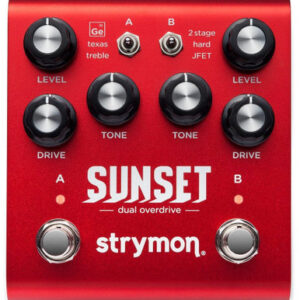
Strymon Sunset Dual Overdrive Pedal

Retailing in the region of £299.00

On the menu for January 2026 are the Strymon Guitar Pedals, freshly added and carefully selected. These New units are available to order online with fast, secure delivery from trusted UK retailers. Read on for full details, specifications, demos, videos, reviews, and the best places to buy the Strymon Guitar Pedals today.


Spread the love

Description

Spread the love

On the menu for January 2026 are the Strymon Guitar Pedals, freshly added and carefully selected. These New units are available to order online with fast, secure delivery from trusted UK retailers. Read on for full details, specifications, demos, videos, reviews, and the best places to buy the Strymon Guitar Pedals today.

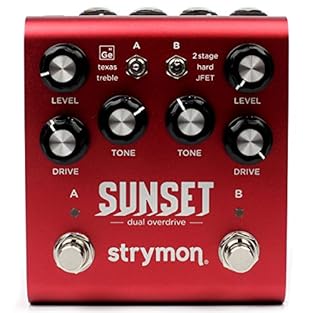
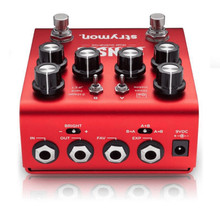
The feature-packed Sunset Dual Overdrive has all of the modern functions that you'd expect from Strymon — including the ability to connect a 'Favourite' switch to recall your best settings, and an expression pedal input to control volume or certain parameters of the drive. This will allow you to explore new sonic territory, with brilliantly detailed and flexible gain sounds!

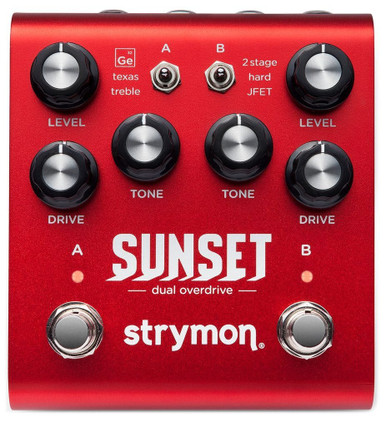
In order to make the most versatile drive pedal possible, Strymon studied 6 different circuit topologies and captured them on 2 different channels. You can easily switch through these with a mini toggle at the top of the pedal for each channel.

Channel A

  • Germanium — The 'Ge' overdrive combines the softer response of germanium diodes with a parallel path that blends in the dry signal as the Drive knob is lowered. At higher gain, the lower-midrange frequencies are emphasized to create a tight, thick response. This overdrive really fattens up single-coil pickups, and responds with a bold push when paired with humbuckers.
  • Texas — The 'Texas' overdrive employs a single stage soft-clipper configuration that is filtered before and after the gain stage, to create a smooth and dynamic overdrive. The original signal dynamics are retained as the gain is increased; perfect for playing the blues or just fattening up your sound with a signature midrange bump.
  • Treble (Boost circuit) — The 'Treble' type is a treble booster that removes the low frequencies as the Tone knob is turned up; great for tightening up an overdriven amp, or driving another gain pedal that's a bit looser on the low-end. Turning the Tone control down brings in the low-end, making for a flexible all-around boost.

Channel B

  • 2 Stage — The '2 Stage' overdrive combines a soft-clipping stage followed by a hard-clipping stage, creating a complex overdrive with a wide range of gain. Its EQ structure preserves the low-end while adding some muscle to push your amp. This overdrive can easily take you from lightly clipped to beefy saturation!
  • Hard — The 'Hard' overdrive uses a single-stage hard-clipping circuit that has a ton of available gain, approaching fuzz territory with the Drive knob maxed. At lower gain, mildly-clipped transparent tones are achieved. The wide-ranging Tone knob lets you shape the top-end from smooth to buzzy.
  • JFET (Boost Circuit) — The 'JFET' type is a clean boost that subtly beefs up your signal with the dynamics and responsiveness created from the JFET front-end. As you turn up the drive, the signal gets rounded and warmer. The is a great option when your amp just "needs a little extra".

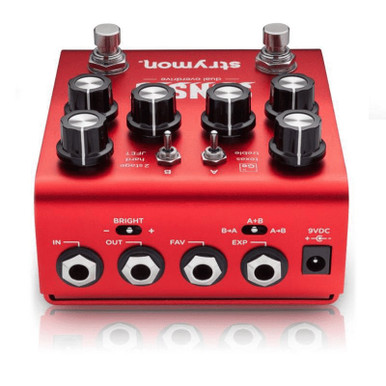
The best way to think of the sunset is as two separate drive pedals in one box. You can stack the drives or use them separately with loads of different outcomes. And with a small toggle right on the back of the pedal, you can switch the order that they go in like A>B or B>A or even run two circuits in parallel!

Specifications

Sound Design

  • Six drive circuit topologies with custom-tuned voicing for each drive type.
  • Precision crafted drive circuits stackable in multiple combinations for a wide variety of complex, responsive tones.
  • Analog class A JFET input gain stage maximizes headroom while adding up to 20dB of pure analogue gain.
  • Drive and Tone control ranges optimized for each circuit topology.
  • Series, reverse series, and parallel drive circuit stacking via Config switch.
  • Bright switch to tailor the sound for use with all amplifiers from dark to bright.
  • Optional variable-threshold noise reduction for taming noisy guitar pickups.

Ins, Outs & Switches

  • High impedance mono input.
  • Mono output.
  • 'Favourite' input to connect an external MiniSwitch to recall a favourite preset.
  • Expression pedal input allows the connection an expression pedal for simultaneous morphing control over multiple parameters (Expression mode), or logarithmic taper for smooth volume control (Volume mode).
Additional information

Weight 0.61 kg

Brand

Strymon

Strymon is an American company renowned for producing high-end, digitally-powered guitar effects pedals that deliver studio-quality sound. Founded in 2009 as a part of Damage Control Engineering, Strymon quickly gained a reputation for its innovative approach to effects, particularly in areas like delay, reverb, and modulation. Their pedals are known for their pristine sound quality, versatility, and deep customization options, often utilizing powerful digital signal processing (DSP) to emulate and enhance analogue sounds. Strymon’s products, such as the Timeline delay, BigSky reverb, and Mobius modulation, are highly regarded by both professional and amateur musicians for their ability to create rich, complex soundscapes. The pedals also feature intuitive controls and rugged construction, making them a staple on pedalboards worldwide.

Category

Guitar Pedals

Tags

Boost

EQ

While Ed Sheeran primarily relies on the natural sound of his acoustic guitar and vocals, he occasionally uses EQ (Equalization) to shape and enhance his tone during live performances or in the studio. EQ pedals or onboard preamps can allow him to adjust the frequency response of his guitar signal to suit the acoustics of different venues or to achieve specific tonal characteristics. Here’s how EQ might be utilized in Ed Sheeran’s setup:

1. **Tonal Shaping**: EQ can be used to adjust the balance of frequencies in the guitar signal, allowing Ed Sheeran to shape his tone to his liking. For example, he might boost the midrange frequencies to bring out the warmth and presence of his acoustic guitar, or cut certain frequencies to reduce any harshness or mud in the sound.

2. **Feedback Control**: In a live setting, EQ can help control feedback by notching out problematic frequencies that might cause the guitar signal to feed back through the amplification system. This can be particularly useful when performing in venues with challenging acoustics or high volume levels.

3. **Room Correction**: In situations where the venue’s acoustics are less than ideal, EQ can be used to compensate for any deficiencies in the sound. By adjusting the EQ settings, Ed Sheeran can tailor the guitar tone to sound more balanced and natural, regardless of the room’s acoustic properties.

4. **Matching Gear**: EQ can also be used to match the tone of Ed Sheeran’s guitar to the sound of other instruments or equipment in his setup. For example, he might adjust the EQ to complement the tonal characteristics of his vocal microphone or to blend seamlessly with backing tracks or other instruments.

Overall, while EQ may not be a central component of Ed Sheeran’s guitar effects setup, it can still play a valuable role in shaping his tone and ensuring that he achieves the desired sound in different performance environments. Whether used subtly for tonal shaping or more aggressively for feedback control, EQ allows Ed Sheeran to tailor his guitar tone to suit his musical vision and performance needs.

Expression

Expression pedals allow real-time control over specific parameters on compatible guitar pedals, such as volume, delay time, modulation depth, or filter sweep. Used with an expression input, they let players shape effects dynamically with their foot, adding movement and performance control that cannot be achieved with fixed knob settings.

Fuzz

A fuzz pedal is one of the earliest and most aggressive forms of distortion, turning your clean guitar signal into a thick, saturated wall of sound. It works by clipping the waveform almost flat, creating a compressed, gritty tone full of harmonic overtones. The result is raw, unruly, and unmistakable — from the sputtering breakup of vintage germanium circuits to the searing sustain of modern silicon designs. Fuzz pedals react strongly to your guitar’s volume and pickup choice, making them dynamic tools for expressive players.

Whether you’re chasing the classic tones of Hendrix and the Smashing Pumpkins or exploring heavy, experimental textures, fuzz remains a favourite for its personality and unpredictability. It can sound smooth and sustaining, or wild and velcro-like, depending on how it’s set up. A good fuzz pedal cuts through the mix while adding thickness and attitude, turning any riff or lead line into something bold and unmistakably alive.

New

This is brand new, fresh in, and a UK warranty is included. New Gear always comes from trusted UK music retailers.

Overdrive

Like a golden layer of melted cheese — warm, gooey, and just put it all over. It adds just the right amount of richness and grit, turning a clean signal into something smooth and savoury. Designed to mimic the natural breakup of a tube amp pushed to its sweet spot, overdrive delivers the flavour of classic rock and blues in every bite. From creamy mid-gain warmth to crisp edge-of-breakup sparkle, it’s the comfort food of guitar tone — simple, satisfying, and endlessly versatile. Whether it’s a mild crunch or a full-bodied roar, overdrive is where good taste begins.

Volume

Volume pedals control the output level of a guitar signal using a foot-operated treadle. They allow smooth volume swells, dynamic control during playing, and easy muting between songs. Volume pedals can be placed at different points in the signal chain to either control overall loudness or adjust gain and drive behaviour when positioned before distortion or overdrive pedals.

Available for Amazon Prime