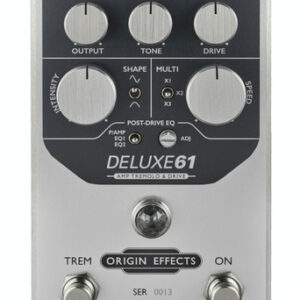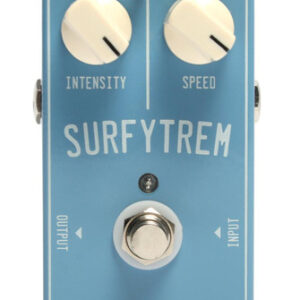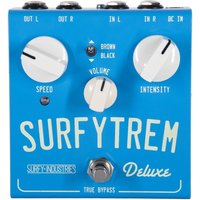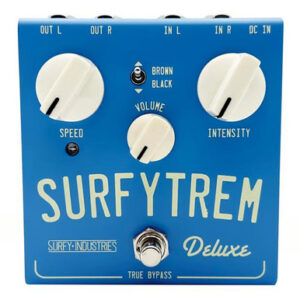

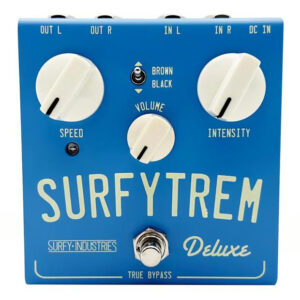


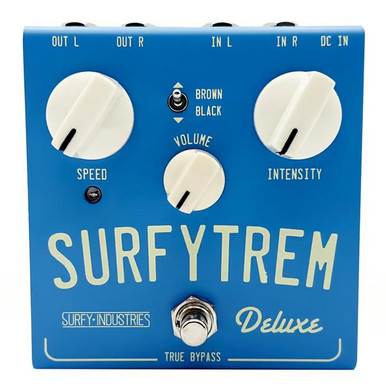
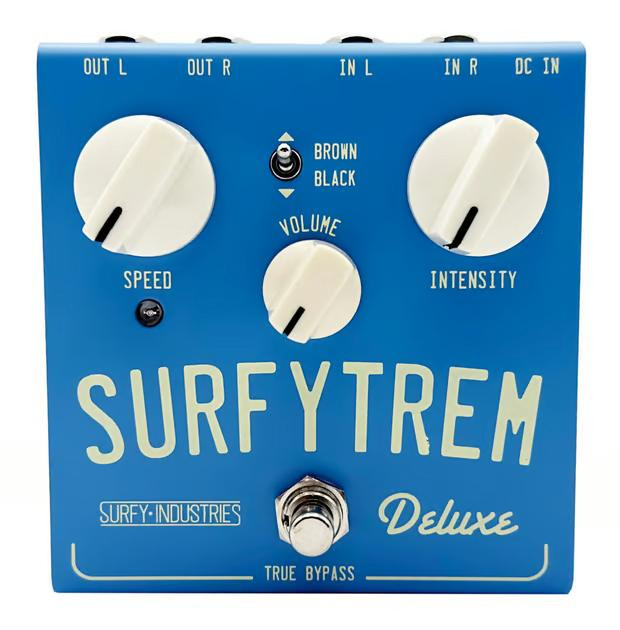


Here’s what Surfy Industries say:
This effect is built to recreate the sound of the famous “vibrato channel” of the vintage Fender® amplifiers. The effect is 100% analog and one of very few tremolos that are based on bias modulation in the same way as our well known SURFYTREM pedal. Bias modulation was used in many vintage Fender amps and is now recreated by using matched JFET transistors.
Key Features
- Stereo effects: the pedal can be used as two separate tremolos sharing the same LFO or for creating stereo effects from a mono source
- Volume control for adjusting the signal level when tremolo is enabled
- True bypass functionality
- Soft touch footswitch
- Brownface / Blackface click-less Mode Switch
- Polarity auto detection allowing to use power supplies with center-positive or center-negative polarity
- Extended supply voltage range accepting 9-12V DC 30mA
Brownface
Imagine the incredible tone out of a Fender® 1961-1962 Showman® amplifier (second channel) with its beautiful and sweet harmonic tremolo voice. This has often been called THE tremolo, imitated by many throughout the years, but equal to none. The signal floats on the harmonic wave, moving up and down, alternating highs and lows. It can be compared with the effect of a rotating speaker in a Leslie system. This kind of tremolo has one great feature: it’s dynamic adaptability. When the melody is slow and intense it pushes its vibrating soul and the tone becomes especially rich and deep, but if you change the mood and the sound becomes aggressive and loud, the effect is almost absorbed and stands back, maintaining the full attack of the guitar. In this mode, the extreme dynamics of the tremolo follow the style of playing and enhance the sound without interfering.
Blackface
In 1964 Fender® introduced the Blackface amplifiers series, gaining a cleaner and brighter sound compared to the Tweed/Brownface models. They used a different kind of tremolo, well known since the ’50s, in which the signal is moved alternatively in and out, a sort of on/off feeling, resulting in a more efficient and audible effect. This functionality is also known as “amplitude modulation”. This tremolo really stands out when needed and cuts through the mix easily and loudly. It is not as dynamic on the melody, but if used in a solo, for example, it really “frees up” the guitar sound, giving it depth and length. This is certainly a more common effect and it probably requires less experience than the harmonic tremolo to be used properly.