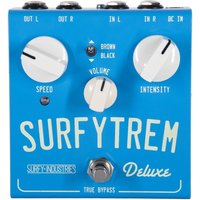
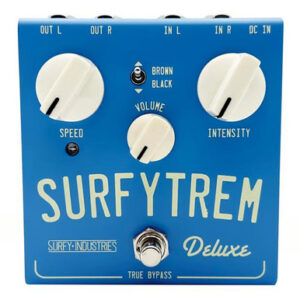
The Surfy Industries SurfyTrem Deluxe is an analogue tremolo pedal designed to recreate the unmistakable character of the classic “vibrato channel” found in some vintage amplifiers. Rather than using digital processing the SurfyTrem Deluxe relies on genuine bias modulation a technique widely used in many early valve amplifiers. By recreating this behaviour with carefully matched JFET transistors the pedal delivers the rich pulse depth and organic movement that made those vintage tremolo circuits so musical and expressive. Beyond classic amp-style tremolo the SurfyTrem Deluxe adds modern flexibility with stereo capability and expanded control. It can operate as two tremolo outputs sharing the same LFO or create wide stereo modulation from a mono input signal. With a dedicated output level control click-less Brownface and Blackface voicing switch and soft-touch true bypass switching the SurfyTrem Deluxe blends authentic vintage tremolo character with practical features for modern pedalboards and performance setups.
Surfy Industries SurfyTrem Deluxe Tremolo Pedal
This is a New Surfy Industries SurfyTrem Deluxe Tremolo Pedal from Surfy Industries its found in our Tremolo & Vibrato Pedals on the Just Pedals menu. Read More below.
As an affiliate partner, we may earn a small commission when you buy through our links — at no extra cost to you.
Brand
Surfy Industries
In the current JustPedals catalogue, Surfy Industries is represented by Reverb Pedals, Tremolo & Vibrato Pedals and Boost Pedals. Current listings include Stereomaker, SurfyMan and SurfyFuzz. That makes the range relevant to players looking for drive, gain and clipping, plus time-based effects and ambience. Check each model for its exact circuit or processing platform, controls, power requirements and connections, particularly where the catalogue includes both pedals and supporting gear.
Category
Tremolo & Vibrato Pedals
Tremolo varies amplitude, making volume rise and fall; vibrato varies pitch, making the note move sharp and flat. Some circuits combine both or derive them from modulation systems that blur the boundary. Rate, depth, waveform and stereo phase determine whether the motion is smooth, pulsing, choppy, seasick or spatial, while tap tempo can lock the cycle to a rhythm.
Tags
Analogue
The signal is shaped by continuously varying electronic circuitry rather than being converted into a digital effect algorithm. Component choice, operating voltage and circuit tolerances influence headroom, noise, clipping texture and the small variations in response between designs.
Digital
Converts the signal or control process into numerical data for algorithmic processing. Digital designs can provide precise timing, long memory, complex routing and repeatable presets; sample rate, conversion, internal resolution and latency influence fidelity and response.
Stereo
Processes, creates or passes two audio channels. True stereo preserves separate left and right inputs, while mono-to-stereo effects generate spatial differences internally; routing, phase behaviour and whether trails remain stereo determine the resulting image. Some outputs sum to mono when only one socket is connected, which can change level or modulation depth.
True Bypass
Connects input directly to output through mechanical or relay switching when the effect is off, removing the active circuit from the audio path. It avoids buffer colour but leaves cable capacitance and switching design to influence high-frequency loss and possible switching noise.
Others Just Ordered :
- I Love A Happy Accident… – Animals Pedal

- Animals Pedal Vintage Van Driving is Very Fun Overdrive

- Animals Pedal Sunday Afternoon Is Infinity Bender

- Ninevolt Pedals | Bath Time Reverb (Animals Pedal)
- This Fuzz Pedal Makes No Sense… But It Sounds Incredible

- ANIME Pedals | Animals Pedal Custom Illustrated Series