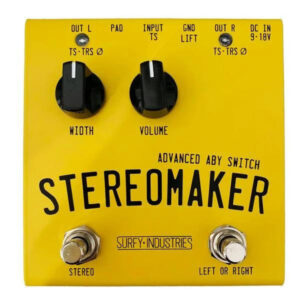




Surfy Industries Stereomaker

£129.99

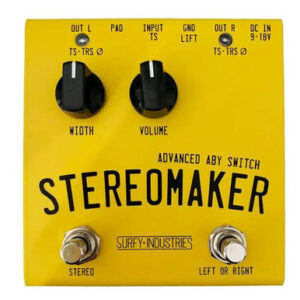
This is the Surfy Industries Stereomaker from Surfy Industries, listed in Specialist Effects Pedals on Just Pedals. Read More below.

View Just
more
and ,

Here’s what Surfy Industries say:

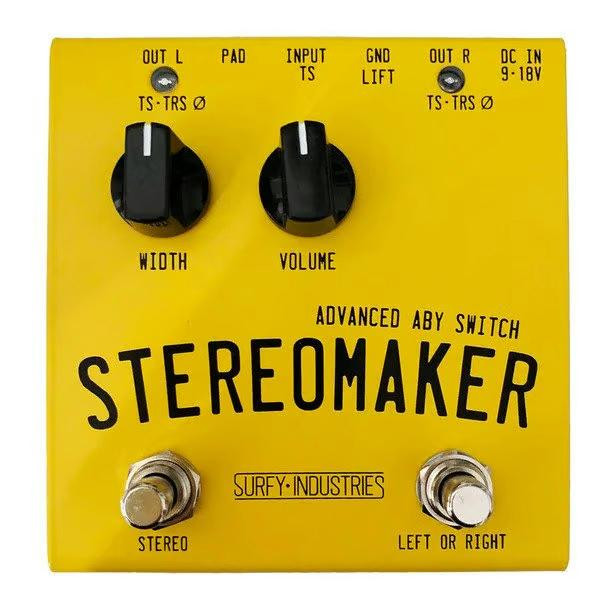
An ABY pedal typically receives the signal from a guitar or other instrument and splits it into two outputs. The StereoMaker is fully buffered and packed with features like: soft touch JFET switching, transformer isolated outputs, pseudo stereo effects, 180 degrees phase reverse and ground lift.

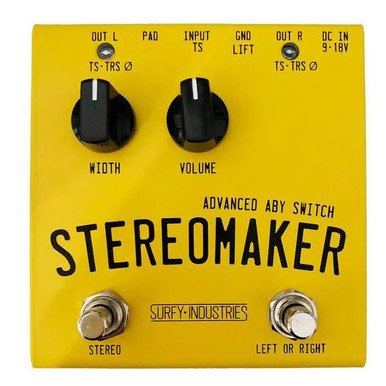
In STEREO mode the width and volume controls are enabled to optimize a pseudo stereo sound. The PAD switch makes it possible to attenuate line level signal to instrument level. Also the StereoMaker can be used as a direct box to convert unbalanced to balanced signals becoming a usefultool for keyboard players and recording studios.

Pseudo Stereo Effect

A simulated stereo effect is generated using analog complementary comb filters. This unique implementation makes it possible to simulate the mixture of direct and reflected sound waves in a room in a very realistic way. This effect is 100% analog and safe to mix back into mono, no side effects.

Out-Of-Phase Signals

Sometimes reverse phase effects can occur resulting in a “non-distinct”, “hollow sound”. The reason might be that two guitar amps has been used with different number of gain stages. The StereoMaker has a built-in 180 degrees polarity reverse circuit to phase-match amps. Just pull the output plug half way out to get the reverse phase.

Brand

Surfy Industries

Surfy Industries capture the golden age of surf tone with modern reliability. From the legendary SurfyBear Reverb to their lush tremolos and vibes, each unit is built to deliver that classic 60s splash and shimmer. Designed by surf tone purists, their gear brings authentic vintage circuits into a modern, road-ready format — perfect for players who crave real spring reverb and retro charm.

Category

Specialist Effects Pedals

Specialist effects alter the signal in ways that do not sit cleanly inside one established family. They may use granular processing, frequency shifting, resonators, freeze or sustain, bit reduction, ring modulation, feedback networks or combinations of several techniques. The relevant distinction is the underlying process, its tracking or latency, and how completely the dry signal can be blended or replaced.

Tags

Analogue

The signal is shaped by continuously varying electronic circuitry rather than being converted into a digital effect algorithm. Component choice, operating voltage and circuit tolerances influence headroom, noise, clipping texture and the small variations in response between designs.

Stereo

Processes, creates or passes two audio channels. True stereo preserves separate left and right inputs, while mono-to-stereo effects generate spatial differences internally; routing, phase behaviour and whether trails remain stereo determine the resulting image. Some outputs sum to mono when only one socket is connected, which can change level or modulation depth.