Brand
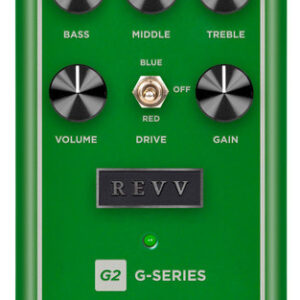
In the current JustPedals catalogue, Revv is represented by Preamp & DI Pedals, Overdrive Pedals and Noise Gate Pedals. Current listings include Tilt Boost, Amplification G8 Noise Gate and G8 Noise Gate. That makes the range relevant to players looking for drive, gain and clipping, plus modelling, direct rigs and multi-effects. Check each model for its exact circuit or processing platform, controls, power requirements and connections, particularly where the catalogue includes both pedals and supporting gear.
Category
A preamp brings an instrument signal to a controlled level and shapes its impedance, gain and frequency balance before amplification or recording. A DI converts the signal for a balanced, low-impedance connection and may include ground lift, pad and transformer isolation. Combined units can add drive, cabinet filtering, effects loops and parallel outputs while keeping the direct path stable.
Tags
The signal is shaped by continuously varying electronic circuitry rather than being converted into a digital effect algorithm. Component choice, operating voltage and circuit tolerances influence headroom, noise, clipping texture and the small variations in response between designs.
Converts the signal or control process into numerical data for algorithmic processing. Digital designs can provide precise timing, long memory, complex routing and repeatable presets; sample rate, conversion, internal resolution and latency influence fidelity and response.
Clips the waveform firmly and adds a dense series of harmonics with compression and sustain. The clipping devices, gain stages and tone filters determine whether the result is tight, smooth, mid-focused, scooped, grainy or deliberately abrasive.
Uses moderate clipping and gain-dependent compression to add harmonics while retaining much of the original note contour. Bass filtering, mid emphasis, clipping symmetry and available headroom decide whether it sounds open and amplifier-like, tightly focused or heavily saturated.
Connects input directly to output through mechanical or relay switching when the effect is off, removing the active circuit from the audio path. It avoids buffer colour but leaves cable capacitance and switching design to influence high-frequency loss and possible switching noise.