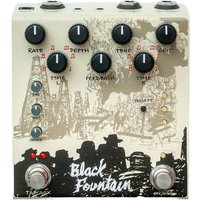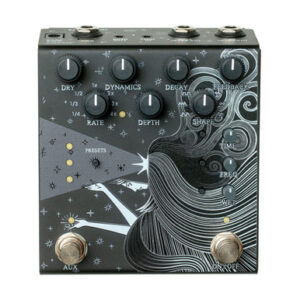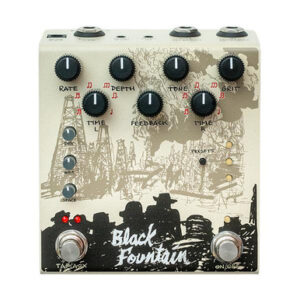
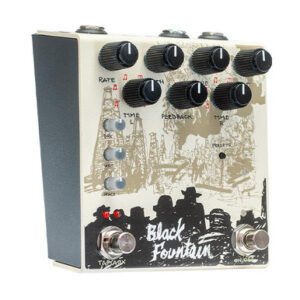

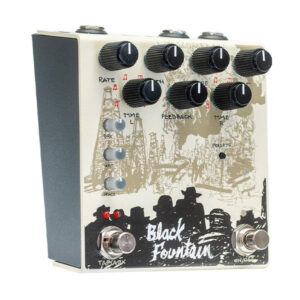
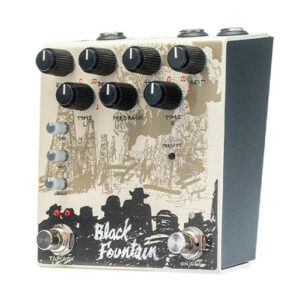
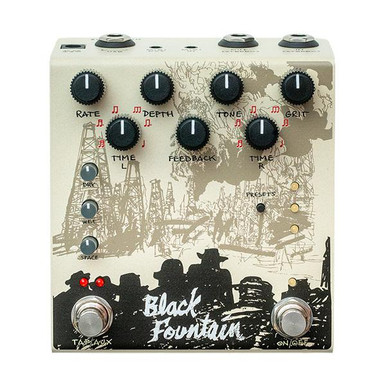
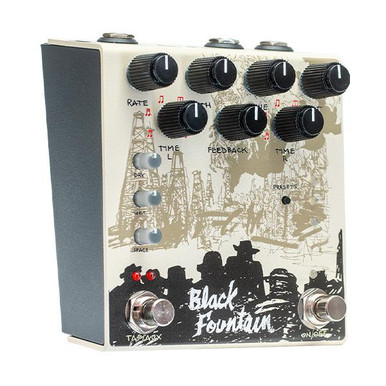
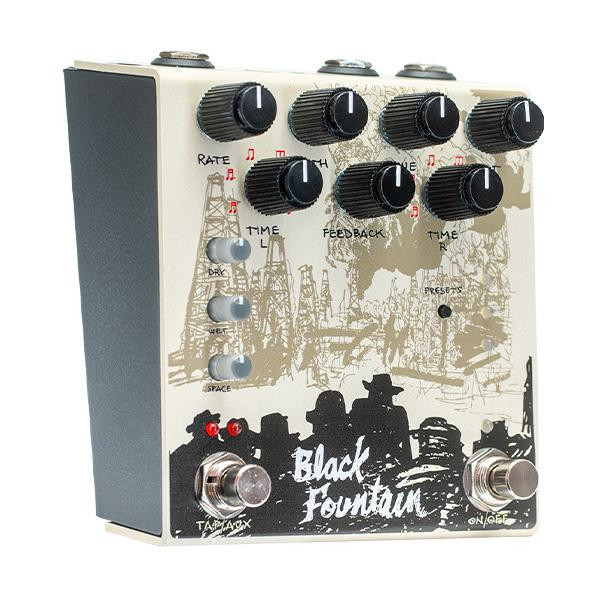
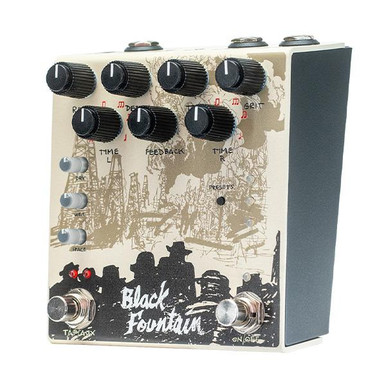
Building on the inimitable Black Fountain, a pedal that put OBNE on the map and for many a favourite always-on device, Black Fountain Stereo is much more than just turning things from mono into stereo. It truly expands Old Blood Noise Endeavors’ highly regarded ‘oil-can delay’ pedal right into a multi-tool.
With a wider control set that’s complete with added sonic options, a lower noise floor, dual delay lines that play together in a multitude of ways, presets, MIDI and expression control over everything, Black Fountain Stereo combines a sonic powerhouse of creative delay tones and into a pedalboard-friendly package.
Key Features
- Characterful ‘oil-can delay’ pedal
- Stereo input and output, with the option for Mono or Mono-in-Stereo-out routing
- Analog dry through
- Onboard Presets, plus control via MIDI
- Selectable Buffered Trails or True Bypass modes
Oil-Can Delay
Black Fountain Stereo emulates the sound of a spinning oil-can delay. This is a warm, modulated and a little gritty type of tone that’s perfect for chorusing, doubling, slap back and long rhythmic delays alike. You choose the amount and rate of modulation, the tone and grit of the core voice, the two delay times and their feedback. Plus, to top it off the mono/stereo voicing of it all can be set exactly as you like and everything can be saved into presets, for easy recall.
Controls
The Rate and Depth controls set the amount of modulation and speed, Tone shapes the warmth of the repeats, while Grit sets the amount of drive in the repeats. To help maintain the clarity of your tone or for more special effects, you can set the mix of volume of either the Dry and/or Wet levels. Space defines the mono delay mode or stereo width and adds diffusion past the noon position.
Separate controls are available for setting the Left and Right Delay Time as well as being able to choose between six subdivisions for each side when holding the Tap footswitch. That little Tap switch (surprise) helps you set the delay repeats in time with your tempo, while holding it down will give for infinite feedback. Optionally, it can also be used as a preset switcher.