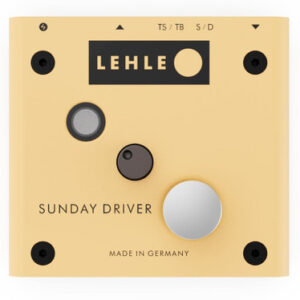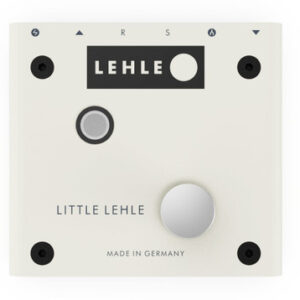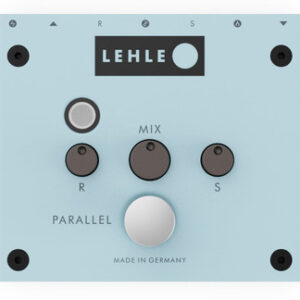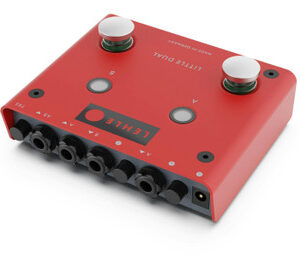
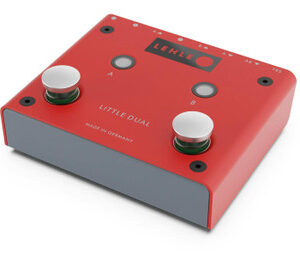

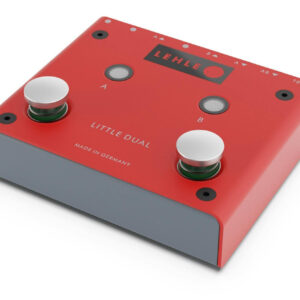
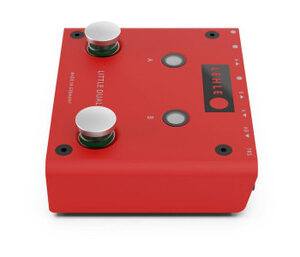
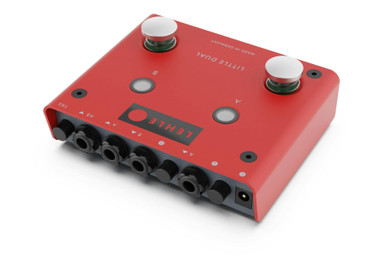
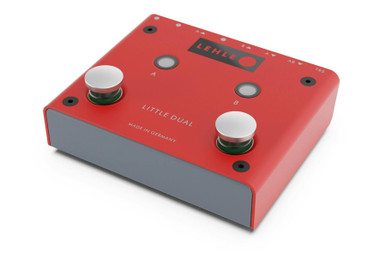
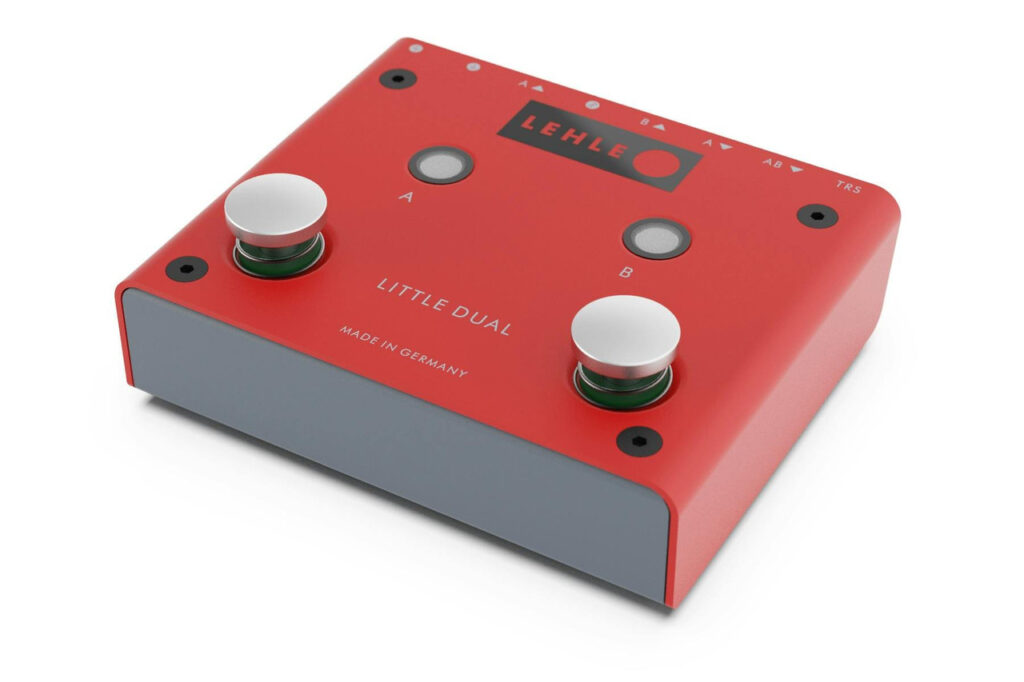
Here's what Lehle say about the Dual II:
The LEHLE LITTLE DUAL II is the successor to the Lehle Little Dual and is a maximum signal-fidelity amp switcher for two amps. By using the soft-touch switches you can switch between two connected amplifiers hum-free and without sound loss.
Two different operating modes are ready for you. You decide if you want to activate or deactivate every output individually or if you want to switch between the amps and activate the remaining one.
The LEHLE-Switches work with a microcontroller and an intelligent True-Bypass-Relay-Circuit with active pop noise suppression circuit. Thereby they switch the LEHLE LITTLE DUAL II even faster than mechanical switches and in addition to that wear- and noise-free.
The easy-action mushroom-shaped buttons characteristic of LEHLE products are mounted in the cover, so that your foot pressure is transmitted indirectly only, via a spring. Thus the electronics board is not exposed to mechanical loads, making the LEHLE LITTLE DUAL II virtually indestructible and guaranteeing years of trouble-free switching.
High-intensity LEDs make it easy to read off switching state A or B, or both, even under high-power spots.
The centrepiece of the LEHLE LITTLE DUAL II is its high-end LEHLE TRANSFORMER HZ, which galvanically isolates output A from output B, making history of hum loops – permanently! The LEHLE LITTLE DUAL II features a gold-plated contact phase inverter and a gold-plated contact ground switch. The two inputs can also be routed in stereo to outputs A and B, if you use the stereo signal of an effects unit as the input, for example. This also makes it possible to route instruments equipped with two pickups, including many acoustic and hybrid guitars, and also double basses, via two amplifier systems – with no complications.
Additionally the LEHLE LITTLE DUAL II is equipped with a TRS switch. Therewith it is possible to send in above-mentioned stereo- or dual-mono signals via a TRS jack or “stereo-jack”.
These signals can be operated either in alternation or in parallel – without hum, and without sound losses, needless to say. The LEHLE LITTLE DUAL II – small, but so utterly effective!
Key Features
- ABY switcher (A or B or both)
- Hum and noise-free switching
- High-impedance LEHLE TRANSFORMER HZ with phase and ground switch
- Two different operating modes
- Stereo-routing option
- Active pop suppression circuit