
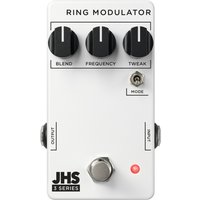
The JHS Pedals 3 Series Ring Modulator is a compact modulation pedal that takes a famously strange effect and makes it easy to use. Built in Kansas City with high-quality parts it keeps the 3 Series format simple while still giving you a wide spread of sounds. The Blend control mixes the ring modulation with your dry signal so you can add a barely-there harmonic edge or push the effect right to the front. Frequency adjusts the oscillator speed moving from slow pulsing movement to brighter bell-like textures that feel sharp unusual and expressive. Two modes give the pedal its range. Earworm mode is inspired by the Way Huge Ringworm with the Tweak control adding an auxiliary LFO for wobble and movement. Green Lantern mode takes inspiration from the Green Ringer circuit blending in a wave-rectified octave effect alongside the ring modulation. It can sit subtly under a solo add animated texture to riffs or become properly chaotic with gain in front. The compact enclosure fits easily into tight pedalboard spaces.
JHS Pedals 3 Series Ring Modulator
This is a New JHS Pedals 3 Series Ring Modulator from JHS Pedals its found in our Modulation Pedals on the Just Pedals menu. Read More below.
As an affiliate partner, we may earn a small commission when you buy through our links — at no extra cost to you.
Related videos



Brand
JHS Pedals
JHS Pedals grew from Josh Scott’s pedal-modification work in 2007 into a Kansas City effects maker. Scott’s first original designs followed in 2008; the Morning Glory began as his reinvention of the Marshall Bluesbreaker. The JustPedals catalogue carries the Morning Glory V4 and Muffuletta, along with practical tools such as the Little Black Buffer, Buffered Splitter and Little Black Amp Box. JHS describes its guitar pedals as made in Kansas City, USA. The range mixes original drive and fuzz designs with utility pedals, so the current listings show more than a single “boutique overdrive” identity.
Category
Modulation Pedals
Modulation changes a signal through a continuously moving control source. This broad category covers effects that alter delay time, phase, pitch, amplitude or filtering to create rotation, movement and evolving texture when no narrower effect family is dominant. Waveform, rate, depth, stereo phase and control routing determine the shape and spatial behaviour of that movement.
Others Just Ordered :
- I Love A Happy Accident… – Animals Pedal

- Animals Pedal Vintage Van Driving is Very Fun Overdrive

- Animals Pedal Sunday Afternoon Is Infinity Bender

- Ninevolt Pedals | Bath Time Reverb (Animals Pedal)

- This Fuzz Pedal Makes No Sense… But It Sounds Incredible

- ANIME Pedals | Animals Pedal Custom Illustrated Series
