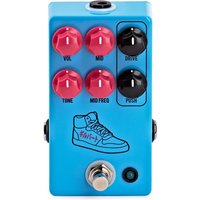
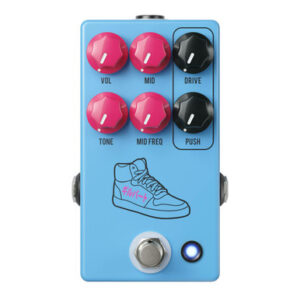
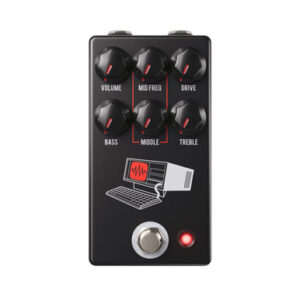
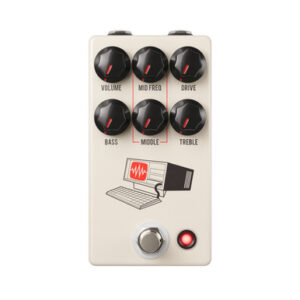
The tone of a rock icon. The JHS Paul Gilbert Distortion presents a truly unique pedal thats crafted to the specifications of former Racer X and Mr. Big guitarist Paul Gilbert. Featuring a myriad of intricate controls active mid-frequency preamp and an authentic tube response – the Paul Gilbert Distortion is destined for the pedalboards of rock and blues guitarists everywhere. A FET based distortion engine unleashes the authentic tone and feel of a pushed tube amplifier. So you can emulate the tone of a loud stadium-level amp without bringing the house down. Next up the active mid-frequency preamp. Not often seen in a guitar pedal this design is located at the front of the FET circuitry offering a huge variety of tonal possibilities. Not to mention all the midrange control you could ever want letting you alternate between bold punching mids and a total sweep for those thick rock n roll tones. Put simply the Paul Gilbert Distortion is versatile. And you can dial in your exact sound with the vast range of tone and gain controls on display. This is your dream dirt channel in a compact pedal housing. So you can take it with you to enhance every single performance.
JHS Paul Gilbert PG-14 Distortion
This is a New JHS Paul Gilbert PG-14 Distortion from JHS Pedals is in our Distortion Pedals category on Just Pedals. Read More below.
As an affiliate partner, we may earn a small commission when you buy through our links — at no extra cost to you.
Related videos

Brand
JHS Pedals
JHS Pedals grew from Josh Scott’s pedal-modification work in 2007 into a Kansas City effects maker. Scott’s first original designs followed in 2008; the Morning Glory began as his reinvention of the Marshall Bluesbreaker. The JustPedals catalogue carries the Morning Glory V4 and Muffuletta, along with practical tools such as the Little Black Buffer, Buffered Splitter and Little Black Amp Box. JHS describes its guitar pedals as made in Kansas City, USA. The range mixes original drive and fuzz designs with utility pedals, so the current listings show more than a single “boutique overdrive” identity.
Category
Distortion Pedals
Distortion clips the waveform more firmly than overdrive, generating dense upper harmonics, longer sustain and a more compressed response. Circuit topology and filtering decide whether the sound is tight and focused, broad and aggressive, smooth or deliberately abrasive. Gain sets the amount of clipping, while pre- and post-distortion tone controls strongly influence low-end definition, midrange presence and high-frequency texture.
Others Just Ordered :
- Mooer Meta FX – Review
- MOOER META FX Review: 3 Effects in 1—but Here’s the Problem
- I Wasn’t Expecting To Be Impressed – But What Is The Mooer Meta FX?
- Mooer // META FX Stereo Multi-Effect Platform (Demo)
- A NEW GENERATION OF PEDALS IS HERE – Mooer Meta FX Reverb Review
- Mooer META FX | All the REVERBS from subtle to WILD!