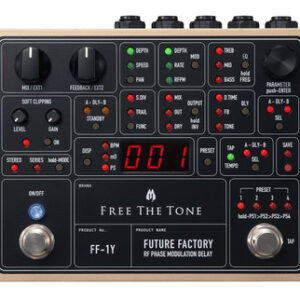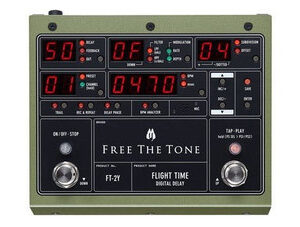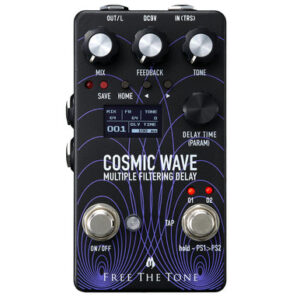
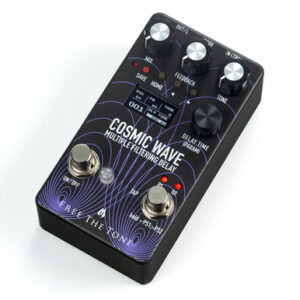

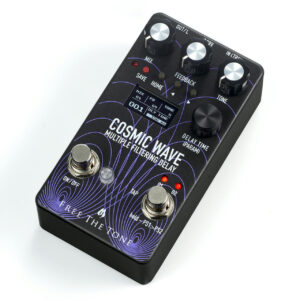
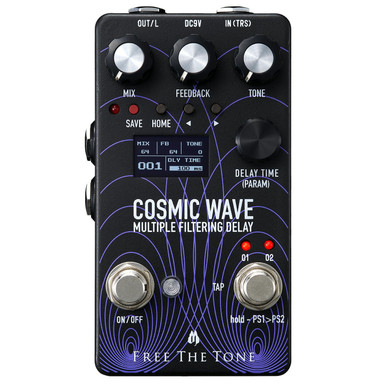
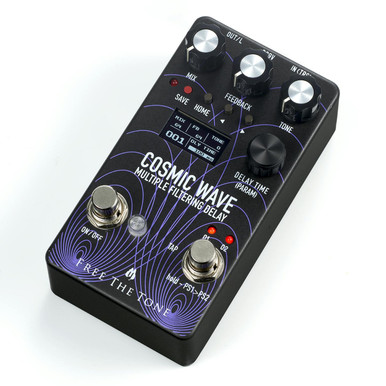
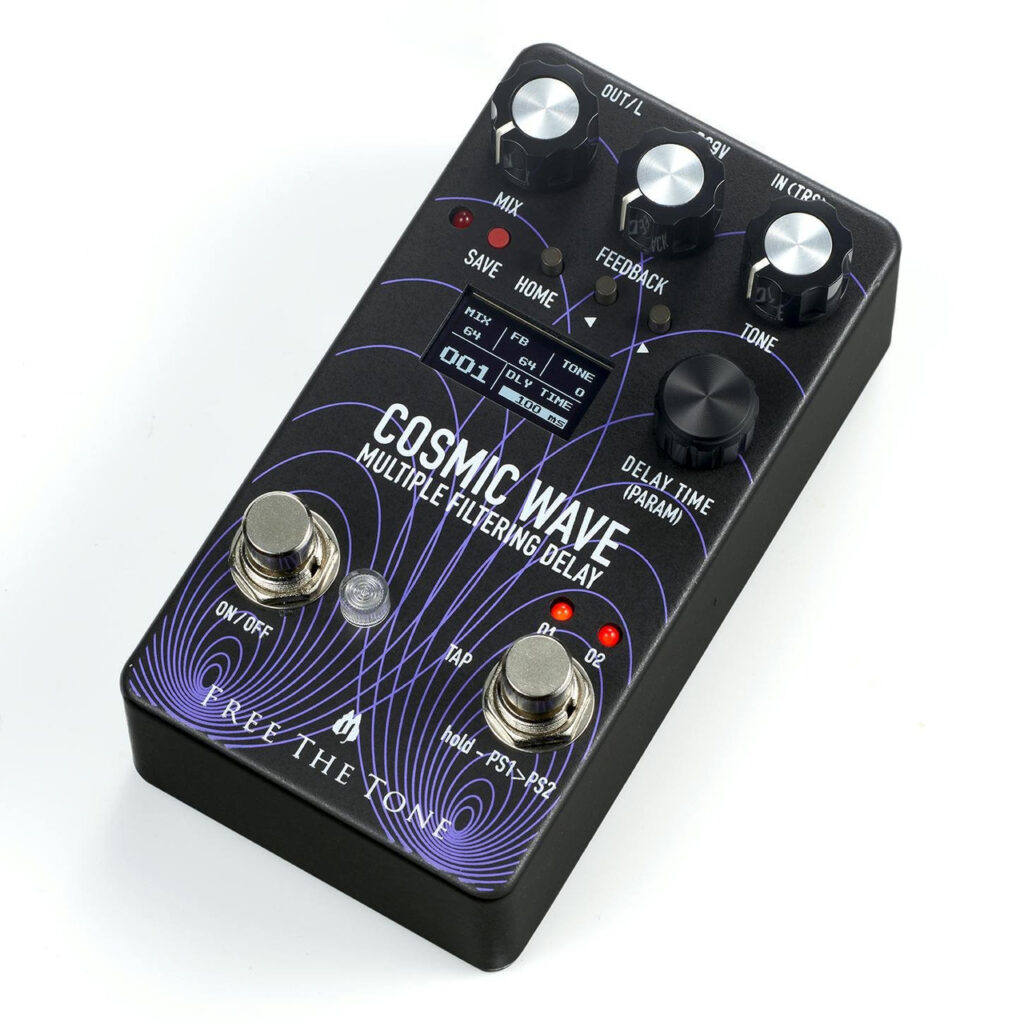
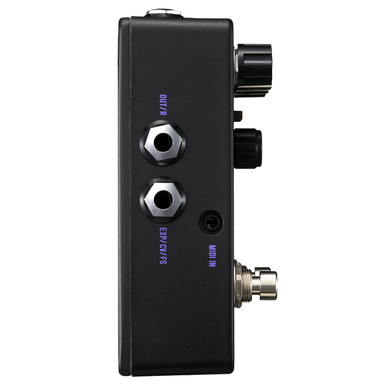
Free The Tone's Cosmic Wave is a compact, but epoch-making digital delay pedal with multiple filter functions. Using high-speed signal processing with a dedicated DSP and analogue/digital audio circuits perfected over time, this pedalboard-friendly unit attains high sound quality equal to Free The Tone's acclaimed FT-2Y Flight Time Digital Delay and FF-1Y Future Factory RF Phase Modulation Delay pedals.
The Cosmic Wave's tone filter can process the delay sound to have a rich sound or conversely adjust it to be far from the original tone. The proprietary Cosmic filter creates an ethereal effect reminiscent of outer space — adding a new colour to your delay sounds. Utilising a new method, the newly-developed reverse delay succeeds in producing a smoother, more musical reverse sound.
In addition, Free The Tone have added a new function to adjust the number of output bits of the delay sound in 1-bit units, from smooth and high-quality 24-bit to rough 8-bit sound that contains distorted noise when the volume is lowered. You can reproduce the nuances of the delay sound used in the 1980s and '90s, and even the delay sound with the bit-crusher effect applied!
Key Features
- Built-in multiple filter effects, including equalizer function. It's possible to apply multiple filters at the same time (Cosmic Filter, Bandpass Filter, 3-Band EQ, Tone).
- Equipped with a newly-developed reverse delay.
- Features output bit number adjustment function (8–24 bits).
- Small display for dramatically improved operability.
- High-speed effect processing performed by a dedicated DSP.
- Combination of high-speed arithmetic processing with 32-bit fixed-point arithmetic and high-precision arithmetic processing with 32-bit floating-point arithmetic achieves both high-quality sound and high processing speed, and provides the best performance.
- Delay time can be indicated in milliseconds or BPM.
- Tempo can be tap-entered via the footswitch.
- Presets 1 and 2 can be easily switched via the footswitch.
- Feedback Level Limit function.
- Kill Dry function.
- Trail On/Off function.
- Delay Phase Inversion function.
Specifications
- Number of Presets: 128 (Users), 11 (Factory)
- Input Impedance: 1 MΩ
- Output Load Impedance: Min. 10 kΩ
- Maximum Input Level: +10 dBm
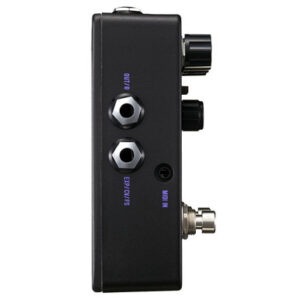
- Terminals: 1 x 1/4" Standard TRS Phone Jack (IN(TRS)), 3 x 1/4" Standard TS Phone Jacks (OUT/L, OUT/R, EXP/CV/FS), DC 9V Input Jack (for AC-DC Adapter), 3.5 mm Stereo Mini Phone Jack (MIDI IN)
- Power: 6F22 Battery (Alkaline Type), DC 9V AC-DC Adapter
- Current Consumption: Approx. 185 mA
- Dimensions: 66 (W) x 125 (D)x 54 (H) mm
- Weight Approx: 335 g
- Accessories: Warranty Card, Web Access Card, Safety Instructions, Rubber Foot