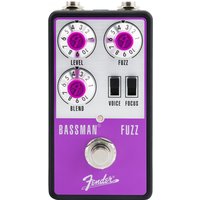
The Fender Bassman Fuzz pedal is a meticulously crafted effects pedal designed to deliver thick bass fuzz tones. Drawing inspiration from the original Bassman tube amp line this pedal crams decades of bass fuzz tones into a compact footprint. The Bassman Fuzz offers two voices of speaker-pumping grit and all the right controls to keep your low end solid. The buffer-friendly fuzz can be tamed to balance with your clean lows using the three-position focus switch and blend knob. Select where the fuzz sits in the mix from three focus frequencies: full frequency band just the mid and high frequencies or high frequencies only with each setting leaving plenty of room to blend in the right amount of your clean signal underneath the fuzz.Designed for durability and performance the Bassman Fuzz features a soft-touch relay true bypass with auto bypass when no power is present. The side-mounted pad switch is ideal for active basses and the top-mounted jacks make for easy pedalboard integration. The road-ready aluminium enclosure and inset aluminium face plate draw in vintage Fender aesthetics ensuring this pedal not only sounds great but looks great on any setup. Whether youre performing live or recording in the studio the Bassman Fuzz is a versatile addition to your bass rig.
Fender Bassman Fuzz Pedal
This is a New Fender Bassman Fuzz Pedal from Fender its found in our Fuzz Pedals on the Just Pedals menu. Read More below.
As an affiliate partner, we may earn a small commission when you buy through our links — at no extra cost to you.
Related videos

Brand
Fender
Fender’s effects line draws on the company’s Southern California instrument-and-amplifier history. The all-original pedal range Fender introduced in the late 2010s was designed in Southern California with input from gigging and studio musicians. JustPedals listings include The Bends compressor, Marine Layer reverb, Pugilist distortion, Tre-Verb and Smolder Acoustic Overdrive. That range connects familiar Fender amplifier sounds with dedicated stompboxes, while also covering bass and acoustic applications. The brand name does not indicate where every model was manufactured; compare each pedal’s controls, routing and model-specific specifications.
Category
Fuzz Pedals
Fuzz drives the signal into extreme clipping, often flattening the waveform and generating a thick spectrum of harmonics. Transistor type, bias, input loading and tone filtering create markedly different responses, from loose and velvety to gated, spluttering or octave-rich. Some circuits interact strongly with pickup impedance and guitar volume, while others include buffers or blends for a more consistent response.
Tags
Bass
Voiced or equipped to retain low-frequency fundamentals and the higher headroom of a bass signal. Clean blends, crossovers and bass-specific filter ranges can preserve weight and articulation while the effected portion adds harmonics, movement or ambience.
True Bypass
Connects input directly to output through mechanical or relay switching when the effect is off, removing the active circuit from the audio path. It avoids buffer colour but leaves cable capacitance and switching design to influence high-frequency loss and possible switching noise.
Others Just Ordered :
- I Love A Happy Accident… – Animals Pedal

- Animals Pedal Vintage Van Driving is Very Fun Overdrive
- Animals Pedal Sunday Afternoon Is Infinity Bender
- Ninevolt Pedals | Bath Time Reverb (Animals Pedal)
- This Fuzz Pedal Makes No Sense… But It Sounds Incredible

- ANIME Pedals | Animals Pedal Custom Illustrated Series