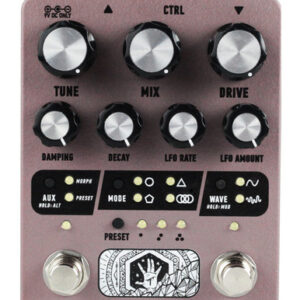
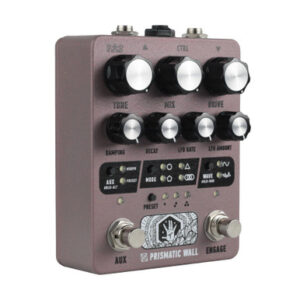
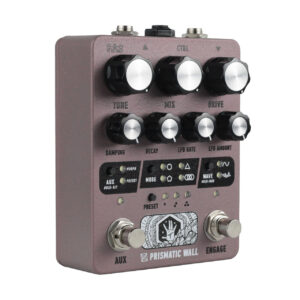
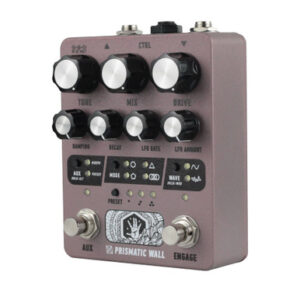
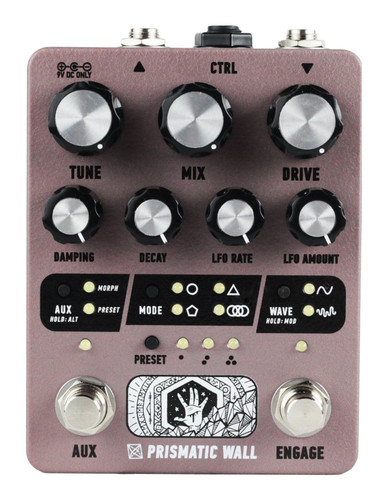
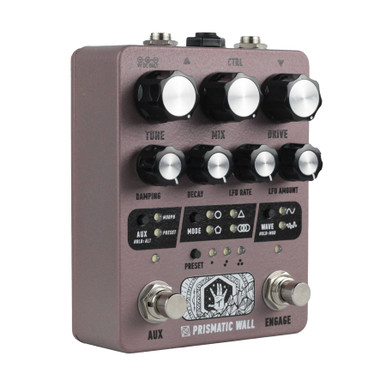
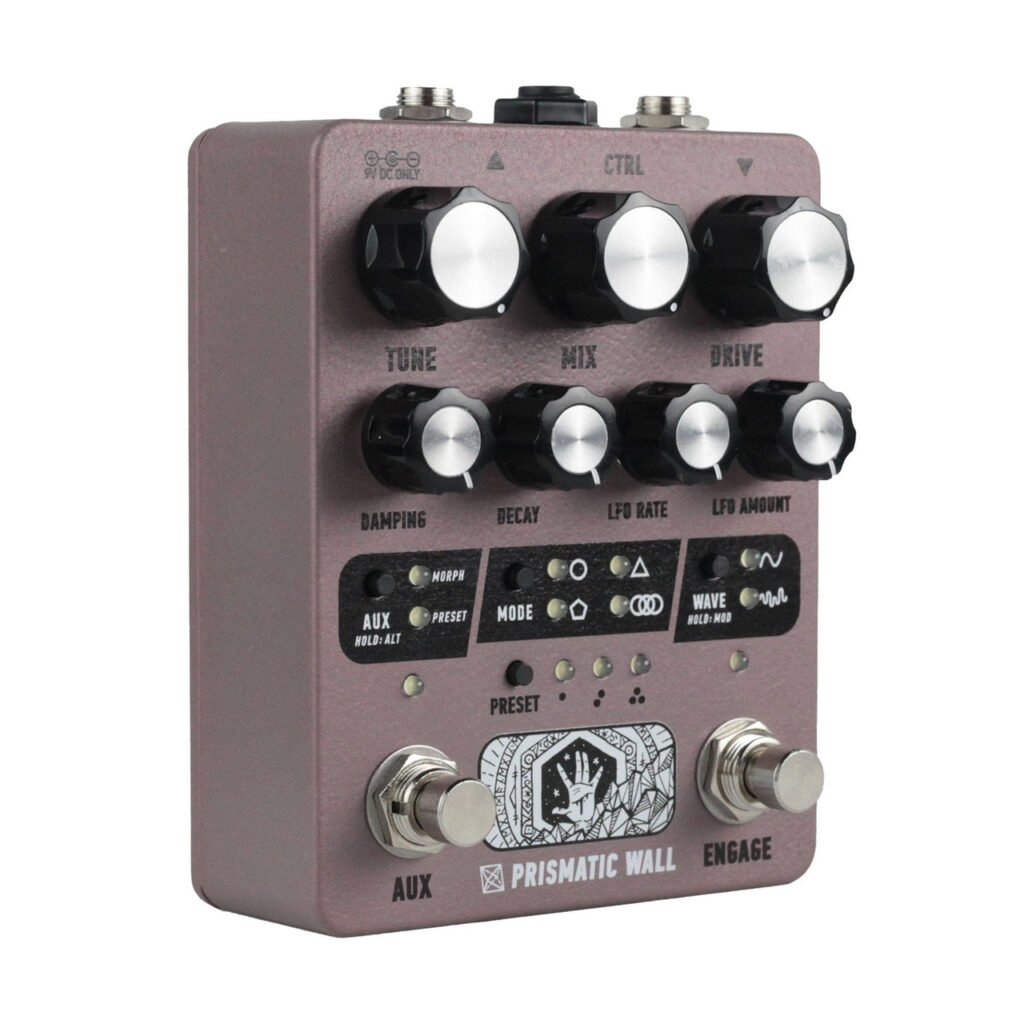
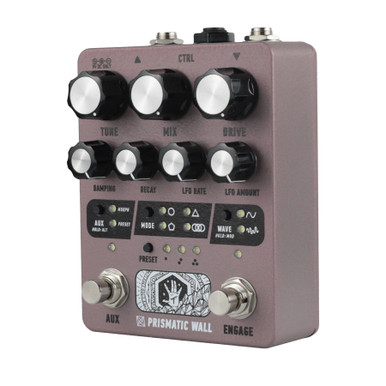
Electronic Audio Experiments Prismatic Wall Pedal

£399.00

This is the Electronic Audio Experiments Prismatic Wall Pedal from Electronic Audio Experiments, listed in Specialist Effects Pedals on Just Pedals. Read More below.

View Just
more
and , , , ,

Emulate the resonance of sympathetic strings and produce effects that sound something like a synthesizer and a reverb and have endless fun traversing its intricate layers and design your own unique tone like it’s an extension of your instrument!

To put it simply, the simulated vibrations form a sustaining spectral extension of your instrument that retains a tangible physicality despite its surrealist underpinnings, obviously.

Key Features

  • Buffered Bypass or Trails Bypass – Choose whether to buffer your signal, or let the Prismatic Wall resonate even after turning it off.
  • Wet/Dry Tone Control – Choose just how much of the prismatic wall is in your tone.
  • Primitive Analogue Feel – The hardware combines primitive DSP with analogue saturation to give you a sonic character that sounds from a particular era of analogue tone.

The effects make you feel like you are virtually plucking the strings too, and letting the reactive tone send you and anyone who hears it into a trance, where you can close your eyes and feel how the sound reacts.

By using the fully digital user interface this enables all parameters to be controlled via MIDI, saved as presets, and even modulated by the onboard LFO. In addition, the Morphing function enables controllable transitions between two distinct settings via the Aux footswitch or an expression/CV source.

Who are Electronic Audio Experiments?

Electronic Audio Experiments is an exploration in sound and texture via electronics. Founded in 2015 by guitarist and electrical engineer John Snyder, EAE focuses primarily on stompboxes for electric guitar and bass, with occasional ventures into amplification and synthesis.

Assembled in a small workshop in Boston, MA by a close-knit team with strong ties to the world of audio, offering a mix of unique, purpose-built designs and homages to forgotten circuits of the past—all engineered to exceed the highest standards of quality and enrich the sounds of scrappy touring bands and discerning studio artists alike.
 

Brand

Electronic Audio Experiments

Category

Specialist Effects Pedals

Specialist effects alter the signal in ways that do not sit cleanly inside one established family. They may use granular processing, frequency shifting, resonators, freeze or sustain, bit reduction, ring modulation, feedback networks or combinations of several techniques. The relevant distinction is the underlying process, its tracking or latency, and how completely the dry signal can be blended or replaced.

Tags

Analogue

The signal is shaped by continuously varying electronic circuitry rather than being converted into a digital effect algorithm. Component choice, operating voltage and circuit tolerances influence headroom, noise, clipping texture and the small variations in response between designs.

Buffered Bypass

Keeps an active buffer in the signal path when the effect is bypassed. The buffer converts a high-impedance input to a lower-impedance output, helping long cables and multiple pedals retain level and high frequencies, although its headroom and noise remain part of the path.

Digital

Converts the signal or control process into numerical data for algorithmic processing. Digital designs can provide precise timing, long memory, complex routing and repeatable presets; sample rate, conversion, internal resolution and latency influence fidelity and response.

MIDI

Sends, receives or responds to Musical Instrument Digital Interface messages rather than carrying the instrument audio itself. Program changes recall presets, continuous controllers move parameters, and MIDI clock or transport messages synchronise timing between devices.

Presets

Stores complete groups of parameter values for later recall. The number of locations, switching time, spillover behaviour and whether presets include routing, expression and MIDI assignments determine how completely one sound can change into another.