
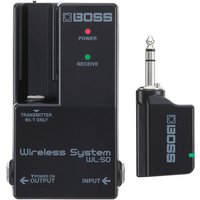
The Boss WL-50 Wireless Guitar System is designed to seamlessly integrate into any pedalboard providing a quick and easy way to create a wireless rig. The WL-50 system is equipped with Boss high-performance wireless technology delivering a wide dynamic range with ultra-low latency and rock-solid audio. The Boss Wireless System also features an in-built cable tone simulation offering two different cable lengths to reproduce the natural capacitive effect of a short or long guitar cable or simply bypass it altogether. To ensure players can deliver a wireless performance anywhere the receiver can be powered by two AA batteries for the ultimate portability. Another unique feature of the receive is its ability to provide power to additional stompboxes when powered via an AC adaptor making the Boss WL-50 Wireless Guitar System an incredibly versatile system suitable for life on the road.
Boss WL-50 Wireless Guitar System for Pedalboard Integration
This is a New Boss WL-50 Wireless Guitar System for Pedalboard Integration from Boss its found in our Wireless Systems on the Just Pedals menu. Read More below.
As an affiliate partner, we may earn a small commission when you buy through our links — at no extra cost to you.
Related videos

Brand
Boss
BOSS began in Osaka in 1973 as MEG Electronics, a company dedicated to effects. Its first BOSS-branded effect was the CE-1 Chorus Ensemble in 1976; the OD-1, SP-1 and PH-1 launched the compact-effects series in 1977. The JustPedals catalogue includes familiar overdrives and distortions such as the OD-3, SD-1, BD-2, DS-1 and MT-2 Metal Zone, as well as utility items such as the PCS-20A cable. BOSS now spans compact pedals, multi-effects, loopers, tuners and controllers. Manufacturing origin should be checked by model rather than inferred from the brand’s Japanese history.
Category
Wireless Systems
An instrument wireless system replaces the cable between instrument and receiver with a radio link. Frequency band, channel management, range and latency determine connection quality, while input headroom and digital conversion affect the signal itself. Battery life, rechargeable transmitters, cable emulation, receiver format and licence-free operation in the intended region are central compatibility points.
Others Just Ordered :
- I Love A Happy Accident… – Animals Pedal

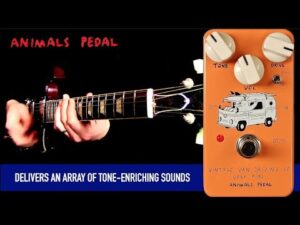
- Animals Pedal Vintage Van Driving is Very Fun Overdrive
- Animals Pedal Sunday Afternoon Is Infinity Bender
- Ninevolt Pedals | Bath Time Reverb (Animals Pedal)
- This Fuzz Pedal Makes No Sense… But It Sounds Incredible

- ANIME Pedals | Animals Pedal Custom Illustrated Series