
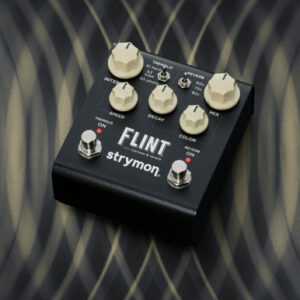
Strymon’s immensely-popular Flint pedal, known for its magical combination of tremolo and reverb, has been updated! This second-generation stompbox provides the same gorgeous, ’60s-inspired trem/verb tones we all know and love — but adds significant new features to give you additional flexibility, power and ease-of-use on stage and in the studio.
Strymon has most notably extended the range of the Flint’s ‘Speed’ control so that you can slow the tremolo down even more than before, while on the reverb side, the pre-delay time is now adjustable. Further upgrades include full MIDI implementation for control over just about every single Flint parameter, a premium analogue JFET input circuit, and a new ARM DSP chip for increased processing power. Go from splashy, pulsing twang to throbbing, swampy blues — all the way to ambient, trembling and serene reverberated pads with Strymon’s new and improved Flint V2 pedal!
Key Features
- 3 tremolo types: ’61 Harm (harmonic tremolo), ’63 Tube (power tube tremolo), and ’65 Photo (photocell tremolo).
- 3 reverb types: ’60s (spring tank reverb), ’70s (electronic plate reverb), and ’80s (hall rack reverb).
- Expanded ‘Speed’ control allows you to attain a wider range of tremolo speeds, all the way down to nearly 1Hz at its minimum setting.
- Ultra-low noise, high-performance 24-bit 96kHz A/D and D/A converters and a 20Hz to 20kHz frequency response.
- Full MIDI implementation lets you control just about every knob, switch and setting remotely via the EXP/MIDI jack or USB-C connector. Tremolo speed can be synchronized via MIDI Clock Sync, and the sync setting can be saved for each preset.
- Save and recall all the new sounds you create via 300 onboard MIDI preset locations.
- Class A JFET preamp input ensures uncompromised dynamics, exceptional touch sensitivity and superb responsiveness.
- 2 dedicated +/-3dB boost/cut secondary functions (one for each side of Flint). Lets you add a little extra “oomph” when needed, or dial things back a bit.
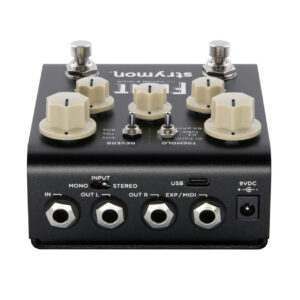
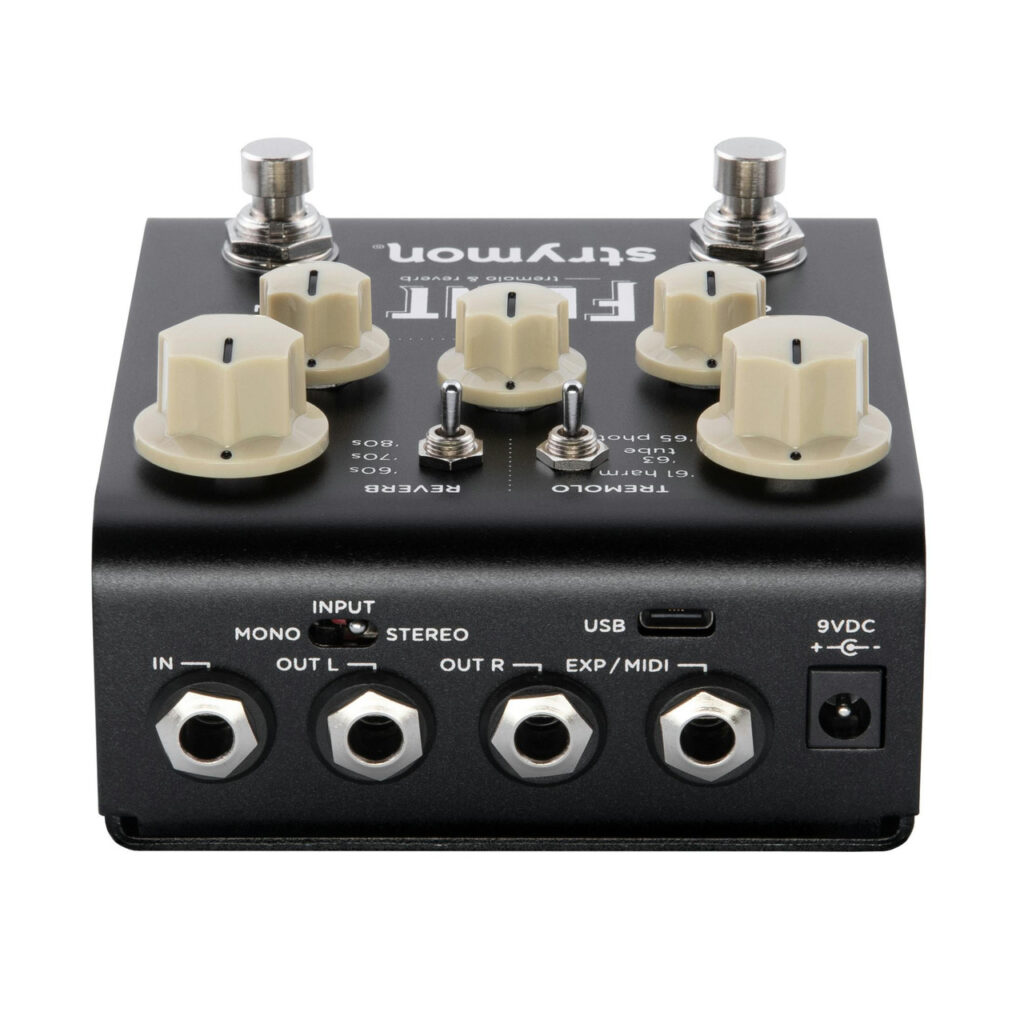
- Full stereo in/out capabilities means zero compromises when it comes to signal routing or pedal placement. Select mono or stereo (TRS) input with the flick of the rear panel switch.
- Easily control the Flint V2 with an expression pedal or MultiSwitch Plus.
- ‘Effect Order’ secondary function that lets you choose exactly how you want your reverb and tremolo routed for ultimate tonal control.
- New ARM DSP chip provides more processing power for every sonic nuance, with less energy consumption on your pedalboard.
- True/buffered bypass, for a 100% unprocessed signal or a conditioned signal with preserved high-end integrity.
- Adjustable line/instrument input signal level, with line level mode providing 10dB of added headroom for use with active bass guitars, synths, amps effects loops, vocals and more.
Sounds for a Classic Era
Flint gives you the pulsating, soothingly-hypnotic effects pioneered in vintage amplifier tremolo circuits, along with three classic and completely unique reverb algorithms. On the tremolo side, you can choose between the sonically-complex ’61 Harmonic Tremolo, the swampy and sultry ’63 Power Tube Tremolo, and the sharp and balanced ’65 Photocell Tremolo. On the reverb side, you can select the classic ’60s Spring Tank Reverb, the inventive ’70s Electronic Plate Reverb, or the nostalgic ’80s Hall Rack Reverb.
Tremolo Types
- ‘61 Harm: Harmonic band filtering that alternates low and high frequencies for a hypnotic effect.
- ‘63 Tube: A smooth volume pulsing effect created by modulating the bias point of the output tubes.
- ‘65 Photo: Sharper-edged volume effect achieved by using a photocell and light-dependent resistor.
Reverb Types
- ‘60s: Full-sized, two-spring tank typical of those found on vintage guitar amps.
- ‘70s: Electronic plate that uses multi-tap parallel delay lines with filtered feedback paths.
- ‘80s: Studio digital microprocessor rack hall reverb with modulating delay lines.
Controls & Routing
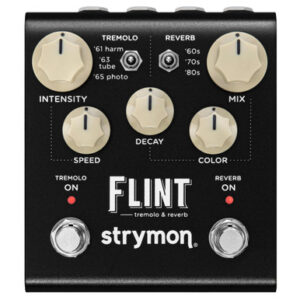
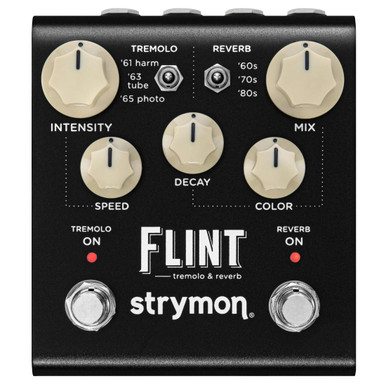
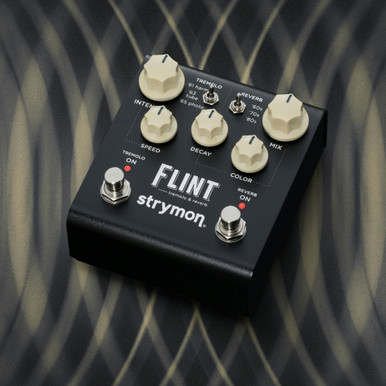
- TREMOLO TYPE: Switches between three tremolo types: ’61 Harm, ’63 Tube and ’65 Photo.
- INTENSITY: Controls the intensity or depth of the tremolo effect.
- SPEED: Adjusts the tremolo LFO frequency from slow to fast.
- REVERB TYPE: Switches between three reverb types: ’60s, ’70s and ’80s.
- MIX: Adjusts the reverb wet mix from 100% dry at minimum to 100% wet with no dry signal at maximum. Set to 3 o’clock for a 50/50 dry/ wet mix.
- DECAY: Varies the reverb time. The ‘70s and ‘80s verbs approach “infinite” decay at maximum.
- COLOUR: Influences the reverb tone from darker at low settings, to brighter at high settings.
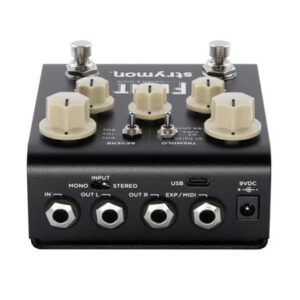
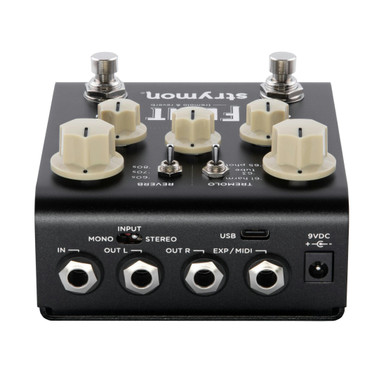
- AUDIO INPUT SELECTOR: Mono: Use with a mono input signal. Output is stereo. Stereo: Use with a stereo input signal. Output is stereo.
- IN: High-impedance, ultra-low noise, discrete Class A JFET preamp input. TRS adapter cable required for stereo input signal.
- OUTPUTS: Low-impedance stereo audio signal outputs. Use OUT L for mono output.
- EXP/MIDI: Multi-function communication jack for external control of Flint’s features and functions. Use a standard TRS expression pedal for continuous control over the knobs of the pedal (default setting). See complete User Manual for details about configuring for MIDI communication or accessories such as Strymon Conduit, MultiSwitch Plus, and MiniSwitch.
- USB-C: Computer connection for controlling via MIDI and for performing firmware updates.
Specifications
Ins, Outs & Switches
- High-impedance, ultra-low noise discrete Class A JFET TRS stereo input
- Low-impedance independent TS stereo outputs
- Expression pedal input allows the connection of a TRS expression pedal, MiniSwitch, MultiSwitch Plus, or TRS MIDI connection
- USB jack for controlling via MIDI from a computer or for performing firmware updates
- Dedicated ‘Reverb On/Off & ‘Tremolo On/Off’ footswitches
Audio Quality
- Premium JFET analogue front end
- Ultra-low noise, high performance 24-bit 96kHz A/D and D/A converters provide uncompromising audio quality
- 520MHz ARM Superscalar processor
- 32-bit floating point processing
- 20Hz to 20kHz frequency response
- Audio Input Impedance: 1M Ohm
- Audio Output Impedance: 100 Ohm
General
- Strong and lightweight anodized black aluminium chassis
- Power Requirements: 9V DC centre-negative, with a minimum of 300mA current
- Dimensions: 4.5” deep x 4” wide x 1.75” tall (11.4 cm deep x 10.2 cm wide x 4.4 cm tall)
- Designed and built in the USA