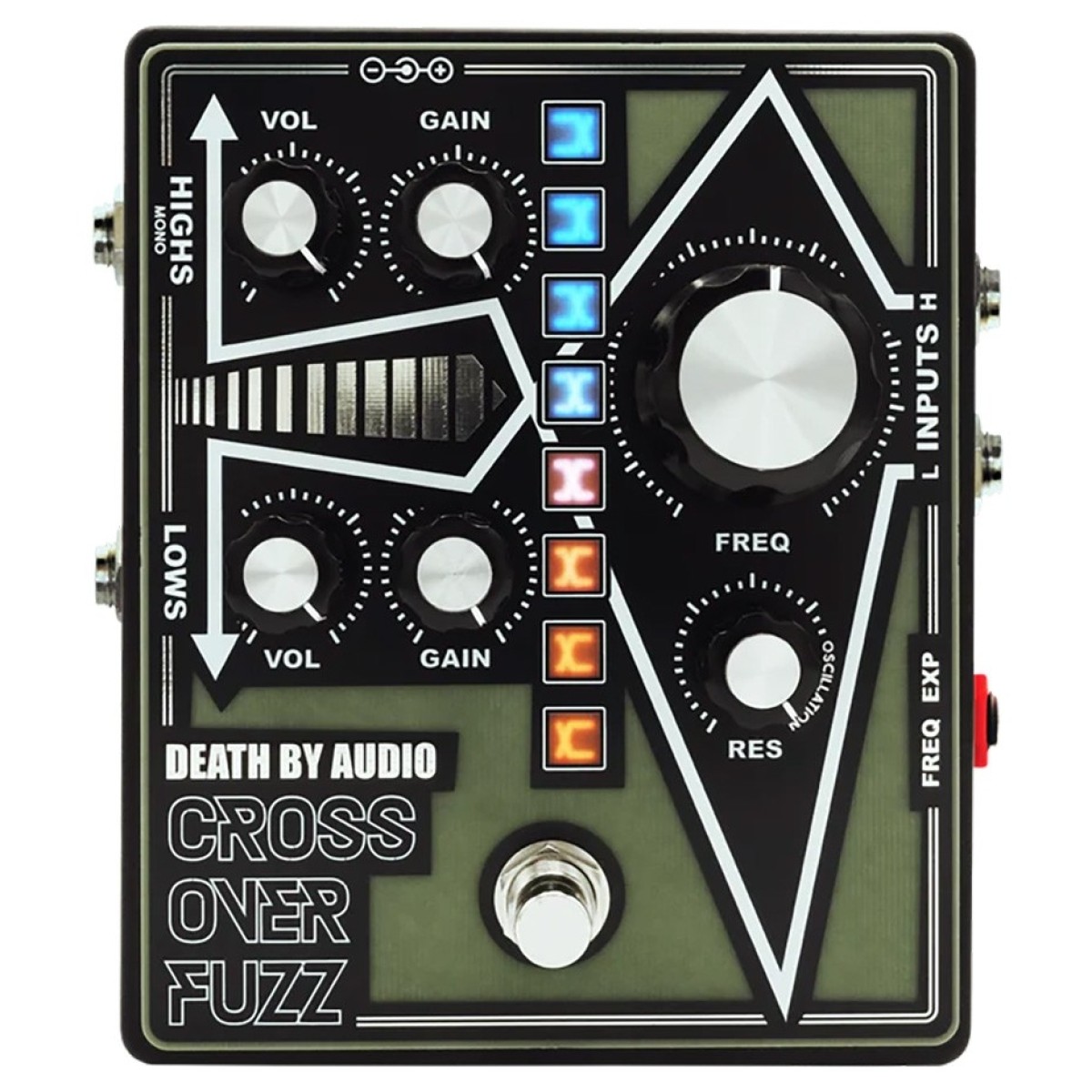
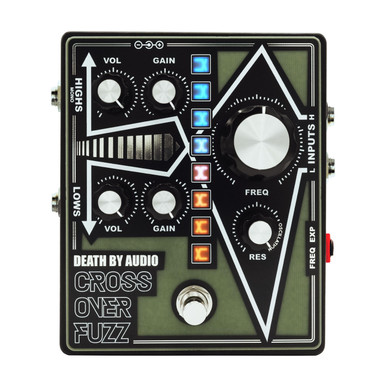
The Death By Audio Crossover Fuzz is a savage dual-band fuzz pedal that splits your signal into highs and lows then annihilates each side with its own wall of fuzz. With separate gain and volume controls for both frequency bands you can sculpt your tone with precision from thick earth-shaking lows to screaming cutting highs. Linked filters move in tandem through the FREQ control giving you sweeping resonant shifts that range from subtle tone shaping to total sonic chaos. Its a fuzz engine designed to reshape your sound and push it into uncharted territory. Built with flexible routing in mind the Crossover Fuzz comes loaded with HIGH and LOW inputs and outputs letting you split your signal into different amps run stereo rigs or create new layers of sound by isolating frequencies. Add in an expression or CV control to move the crossover point in real time and youve got a pedal that feels alive under your feet. With its rugged build reactive LED display and pure analogue fury this fuzz isnt just another stompbox… its a stage-destroying weapon for players who want to stand out in the mix.
Death By Audio Crossover Fuzz Savage Dual-Band Fuzz Pedal
This is a New Death By Audio Crossover Fuzz Savage Dual-Band Fuzz Pedal from Death By Audio, listed in Fuzz Pedals on Just Pedals. Read More below.
As an affiliate partner, we may earn a small commission when you buy through our links — at no extra cost to you.

Brand
Death By Audio
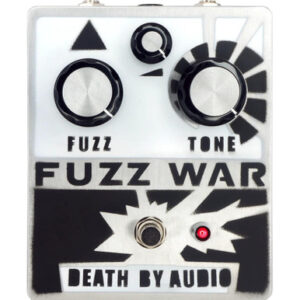
In the current JustPedals catalogue, Death By Audio is represented by Fuzz Pedals, Distortion Pedals and Reverb Pedals. Current listings include Fuzz War, Crossover Fuzz and Echo Dream 2 Delay. That makes the range relevant to players looking for drive, gain and clipping, plus time-based effects and ambience. Check each model for its exact circuit or processing platform, controls, power requirements and connections, particularly where the catalogue includes both pedals and supporting gear.
Category
Fuzz Pedals
Fuzz pedals push a signal into intentionally non-linear clipping, often with strong sustain, compression and harmonic roughness. Designs range from gated splutter and octave-up textures to broad, woolly or saturated sounds, and they can react strongly to pickup level and guitar volume. Bias, tone, gain, input impedance and clean-up behaviour affect how playable the circuit feels. Some fuzzes prefer to see the guitar directly, while others tolerate buffers and complex boards. Check the power requirements, noise floor and useful volume-control range.
Tags
Analogue
Analogue products use continuous audio circuitry for some or all of the signal path, so clipping, filtering or modulation arises from physical components rather than sampled algorithms. The label does not guarantee a particular tone; component choice, headroom, bias, noise and the surrounding gain stages still matter. Check whether the switching, presets, control section or cabinet stage is digital when the exact signal path is important.
Stereo
Stereo products provide separate left and right audio paths, which may widen modulation, preserve independent delays or route a pedalboard into two amplifiers or a mixer. Input and output behaviour is not always symmetrical: some units sum a stereo input, while others create stereo from a mono source. Check whether the effect collapses safely to mono, how the dry signal is routed, the socket format and the destination’s panning and phase requirements.
Others Just Ordered :
- Mooer Meta FX – Review

- MOOER META FX Review: 3 Effects in 1—but Here’s the Problem

- I Wasn’t Expecting To Be Impressed – But What Is The Mooer Meta FX?

- Mooer // META FX Stereo Multi-Effect Platform (Demo)

- A NEW GENERATION OF PEDALS IS HERE – Mooer Meta FX Reverb Review

- Mooer META FX | All the REVERBS from subtle to WILD!