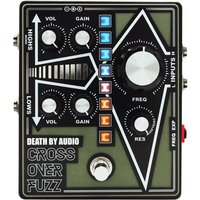
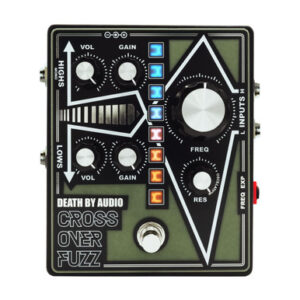
The Death By Audio Crossover Fuzz is a savage dual-band fuzz pedal that splits your signal into highs and lows then annihilates each side with its own wall of fuzz. With separate gain and volume controls for both frequency bands you can sculpt your tone with precision from thick earth-shaking lows to screaming cutting highs. Linked filters move in tandem through the FREQ control giving you sweeping resonant shifts that range from subtle tone shaping to total sonic chaos. Its a fuzz engine designed to reshape your sound and push it into uncharted territory. Built with flexible routing in mind the Crossover Fuzz comes loaded with HIGH and LOW inputs and outputs letting you split your signal into different amps run stereo rigs or create new layers of sound by isolating frequencies. Add in an expression or CV control to move the crossover point in real time and youve got a pedal that feels alive under your feet. With its rugged build reactive LED display and pure analogue fury this fuzz isnt just another stompbox… its a stage-destroying weapon for players who want to stand out in the mix.
Death By Audio Crossover Fuzz Savage Dual-Band Fuzz Pedal
This is a New Death By Audio Crossover Fuzz Savage Dual-Band Fuzz Pedal from Death By Audio is in our Fuzz Pedals category on Just Pedals. Read More below.
As an affiliate partner, we may earn a small commission when you buy through our links — at no extra cost to you.

Brand
Death By Audio
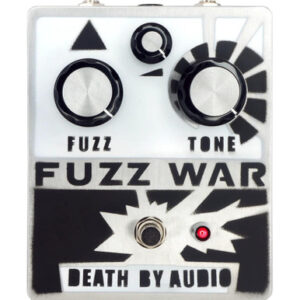
In the current JustPedals catalogue, Death By Audio is represented by Fuzz Pedals, Distortion Pedals and Reverb Pedals. Current listings include Fuzz War, Crossover Fuzz and Echo Dream 2 Delay. That makes the range relevant to players looking for drive, gain and clipping, plus time-based effects and ambience. Check each model for its exact circuit or processing platform, controls, power requirements and connections, particularly where the catalogue includes both pedals and supporting gear.
Category
Fuzz Pedals
Fuzz drives the signal into extreme clipping, often flattening the waveform and generating a thick spectrum of harmonics. Transistor type, bias, input loading and tone filtering create markedly different responses, from loose and velvety to gated, spluttering or octave-rich. Some circuits interact strongly with pickup impedance and guitar volume, while others include buffers or blends for a more consistent response.
Tags
Analogue
The signal is shaped by continuously varying electronic circuitry rather than being converted into a digital effect algorithm. Component choice, operating voltage and circuit tolerances influence headroom, noise, clipping texture and the small variations in response between designs.
Stereo
Processes, creates or passes two audio channels. True stereo preserves separate left and right inputs, while mono-to-stereo effects generate spatial differences internally; routing, phase behaviour and whether trails remain stereo determine the resulting image. Some outputs sum to mono when only one socket is connected, which can change level or modulation depth.
Others Just Ordered :
- I Love A Happy Accident… – Animals Pedal

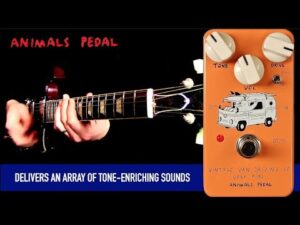
- Animals Pedal Vintage Van Driving is Very Fun Overdrive
- Animals Pedal Sunday Afternoon Is Infinity Bender

- Ninevolt Pedals | Bath Time Reverb (Animals Pedal)

- This Fuzz Pedal Makes No Sense… But It Sounds Incredible

- ANIME Pedals | Animals Pedal Custom Illustrated Series