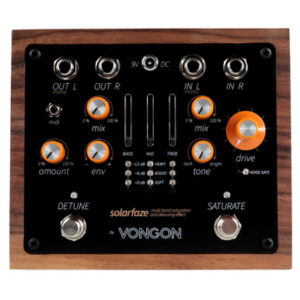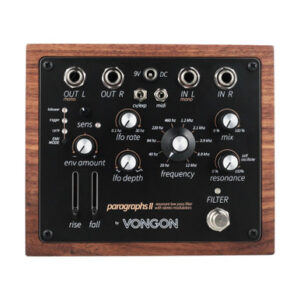
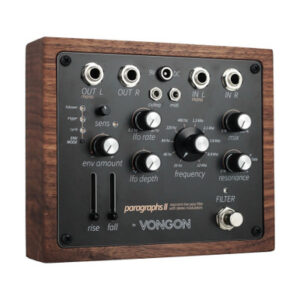
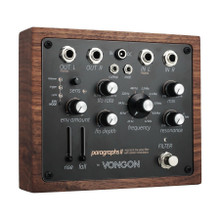

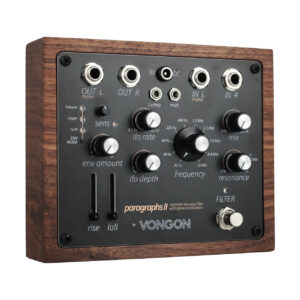
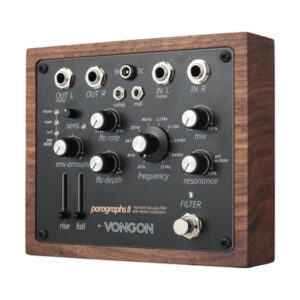
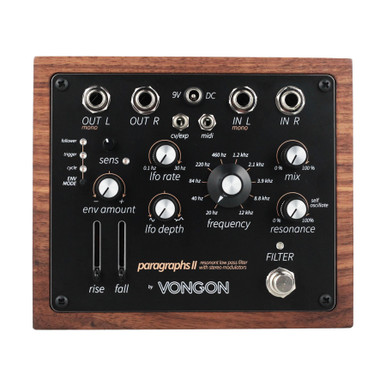
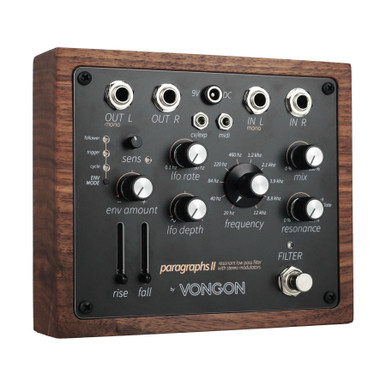
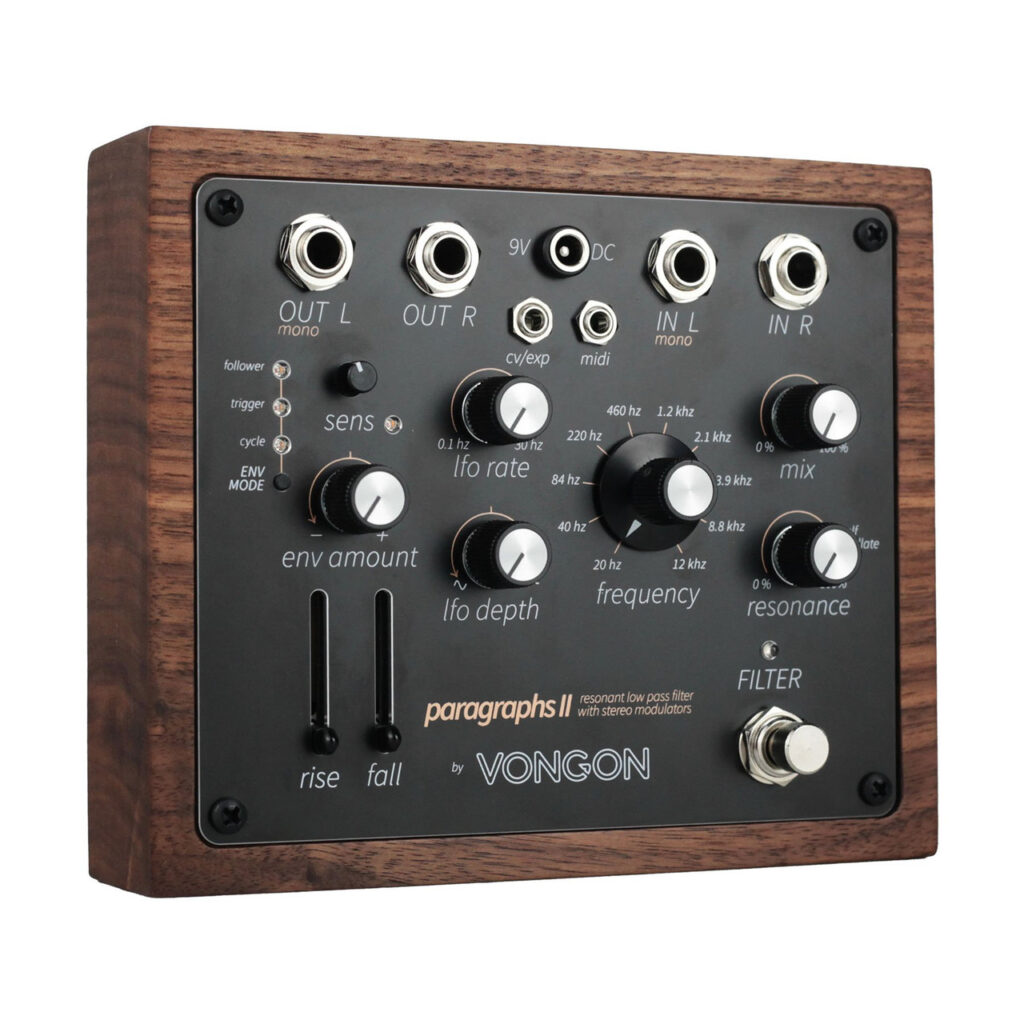
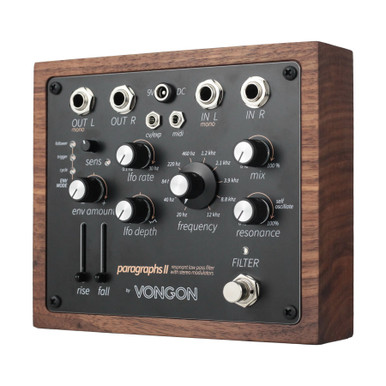
Filter, modulate, and harmonically shape tone with powerful synth-style effects. Plug in your guitar, bass or even keyboards into the Paragraphs II and sculpt tone your way with the intriguing hands-on interface.
Paragraphs II is the latest generation of VONGON’s four-pole resonant low-pass filter effect. It now features stereo inputs and outputs, with a focus on modulation functions that respond to your playing dynamics and add stereo depth.
Key Features
- Four-pole resonant low-pass filter with stereo inputs and outputs
- Rich ladder-style filter for harmonic tone shaping
- Improved signal-to-noise ratio for clean, clear tones ipolar envelope generator with rise and fall controls (5 ms to 4 seconds)
- Dynamic auto-wah and ducking effects with follower mode
- One-shot envelope triggers with adjustable threshold in trigger mode
- Rhythmic pulsing modulation with cycle mode
- LFO inverted between left and right channels for natural widening effect
- LFO with sine wave or smoothed random-style modulation (0.1Hz to 30Hz)
- CV input for filter cutoff modulation, supports audio rate signals
- MIDI input for control of every parameter and access to 9 onboard presets
- Adjustable for instrument or line-level inputs
- Standard 9-volt, center-negative power supply compatibility
- Housed in a single block of walnut, CNC routed, hand sanded & polished
Complex Tone Shaping Capabilities
At the core of paragraphs II is the same rich ladder-style filter found in our replay synthesizer, offering exceptional harmonic tone shaping with precise control. This low-pass filter excels at adding character to harmonically complex, fuzzed, and distorted signals. Its improved signal-to-noise ratio also ensures a clean, clear tone for more pristine sources like clean guitar, bass, or electric keyboards.
Envelope Filtering & Pulsing Modulation
The bipolar envelope generator can dynamically open or close the filter based on your playing dynamics, processing the left and right inputs separately to create a complex stereo field. With independent rise and fall controls spanning from 5 milliseconds up to 4 seconds, you can achieve everything from sharp, percussive accents to slowly evolving swells and fades. In follower mode, track or inversely track the filter frequency to your playing volume, generating dynamic auto-wah and ducking effects. The trigger mode delivers a one-shot envelope when your playing surpasses an adjustable threshold, offering a percussive pluck or smooth fade at the onset of your sound. Additionally, the cycle mode provides rhythmic, pulsing modulation.
Low Frequency Oscillator
The LFO (Low Frequency Oscillator) operates 180° out of phase between the left and right channels, creating a natural widening effect. With 0.1Hz to 100Hz of sine wave or smoothed random-style modulation, it offers everything from slow, subtle motion to rapid tremolo and ring modulation style effects.
Connectivity
The effect connects to your instrument with standard 1⁄4” jacks, adjustable to be optimized for instrument or line-level inputs. The control voltage (cv/exp) input modulates the filter cutoff frequency for integrating modular gear or expression pedals. The MIDI input enables remote control of every pedal parameter and access to 9 onboard preset slots. The pedal is powered by standard 9-volt, center-negative style power supplies.
Specifications
- 165mm x 140mm x 45mm
- 1⁄4” TS Jacks
- Input impedance: 1MΩ
- Output impedance: <1kΩ
- Power supply: 9 VDC, center-negative
- Current draw: 200mA
- 5mm control voltage input (0-3.3 Volts)
- 5mm MIDI input (Type B)
- Buffered bypass
- Soft-touch foot switch