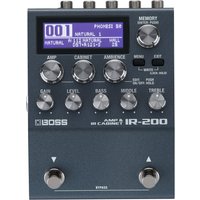
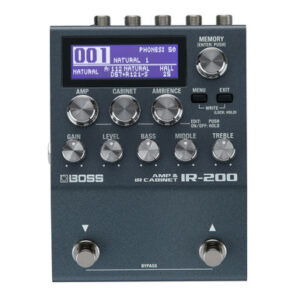
The Boss IR-200 Amp and IR Cabinet Simulator is a pedal loaded with a universe of tones. It contains eight guitar amps and three bass models which cater to virtually any style and genre. If you love playing with different amp and cab voicings youll love this. 32-bit AD/DA 32-bit floating-point processing and a 96kHz sampling rate lead to crisp crystal-clear sound quality whilst over 150 hi-res cab impulse responses from Boss and Celestion Digital let you make a voicing which is truly yours. In addition theres a hose of memory slots including 128 for loading your own IRs and 128 slots for storing your own presets. This pedal is guaranteed to change your rig for the better.
Boss IR-200 Amp and IR Cabinet Simulator
£317.50
This is a New Boss IR-200 Amp and IR Cabinet Simulator from Boss its found in our Amp & Cab Simulator Pedals on the Just Pedals menu. Read More below.
View Just Boss
As an affiliate partner, we may earn a small commission when you buy through our links — at no extra cost to you.
Related videos

Brand
Boss
BOSS began in Osaka in 1973 as MEG Electronics, a company dedicated to effects. Its first BOSS-branded effect was the CE-1 Chorus Ensemble in 1976; the OD-1, SP-1 and PH-1 launched the compact-effects series in 1977. The JustPedals catalogue includes familiar overdrives and distortions such as the OD-3, SD-1, BD-2, DS-1 and MT-2 Metal Zone, as well as utility items such as the PCS-20A cable. BOSS now spans compact pedals, multi-effects, loopers, tuners and controllers. Manufacturing origin should be checked by model rather than inferred from the brand’s Japanese history.
Category
Amp & Cab Simulator Pedals
Amp and cabinet simulators reproduce the gain stages, tone stack, power-amp response, loudspeaker colour and microphone character of a recorded amplifier chain. Analogue circuits, digital models and impulse responses approach this in different ways. The important distinctions are the available amp and cabinet types, editable microphone or room settings, latency, output routing, preset recall and whether speaker simulation can be bypassed for a real amplifier.
Tags
Bass
Voiced or equipped to retain low-frequency fundamentals and the higher headroom of a bass signal. Clean blends, crossovers and bass-specific filter ranges can preserve weight and articulation while the effected portion adds harmonics, movement or ambience.
Digital
Converts the signal or control process into numerical data for algorithmic processing. Digital designs can provide precise timing, long memory, complex routing and repeatable presets; sample rate, conversion, internal resolution and latency influence fidelity and response.
Presets
Stores complete groups of parameter values for later recall. The number of locations, switching time, spillover behaviour and whether presets include routing, expression and MIDI assignments determine how completely one sound can change into another.
Others Just Ordered :
- I Love A Happy Accident… – Animals Pedal

- Animals Pedal Vintage Van Driving is Very Fun Overdrive
- Animals Pedal Sunday Afternoon Is Infinity Bender

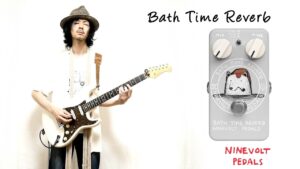
- Ninevolt Pedals | Bath Time Reverb (Animals Pedal)
- This Fuzz Pedal Makes No Sense… But It Sounds Incredible

- ANIME Pedals | Animals Pedal Custom Illustrated Series