Electro Harmonix Nano Metal Muff Distortion Pedal

£69.99

This is a New Electro Harmonix Nano Metal Muff Distortion Pedal from Electro Harmonix, listed in Distortion Pedals on Just Pedals. Read More below.

View Just
more
and ,

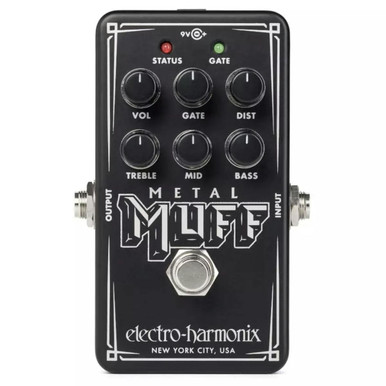
The Electro-Harmonix Nano Metal Muff is built for guitarists seeking filthy, hard-hitting distortion tones! Aggressive and intense, the Nano Metal Muff is like a weapon for your pedalboard — boasting a powerful 3-band EQ section that allows you to precisely shape the unit’s high-gain textures to absolute perfection.

A newly-designed noise gate circuit is a thoughtful addition, making the Nano Metal Muff usable even with the most extreme of gain settings. Eliminating hum with effective noise cancellation, you’ll find it difficult to find any distortion pedal at the Nano Metal Muff’s affordable price-point that sports this fantastic feature! A dedicated LED indicates when the gate is engaged too, for an engaging visual feedback experience.

Key Features

  • Voiced for the heavy metal player
  • Compact, pedalboard-friendly footprint
  • Extensive EQ control: Bass (+/- 14dB) cut or boost, Mid (+/- 15dB) and Treble (+/- 10dB)
  • VOL (volume) sets the pedal’s output level
  • DIST adjusts input gain and distortion
  • Noise gate eliminates unwanted noise and includes an LED to indicate when the output signal is muted

Specifications

  • Circuit: Analogue
  • Bypass: Buffered
  • Audio: Mono
  • Power: 9V (Battery Included)
  • Power Supply: No (Not Included)
  • Current Draw: 24 mA
  • Dimensions: 4.5″ x 2.75″ x 2.1″
Related videos

Brand

Electro Harmonix

In the current JustPedals catalogue, Electro Harmonix is represented by Fuzz Pedals, Overdrive Pedals and Octave Pedals. Current listings include Q-Tron+, Nano Clone and V256 Vocoder. That makes the range relevant to players looking for drive, gain and clipping, plus time-based effects and ambience. Check each model for its exact circuit or processing platform, controls, power requirements and connections, particularly where the catalogue includes both pedals and supporting gear.

Category

Distortion Pedals

Distortion pedals use stronger or more deliberate clipping than a typical overdrive, adding harmonics, compression and sustain. Some are voiced for amp-like crunch, others for high-gain rhythm or a deliberately abrasive texture. Gain, tone, presence, resonance and output controls determine how the pedal interacts with the amplifier and pickups; a blend or noise gate can preserve clarity in heavier settings. Placement changes the result, so check whether the design is intended to push an amp, run into a clean platform or feed a direct cabinet simulation.

Tags

Analogue

Analogue products use continuous audio circuitry for some or all of the signal path, so clipping, filtering or modulation arises from physical components rather than sampled algorithms. The label does not guarantee a particular tone; component choice, headroom, bias, noise and the surrounding gain stages still matter. Check whether the switching, presets, control section or cabinet stage is digital when the exact signal path is important.

Bass

Bass products are designed or voiced to retain low-frequency information and usable headroom with bass guitar or other low-register sources. Controls may centre on clean blend, low-end EQ, compression, crossover points or drive character. A guitar pedal can sometimes work well on bass, but it may remove the fundamental or compress the transient. Check the frequency response, input impedance, output level and dry-signal path with the intended tuning and amplifier.