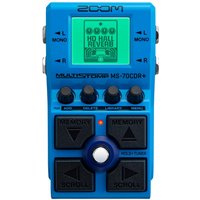
The Zoom MS-70CDR+ is designed for musicians looking for versatile effects in a compact powerful pedal. Offering 149 built-in effects – including choruses delays and reverb; this stompbox is perfect for shaping a wide range of tones. You can use up to 6 effects at once creating rich layered sounds that suit any musical style. The MS-70CDR+ is also equipped with stereo inputs and outputs making it ideal for use with guitars synths and keyboards. With 100 user patch slots you can save and recall your custom effects easily while 80 preset patches provide instant inspiration. With newly designed analog circuits for better audio quality and USB MIDI support for remote patch changes this pedal is a highly adaptable tool. Built for live and studio use the MS-70CDR+ delivers clear pristine sound in a durable compact design.
Zoom MS-70CDR+ MultiStomp Chorus Delay and Reverb Pedal
This is a New Zoom MS-70CDR+ MultiStomp Chorus Delay and Reverb Pedal from Zoom its found in our Delay & Reverb Pedals on the Just Pedals menu. Read More below.
As an affiliate partner, we may earn a small commission when you buy through our links — at no extra cost to you.
Related videos
Brand
Zoom
ZOOM CORPORATION is a Tokyo-based Japanese maker founded in 1983. After developing audio components and rhythm equipment, it released the compact 9002 multi-effects processor in 1990 and later the popular 505 Guitar. Today its guitar, bass and acoustic processors range from small practice units to larger floorboards. JustPedals listings include the G1X FOUR and B1 FOUR, plus the A1 FOUR for acoustic instruments and its expression-pedal version. Compare each model’s instrument focus and expression controls: similarly sized Zoom units can be built around different effects and playing needs.
Category
Delay & Reverb Pedals
Delay and reverb are combined here because both create a sense of time and space but do so differently. Delay produces distinct repeats; reverb builds a dense field of reflections around the note. Dual-effect designs may run the sections in series or parallel, synchronise them to tempo and allow separate routing, so the interaction can range from a short room with a single echo to long, evolving ambient trails.
Tags
Analogue
The signal is shaped by continuously varying electronic circuitry rather than being converted into a digital effect algorithm. Component choice, operating voltage and circuit tolerances influence headroom, noise, clipping texture and the small variations in response between designs.
MIDI
Sends, receives or responds to Musical Instrument Digital Interface messages rather than carrying the instrument audio itself. Program changes recall presets, continuous controllers move parameters, and MIDI clock or transport messages synchronise timing between devices.
Presets
Stores complete groups of parameter values for later recall. The number of locations, switching time, spillover behaviour and whether presets include routing, expression and MIDI assignments determine how completely one sound can change into another.
Stereo
Processes, creates or passes two audio channels. True stereo preserves separate left and right inputs, while mono-to-stereo effects generate spatial differences internally; routing, phase behaviour and whether trails remain stereo determine the resulting image. Some outputs sum to mono when only one socket is connected, which can change level or modulation depth.
USB
Provides a Universal Serial Bus connection for power, audio, MIDI, firmware or editing data. The supported USB class and connector do not by themselves show its purpose; channel count, sample format, host compatibility and power demand define the actual function.
Others Just Ordered :
- I Love A Happy Accident… – Animals Pedal

- Animals Pedal Vintage Van Driving is Very Fun Overdrive
- Animals Pedal Sunday Afternoon Is Infinity Bender

- Ninevolt Pedals | Bath Time Reverb (Animals Pedal)
- This Fuzz Pedal Makes No Sense… But It Sounds Incredible

- ANIME Pedals | Animals Pedal Custom Illustrated Series