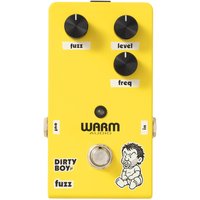
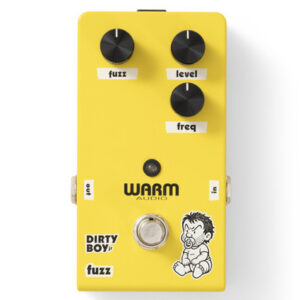
The Warm Audio Dirty Boy Jr. Fuzz is a compact analog fuzz pedal for players chasing responsive vintage-inspired saturation and versatile tonal shaping. Developed alongside Dirty Boy Pedals founder Dany Gomez it recreates the character of the boutique Afro Fuzz circuit while adding practical flexibility for modern pedalboards. Dedicated Fuzz and Volume controls let you move from lightly driven breakup to thick sustaining fuzz without losing clarity or touch response. A six-position frequency selector expands the tonal range far beyond traditional circular-style fuzz pedals. You can dial in heavier low-end weight for dense riffs or sharper upper-mid focus for cutting lead lines and vintage psychedelic textures. The all-analog circuitry reacts naturally to your guitar volume and picking dynamics too making cleanup tones feel smooth and expressive. Finished with true bypass switching and authentic Dirty Boy styling the Dirty Boy Jr. Fuzz brings boutique-inspired fuzz tones into a compact road-ready format.
Warm Audio Dirty Boy Jr. Fuzz
This is a New Warm Audio Dirty Boy Jr. Fuzz from Warm Audio is in our Fuzz Pedals category on Just Pedals. Read More below.
As an affiliate partner, we may earn a small commission when you buy through our links — at no extra cost to you.
Brand
Warm Audio
Warm Audio began with founder Bryce Young’s aim of making the sounds of classic recording equipment more accessible through recreations of well-known analogue designs. The company remains rooted in studio gear, with microphones, preamps and compressors alongside a focused guitar-pedal range. Centavo revisits a sought-after overdrive, Foxy Tone Box is an octave fuzz, Mutation Phasor II is an optical phaser and Warmdrive is an amp-inspired overdrive. JustPedals listings include these models alongside ODD and WA-CV Centavo. The pedal line carries the company’s broader approach into guitar effects by pairing familiar circuit references with practical modern formats.
Category
Fuzz Pedals
Fuzz drives the signal into extreme clipping, often flattening the waveform and generating a thick spectrum of harmonics. Transistor type, bias, input loading and tone filtering create markedly different responses, from loose and velvety to gated, spluttering or octave-rich. Some circuits interact strongly with pickup impedance and guitar volume, while others include buffers or blends for a more consistent response.
Tags
Analogue
The signal is shaped by continuously varying electronic circuitry rather than being converted into a digital effect algorithm. Component choice, operating voltage and circuit tolerances influence headroom, noise, clipping texture and the small variations in response between designs.
True Bypass
Connects input directly to output through mechanical or relay switching when the effect is off, removing the active circuit from the audio path. It avoids buffer colour but leaves cable capacitance and switching design to influence high-frequency loss and possible switching noise.
Others Just Ordered :
- I Love A Happy Accident… – Animals Pedal

- Animals Pedal Vintage Van Driving is Very Fun Overdrive

- Animals Pedal Sunday Afternoon Is Infinity Bender

- Ninevolt Pedals | Bath Time Reverb (Animals Pedal)

- This Fuzz Pedal Makes No Sense… But It Sounds Incredible

- ANIME Pedals | Animals Pedal Custom Illustrated Series