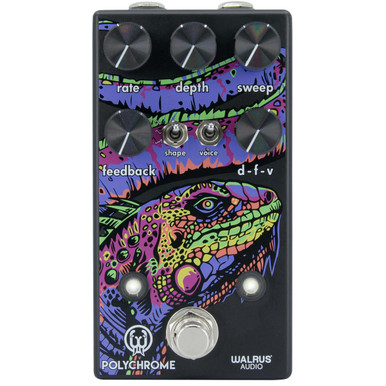
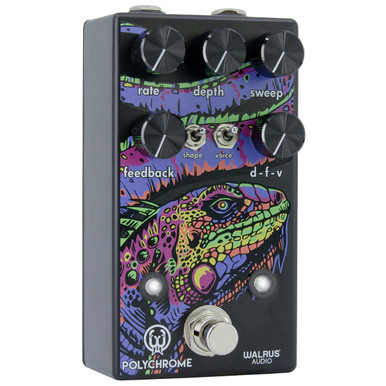
Walrus Audio Polychrome Analog Flanger Pedal

£199.99

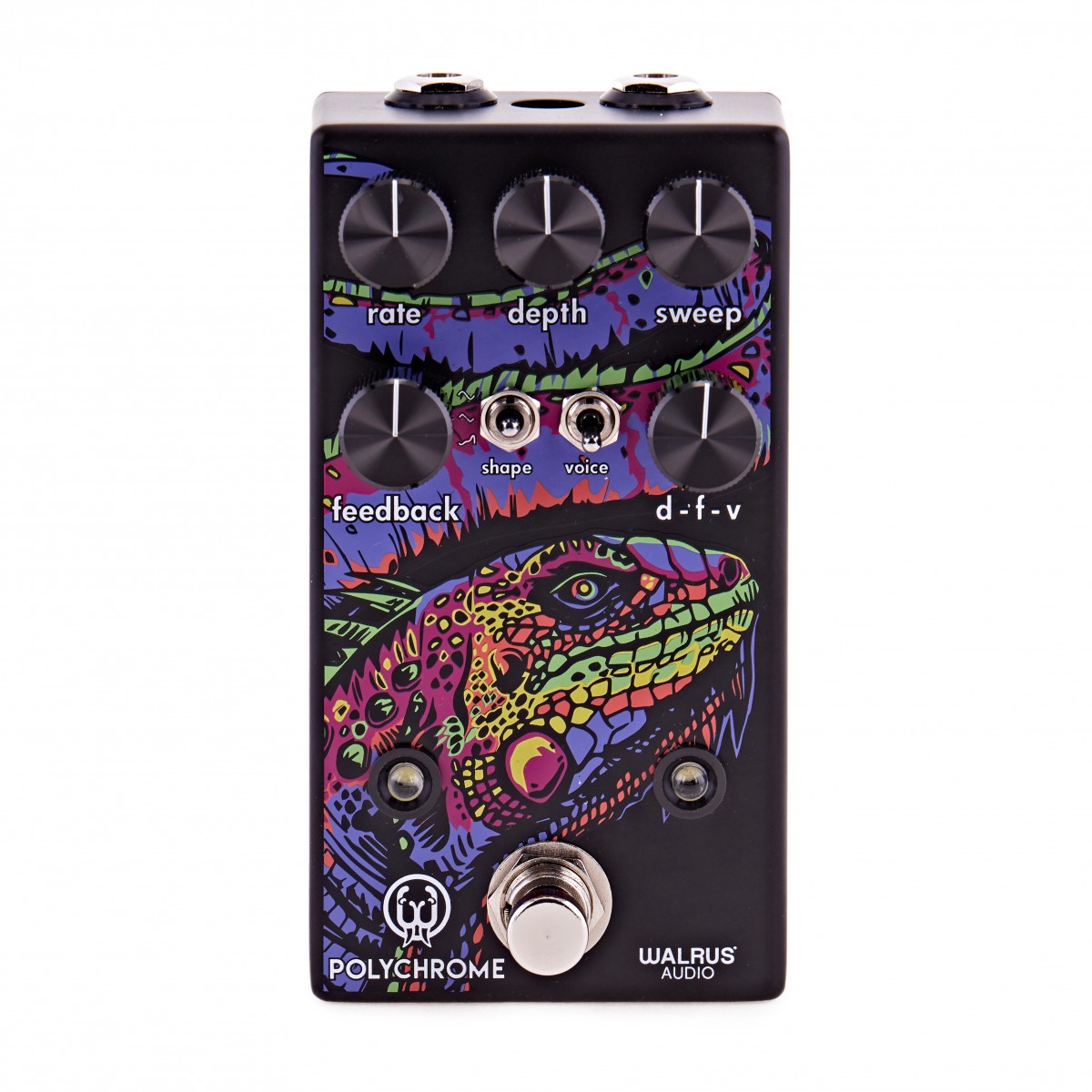
Walrus Audio's Polychrome flanger is a uniquely colourful pedal that can enhance your guitar parts with inspiring, modulated textures. Boasting an analogue design — capturing the spirit of vintage '70s and '80s flangers — you can easily dial in a wealth of lush tones via the D-F-V (Dry, Flange, Vibrato) blend knob and tactile voice […]


Description

Walrus Audio's Polychrome flanger is a uniquely colourful pedal that can enhance your guitar parts with inspiring, modulated textures. Boasting an analogue design — capturing the spirit of vintage '70s and '80s flangers — you can easily dial in a wealth of lush tones via the D-F-V (Dry, Flange, Vibrato) blend knob and tactile voice switches.

Key Features

  • Analogue circuitry provides pristine flanger tones that can embellish any guitar part!
  • Blend in dry signal with the D-F-V knob (Dry, Flange and Vibrato).
  • Voice switch offers two different styles of flange (traditional/complex and notched).
  • Select between 3 LFO shapes: sine, triangle or random.
  • From full-dry, to traditional-flange, to full-pitch-vibrato.
  • Rate knob sets LFO from super-slow 0.1 Hz to 8Hz (with rate LED to preview LFO speed).
  • Depth control determines width of filter sweep.
  • Sweep knob shifts frequency range, from deep flange to tight and traditional-tones.
  • Feedback control to set subtle or more dramatic flanging effects.
  • Smart momentary bypass switch (when the bypass switch is in the off position, press and hold to temporarily activate the effect; releasing the switch turns the effect off).
  • Top-mounted jacks allows you to maximise the space on your pedalboard.

Specifications

  • True Bypass: Yes
  • Power: 9V DC (Center Negative)
  • Current Draw: 100mA (Minimum)
  • Made in the USA

Brand

Walrus

Category

Walrus

Tags

analog

Flanger

A flanger is a type of guitar effects pedal used to create a swirling, whooshing sound by modulating the phase of an audio signal. It works by combining the original signal with a slightly delayed and modulated version of itself. As the two signals interact, they create peaks and troughs in the frequency spectrum, resulting in the characteristic “jet plane” or “swooshing” sound associated with flanging.

Key features of a flanger pedal include:

1. **Rate**: Controls the speed at which the delayed signal is modulated. Higher rates produce faster modulation, while lower rates create slower, more subtle effects.

2. **Depth**: Adjusts the intensity of the modulation effect. Higher depth settings result in more pronounced sweeps, while lower settings produce a gentler effect.

3. **Manual (or Range)**: Sets the center frequency of the modulation. This control allows you to focus the effect on specific frequency ranges, altering the tonal character of the flanging.

4. **Feedback (or Regeneration)**: Determines the amount of modulated signal that is fed back into the effect. Increasing feedback can create more pronounced peaks and troughs, resulting in a more intense effect.

Flanger pedals are commonly used in various music genres, including rock, metal, and psychedelic music, to add movement, depth, and texture to guitar tones. They can be used subtly to add a touch of modulation and dimension to a guitar sound, or more prominently to create dramatic swirling effects. Overall, flanger pedals offer guitarists a versatile tool for shaping and enhancing their tone, adding a dynamic and expressive element to their playing.

Flanger Pedals