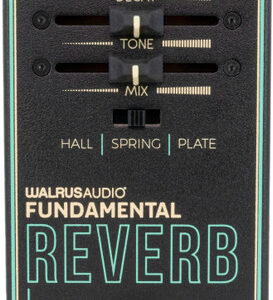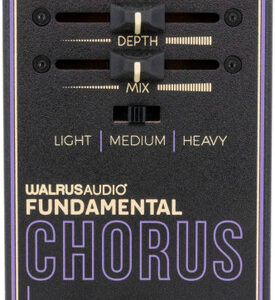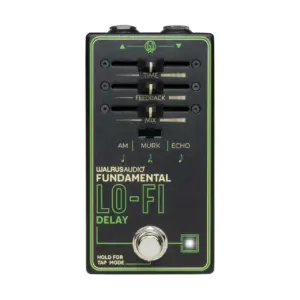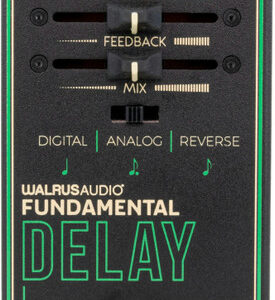
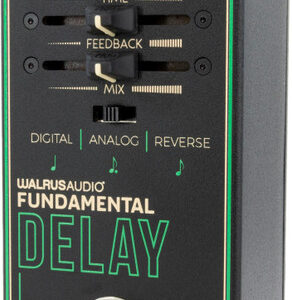
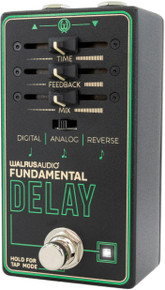

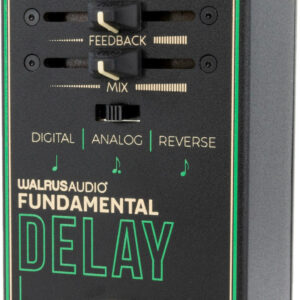
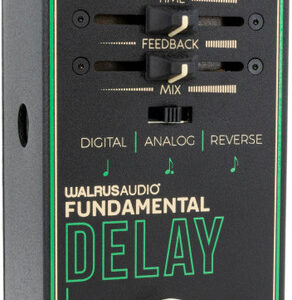
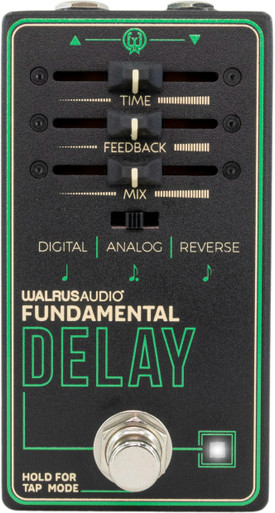
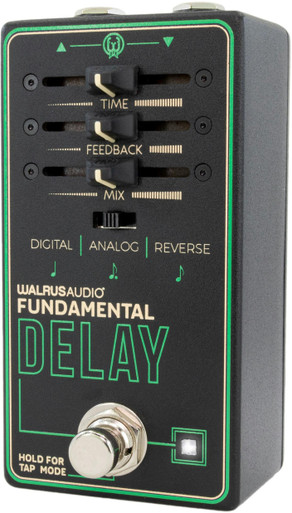
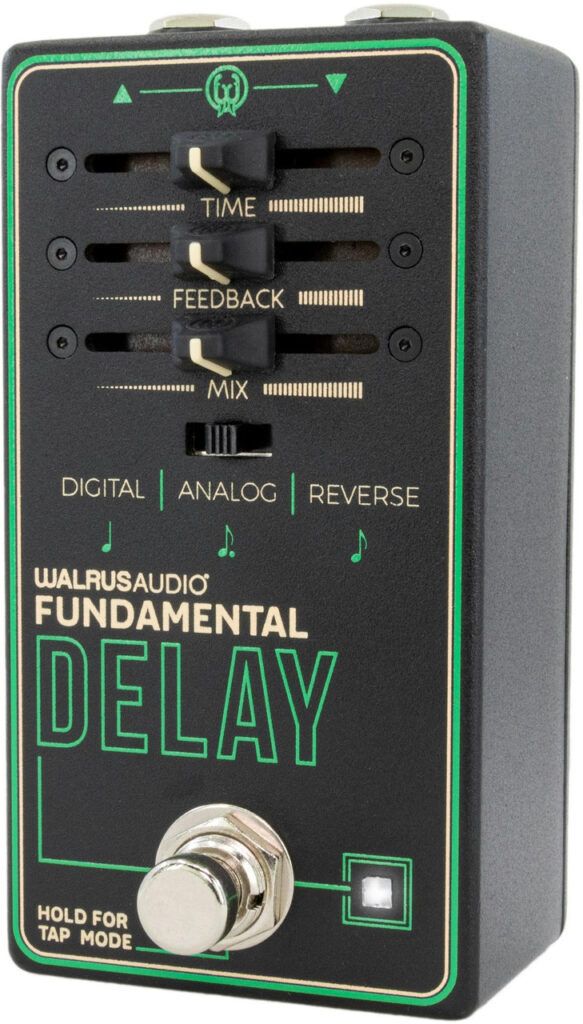
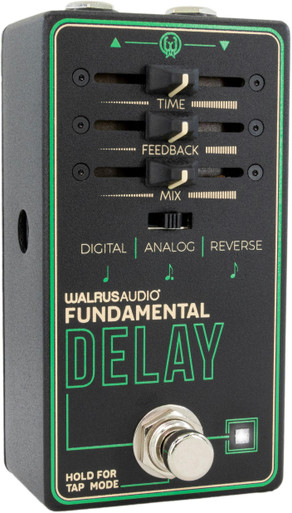
For the Fundamental Series, Walrus Audio have challenged themselves to design a set of pedals with the tonal integrity that’s required to live on a professional’s pedalboard, but with simplified controls friendly enough for even the newest effect pedal users.
Each Fundamental pedal has 3 sliders for tweaking the sound and a three-way switch for changing pedal modes. The result is a line of 8 pedals that will keep you covered from your first band practice, all the way to a sold-out arena.
Fundamental Delay
The Fundamental Delay provides you with the core sounds of repeated effects. With 3 delay algorithms, you can go from clean digital feedback to an analog delay emulation, as well as reversing your trails.
Key Features
- Three Delay algorithms – The slide switch allows you to change between 3 distinct Delay algorithms:
- Digital – Add a clean rhythmic delay back into your signal.
- Analog – Add a filtered and slightly distorted delay back into your signal, designed to replicate the characteristics of bucket brigade delay chips.
- Reverse – Add reversed reverb trails back into your signal, create gentle melodies or push into reverse feedback overload.
- Secondary Control – Control the tap division when tap mode is engaged:
- 1. Quarter Note
- 2. Dotted Eighth Note
- 3. Eighth Note
- Bypass Switch – Turns the effect on and off. Hold down to engage tap mode. Hold down again to disengage tap mode.
- Bypass LED – Illuminated when the effect is engaged, and will blink with tapped tempo when tap mode is engaged.
- Tap Mode – To enter tap mode, hold down bypass until you see the LED flashing. Once it is flashing, tap mode is engaged and the stomp switch will only work as a tap tempo until tap mode is disengaged. While tap mode is engaged, adjusting the program select toggle will only change the division of the tap control. To disengage tap mode, hold down bypass again until you see the LED turn back to solid white.
- Trails Modes – Hold down the stomp switch when applying power to the pedal. Trails mode is the default.
Specifications
- Time: Control the rate of the delayed repeats.
- Feedback: Control the number of repeats.
- Mix: Control the mix of the effect and the original clean signal. All the way to the left is fully clean, and all the way to the right is fully Delay.
- Input Jack: 1/4-inch cable from instrument.
- Output Jack: 1/4-inch cable to amplifier.
- 9v Jack: 9-volt DC, Center Negative, 100mA min