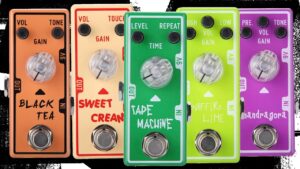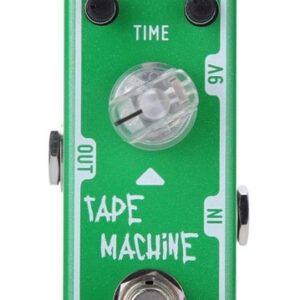
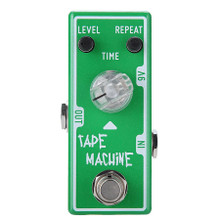
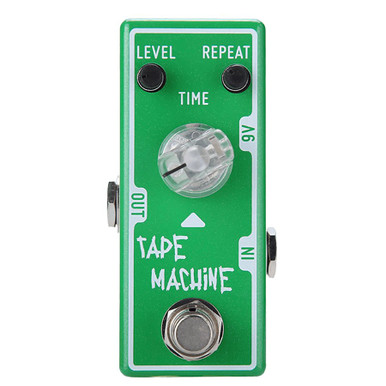
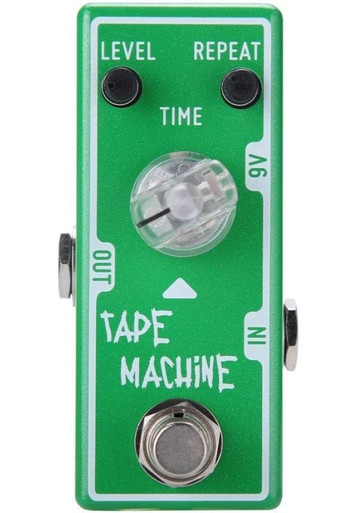
Tone City Tape Machine Delay Pedal

£44.99

This is a New Tone City Tape Machine Delay Pedal from Tone City, listed in Delay Pedals on Just Pedals. Read More below.

View Just
more
and , ,

This pedal will not work with a 9V battery, and requires a 9V DC power supply (not included).

The Tone City Tape Machine Delay is a stunning part-analogue, part-digital delay pedal. This well-designed stompbox keeps your dry signal crisp and clear by running through an analogue circuit, while the delay sounds are processed by a high-quality digital circuit. This gives you the best of both worlds, culminating in a beautifully clear and versatile delay.

Simple Setup

Although the Tape Machine can go from a short slap-back sound to a long and ambient delay, you can craft the perfect sound via the pedal’s 3 controls – time, level and repeat. Allowing you to adjust the pace of the echoes, their volume and the amount of audible repeats respectively, these essential controls are all you need to quickly change up your delay sound on-the-fly. 

With a lot of smaller mini-sized pedals, their controls are not always usable from 0 to 10. The Tape Machine breaks this rule and is usable at almost any setting, making it very versatile and easy to use if you’re new to the world of effects.

Small & Portable

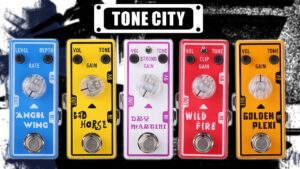
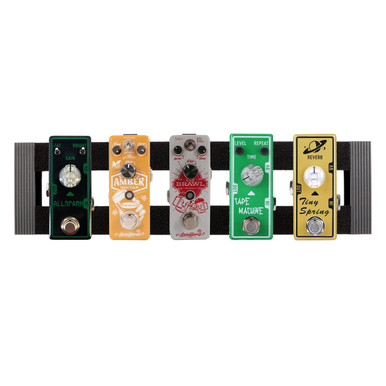
All Tone City pedals are built in a micro pedal format, which not only helps to save precious real-estate on your pedalboard, but also keeps your bank balance healthy thanks to their amazingly low price. But don’t worry, you don’t lose any quality when going down to this small size or cost.

The controls all use high-quality components, and with true bypass switching, your signal will stay as clean and pure as possible.

Specifications

  • Technology: Hybrid
  • Delay Time: 25-600ms
  • Input Impedance: 500k
  • Output Impedance: 10k
  • Mono / Stereo: Mono In, Mono Out
  • Controls: Level, Time, Repeat
  • Bypass Mode: True bypass
  • Power supply: 9VDC, Centre negative
  • Power Consumption: 40 mA
  • Housing size: Mini
  • Dimensions WxHxD (cm): 4,2 x 5,2 x 9,3
  • Country of Origin: Made in China
Related videos

Brand

Tone City

TONECITY was founded in 2014 to make guitar pedals, pedal power supplies and related products. Its chief designer, J. Wong, has played guitar and designed pedals for much of his working life. The catalogue covers overdrive, distortion, fuzz, delay, chorus, reverb, phaser, tremolo and boost, alongside board power. JustPedals listings include the Angel Wing chorus, Model M distortion, Wild Fire distortion, Fuxx fuzz and All Spark boost. The range combines compact tone-shaping pedals with practical rig equipment, so the model’s named effect and role are more useful guides than a broad brand label.

Category

Delay Pedals

Delay records the incoming signal for a chosen interval and repeats it after the original note. Feedback returns repeats to the delay line, while tone, filtering, modulation and saturation determine whether echoes remain clear, darken progressively, wobble like tape or degrade like analogue bucket-brigade circuits. Delay time and rhythmic subdivisions govern the spacing and musical pattern of the repeats.

Tags

Analogue

The signal is shaped by continuously varying electronic circuitry rather than being converted into a digital effect algorithm. Component choice, operating voltage and circuit tolerances influence headroom, noise, clipping texture and the small variations in response between designs.

Battery Powered

Can operate from an internal replaceable battery, usually with different available current and running time from an external supply. Battery chemistry, access and automatic disconnection through the input socket affect practical runtime and storage. High-current digital processing generally shortens battery life more sharply than a simple analogue circuit.

Digital

Converts the signal or control process into numerical data for algorithmic processing. Digital designs can provide precise timing, long memory, complex routing and repeatable presets; sample rate, conversion, internal resolution and latency influence fidelity and response.