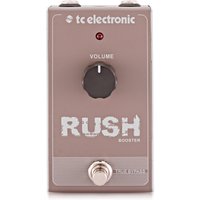
The TC Electronic Rush Booster is a guitar pedal that offers a simple plug-in and play booster for both developing and established guitarists. Its all-analogue circuit provides you with up to 20 dBs of super-transparent clean boost ideal for cutting through any mix. This affordable pedal is housed within a sturdy roadworthy enclosure along with top mounted jack input/output for maximized space on your pedalboard. With extreme value for money the Rush booster is ideal for players on a budget.
TC Electronic Rush Booster Pedal
£35.00
This is a New TC Electronic Rush Booster Pedal from TC Electronic is in our Boost Pedals category on Just Pedals. Read More below.
View Just TC Electronic
As an affiliate partner, we may earn a small commission when you buy through our links — at no extra cost to you.
Related videos
Brand
TC Electronic
Founded in Denmark in 1976 by brothers Kim and John Rishoj, TC Electronic first made its mark with the Stereo Chorus Flanger (SCF), prized for its transparent modulation. The company later developed the TC 2290 digital delay, a landmark studio processor, and extended its guitar range with compact effects, loopers and TonePrint-enabled pedals. JustPedals listings include the MojoMojo overdrive, Dark Matter distortion, Spark Booster, Ditto X2 looper and Flashback Triple Delay. TC Electronic now covers guitar, bass and voice products, so compare the exact model’s stereo routing, presets and control method.
Category
Boost Pedals
A boost raises signal level without deliberately creating a new effect waveform. Clean boosts emphasise level and headroom, while coloured boosts reshape bass, midrange or treble and may add mild clipping at higher settings. Placed before a gain stage, the extra level changes how that stage distorts; placed later, it can provide a volume lift if sufficient headroom remains.
Tags
Analogue
The signal is shaped by continuously varying electronic circuitry rather than being converted into a digital effect algorithm. Component choice, operating voltage and circuit tolerances influence headroom, noise, clipping texture and the small variations in response between designs.
Others Just Ordered :

- I Love A Happy Accident… – Animals Pedal

- Animals Pedal Vintage Van Driving is Very Fun Overdrive

- Animals Pedal Sunday Afternoon Is Infinity Bender

- Ninevolt Pedals | Bath Time Reverb (Animals Pedal)

- This Fuzz Pedal Makes No Sense… But It Sounds Incredible

- ANIME Pedals | Animals Pedal Custom Illustrated Series