
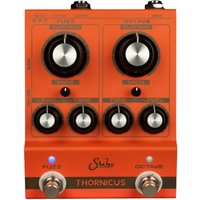
The Suhr Thornicus Ian Thornley Signature Fuzz is a meticulously developed dual-channel fuzz pedal born from years of refinement and real-world use. Designed in collaboration with Ian Thornley it brings together two fully independent fuzz circuits a Classic Fuzz and an Octave Fuzz each with its own dedicated controls. This approach gives players complete freedom to shape their sound whether chasing vintage-inspired saturation or complex harmonically rich octave textures. Originally envisioned as a single fuzz with a shared octave switch the design evolved at Thornleys request to allow deeper control and flexibility. The result is a pedal that adapts easily to different guitars amplifiers and musical contexts. Carefully voiced tone and mids controls let you move from thick scooped fuzz to more focused articulate sounds that cut through a mix. Built to withstand the demands of professional touring the Thornicus combines expressive analogue tone with modern features like MIDI control making it a powerful centrepiece for both traditional and advanced pedalboard setups.
Suhr Thornicus Ian Thornley Signature Fuzz
This is a New Suhr Thornicus Ian Thornley Signature Fuzz from Suhr its found in our Fuzz Pedals on the Just Pedals menu. Read More below.
As an affiliate partner, we may earn a small commission when you buy through our links — at no extra cost to you.
Related videos
Brand
Suhr
In the current JustPedals catalogue, Suhr is represented by Fuzz Pedals, Boost Pedals and Delay Pedals. Current listings include Iso Line Out, Brighton Treble Booster and Discovery Analog Delay. That makes the range relevant to players looking for drive, gain and clipping, plus time-based effects and ambience. Check each model for its exact circuit or processing platform, controls, power requirements and connections, particularly where the catalogue includes both pedals and supporting gear.
Category
Fuzz Pedals
Fuzz drives the signal into extreme clipping, often flattening the waveform and generating a thick spectrum of harmonics. Transistor type, bias, input loading and tone filtering create markedly different responses, from loose and velvety to gated, spluttering or octave-rich. Some circuits interact strongly with pickup impedance and guitar volume, while others include buffers or blends for a more consistent response.
Tags
Analogue
The signal is shaped by continuously varying electronic circuitry rather than being converted into a digital effect algorithm. Component choice, operating voltage and circuit tolerances influence headroom, noise, clipping texture and the small variations in response between designs.
MIDI
Sends, receives or responds to Musical Instrument Digital Interface messages rather than carrying the instrument audio itself. Program changes recall presets, continuous controllers move parameters, and MIDI clock or transport messages synchronise timing between devices.
Others Just Ordered :
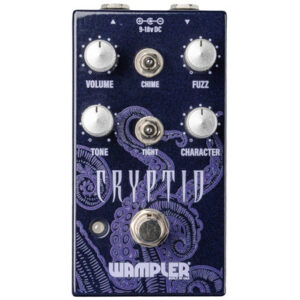
- I Love A Happy Accident… – Animals Pedal

- Animals Pedal Vintage Van Driving is Very Fun Overdrive
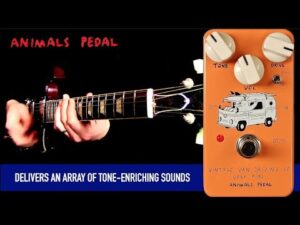
- Animals Pedal Sunday Afternoon Is Infinity Bender
- Ninevolt Pedals | Bath Time Reverb (Animals Pedal)
- This Fuzz Pedal Makes No Sense… But It Sounds Incredible

- ANIME Pedals | Animals Pedal Custom Illustrated Series