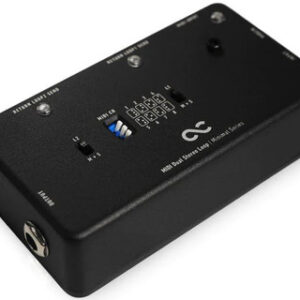
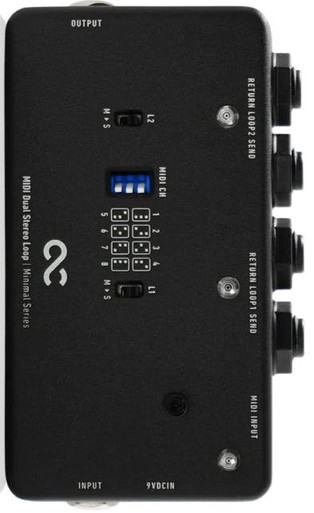
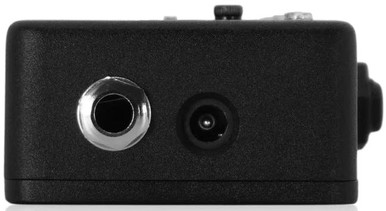
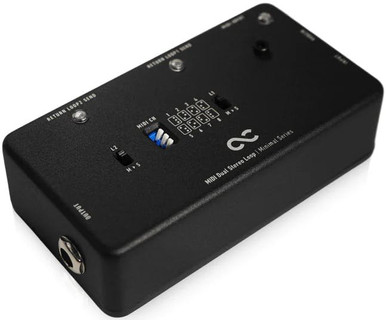
One Control Minimal Series MIDI Dual Stereo Loop

£114.99

This is the One Control Minimal Series MIDI Dual Stereo Loop from One Control, listed in Specialist Effects Pedals on Just Pedals. Read More below.

View Just
more
and ,

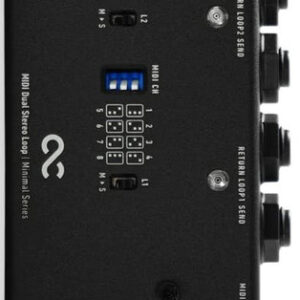
One Control brings players easy MIDI Loop functionality with the new Minimal Series MIDI Dual Stereo Loop pedal (MDSL). This is a stereo effects loop that is powerful for small pedalboard or large effects systems. Switch your loop easily with MIDI with either stereo or mono loops, and you can covert mono signals to stereo (dual mono operation) and send them to stereo effects. And instead of relying on a footswitch you can control the MDSL easily with MIDI from a wide variety of devices.

The OC MDSL can use between 1-8 MIDI channels to receive control signals, and the On/Off of the two effects loops via MIDI PC# or CC#. Use either PC or CC mode to control your loops easily. The simple ON/OFF operation with MIDI switching, you can use the MDSL as an additional effects loop with larger switching systems like the One Control Caiman Tail Loop

MIDI Signal Characteristics

PC# 80: Set it to PC mode. (Factory)
PC# 81: Set it to CC mode.
PC# 90: When you connect the power to the main unit, the ON/OFF setting of each loop is reset. (Factory)
PC# 91: When the power is connected to the main unit, the ON/OFF setting of each loop is set at the end.
PC# 10: Bypass Loop 1. This signal is ignored in CC mode.
PC# 11: Turn on Loop 1. This signal is ignored in CC mode.
PC# 20: Bypass Loop 2. This signal is ignored in CC mode.
PC# 21: Turn on Loop 2. This signal is ignored in CC mode.
PC# 30: Bypass both loops. This signal is ignored in CC mode.
PC# 31: Turn on both loops. This signal is ignored in CC mode.

CC# 102 / Value 10: Bypass loop 1. In PC mode, this signal is ignored.
CC# 102 / Value 11: Turn on loop 1. In PC mode, this signal is ignored.
CC# 102 / Value 20: Bypass loop 2. In PC mode, this signal is ignored.
CC# 102 / Value 21: Turn on Loop 2. In PC mode, this signal is ignored.
CC# 102 / Value 30: Bypass both loops. In PC mode, this signal is ignored.
CC# 102 / Value 31: Turn on both loops. In PC mode, this signal is ignored.

Specifications

  • 120W x 60D x 30H mm
  • 125W x 68D x 32H mm
  • Weight: 366g
  • Current consumption: 120mA
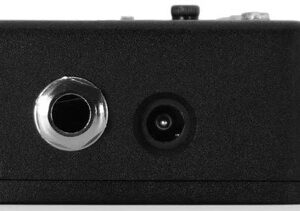
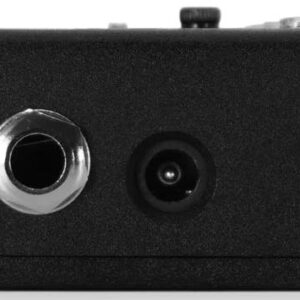
  • Power supply: 9V Adapter (Not Included)
Related videos

Brand

One Control

One Control is a brand that focuses on creating compact, high-quality guitar pedals, often in mini-sized formats. Their product lineup includes a range of effects such as overdrives, distortions, and amp-in-a-box designs. One Control pedals are particularly known for their versatility, providing different tones and textures within a small footprint. Pedals like the Strawberry Red Overdrive and the Lingonberry Overdrive are highly regarded for their ability to cover a wide range of gain levels, from bluesy overdrive to medium-gain distortion.

In addition to individual effect pedals, One Control also produces loop switchers and multi-purpose devices, such as the Minimal Series TRI LOOP, which enhances the flexibility of guitar setups. These tools are designed for musicians who need to manage complex pedalboards or integrate effects seamlessly into their performances.

Category

Specialist Effects Pedals

Specialist effects alter the signal in ways that do not sit cleanly inside one established family. They may use granular processing, frequency shifting, resonators, freeze or sustain, bit reduction, ring modulation, feedback networks or combinations of several techniques. The relevant distinction is the underlying process, its tracking or latency, and how completely the dry signal can be blended or replaced.

Tags

MIDI

Sends, receives or responds to Musical Instrument Digital Interface messages rather than carrying the instrument audio itself. Program changes recall presets, continuous controllers move parameters, and MIDI clock or transport messages synchronise timing between devices.

Stereo

Processes, creates or passes two audio channels. True stereo preserves separate left and right inputs, while mono-to-stereo effects generate spatial differences internally; routing, phase behaviour and whether trails remain stereo determine the resulting image. Some outputs sum to mono when only one socket is connected, which can change level or modulation depth.